Rift Valley Fever: A survey of knowledge, attitudes, and practice of slaughterhouse workers and community members in Kabale District, Uganda
- PMID: 29505579
- PMCID: PMC5860784
- DOI: 10.1371/journal.pntd.0006175
Rift Valley Fever: A survey of knowledge, attitudes, and practice of slaughterhouse workers and community members in Kabale District, Uganda
Abstract
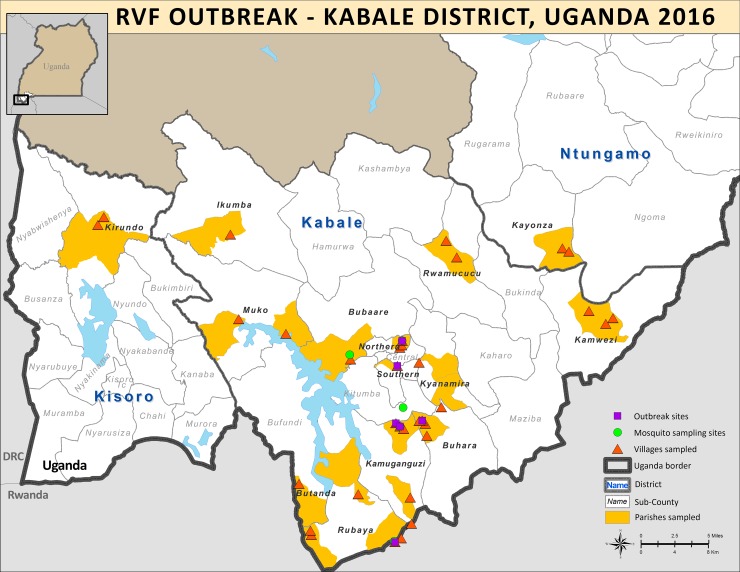
Background: Rift Valley Fever virus (RVF) is a zoonotic virus in the Phenuiviridae family. RVF outbreaks can cause significant morbidity and mortality in humans and animals. Following the diagnosis of two RVF cases in March 2016 in southern Kabale district, Uganda, we conducted a knowledge, attitudes and practice (KAP) survey to identify knowledge gaps and at-risk behaviors related to RVF.
Methodology/principal findings: A multidisciplinary team interviewed 657 community members, including abattoir workers, in and around Kabale District, Uganda. Most participants (90%) had knowledge of RVF and most (77%) cited radio as their primary information source. Greater proportions of farmers (68%), herdsmen (79%) and butchers (88%) thought they were at risk of contracting RVF compared to persons in other occupations (60%, p<0.01). Participants most frequently identified bleeding as a symptom of RVF. Less than half of all participants reported fever, vomiting, and diarrhea as common RVF symptoms in either humans or animals. The level of knowledge about human RVF symptoms did not vary by occupation; however more farmers and butchers (36% and 51%, respectively) had knowledge of RVF symptoms in animals compared to those in other occupations (30%, p<0.01). The use of personal protective equipment (PPE) when handling animals varied by occupation, with 77% of butchers using some PPE and 12% of farmers using PPE. Although most butchers said that they used PPE, most used gumboots (73%) and aprons (60%) and less than 20% of butchers used gloves or eye protection when slaughtering.
Conclusions: Overall, knowledge, attitudes and practice regarding RVF in Kabale District Uganda could be improved through educational efforts targeting specific populations.
Conflict of interest statement
The authors have declared that no competing interests exist.
Figures
References
-
- Elliott RM SC (2013) Bunyaviridae Fields Virology. 6 ed: Lippincott Williams and Wilkins; pp. 1245–1278.
-
- International Committee on Taxonomy of Viruses
-
- Bird BH, Ksiazek TG, Nichol ST, Maclachlan NJ (2009) Rift Valley fever virus. J Am Vet Med Assoc 234: 883–893. doi: 10.2460/javma.234.7.883 - DOI - PubMed
-
- Madani TA, Al-Mazrou YY, Al-Jeffri MH, Mishkhas AA, Al-Rabeah AM, et al. (2003) Rift Valley fever epidemic in Saudi Arabia: epidemiological, clinical, and laboratory characteristics. Clin Infect Dis 37: 1084–1092. doi: 10.1086/378747 - DOI - PubMed
-
- Anonymous (1998) An outbreak of Rift Valley Fever, eastern Africa, 1997–1998. Wkly Epidemiol Rec 73: 105–109. - PubMed
MeSH terms
LinkOut - more resources
Full Text Sources
Other Literature Sources