


Efficacy of a high-potency multivalent foot-and-mouth disease virus vaccine in cattle against heterologous challenge with a field virus from the emerging A/ASIA/G-VII lineage
- PMID: 29506922
- PMCID: PMC5864508
- DOI: 10.1016/j.vaccine.2018.02.016
Efficacy of a high-potency multivalent foot-and-mouth disease virus vaccine in cattle against heterologous challenge with a field virus from the emerging A/ASIA/G-VII lineage
Abstract
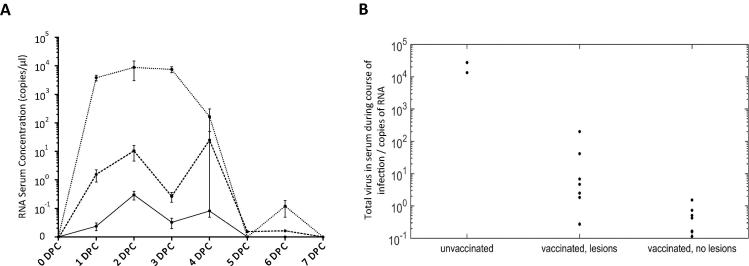
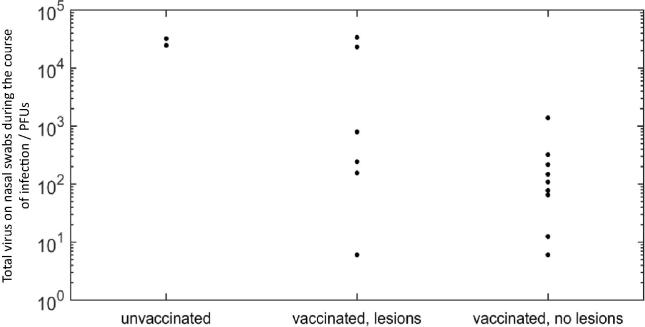
In 2015, outbreaks of foot-and-mouth disease (FMD) in the Middle East were discovered to be caused by a viral lineage (A/ASIA/G-VII), which has recently emerged from the Indian sub-continent. In vitro vaccine matching data generated by the World Reference Laboratory (WRLFMD) indicated that A/ASIA/G-VII field viruses were poorly matched with vaccines (A-SAU-95, A22 IRQ and A-IRN-05) that are already used in the region. In order to assess the likely performance of one of these commercially available FMD vaccines, sixteen cattle were vaccinated with a polyvalent vaccine which contained two serotype A components (A-SAU-95 and A-IRN-05) with a homologous potency of at least 6PD50, and two cattle were left unvaccinated as controls. Twenty-one days later, all 18 cattle were challenged by tongue inoculation with an FMDV field isolate A/IRN/22/2015 from the A/ASIA/G-VII lineage, in line with the European Pharmacopeia PPG test conditions. The two control animals developed generalised FMD, and 7/16 vaccinated animals developed at least one foot lesion, thus only 56.3% were defined as protected. For the vaccine components, there was a significant increase in the probability of protection with increasing serological titres for A-SAU-95 (p = 0.03), but not for A-IRN-05 (p = 0.42). Analysis of FMDV in blood and nasal swabs suggested that vaccination reduced shedding and potential onward spread of FMD virus even if the animal developed foot lesions. In summary, the results from this study suggest that whilst this vaccine would not be appropriate for use in an emergency situation (in previously FMD-free countries), it may be partially effective in the field in endemic countries where repeat prophylactic vaccination is practiced. For emergency reactive vaccination, the findings from this study support the idea that a new vaccine strain should be developed that is tailored to the A/ASIA/G-VII lineage.
Keywords: A/ASIA/G-VII; Challenge; Foot-and-mouth disease virus; Podal generalisation test (PPG); Vaccine.
Copyright © 2018 The Pirbright Institute. Published by Elsevier Ltd.. All rights reserved.
Figures


References
-
- Power A.P., Harris S.A. Cost-benefit evaluation of alternative control policies for foot-and-mouth disease in Great Britain. J Agr Econ. 1973;24(3):573–600. PubMed PMID: WOS:A1973R386000008.
-
- Rweyemamu M.M., Leforban Y. Foot-and-mouth disease and international development. Adv Virus Res. 1999;53:111–126. PubMed PMID: 10582097. - PubMed
-
- Pay T.W.F. Variation in foot-and-mouth disease: application to vaccination. Rev Sci tech Off Int Epiz. 1983;2(3):701–723. - PubMed
Publication types
MeSH terms
Substances
Grants and funding
LinkOut - more resources
Full Text Sources
Other Literature Sources
