. 2018 Mar 5;8(1):3992.
doi: 10.1038/s41598-018-21762-7.

A retrospective study of community-acquired Clostridium difficile infection in southwest China

Affiliations

A retrospective study of community-acquired Clostridium difficile infection in southwest China

Feng Liao et al. Sci Rep. .

Abstract

To identify the prevalence and characteristics of community-acquired Clostridium difficile infection (CA-CDI) in southwest China, we conducted a cross-sectional study. 978 diarrhea patients were enrolled and stool specimens' DNA was screened for virulence genes. Bacterial culture was performed and isolates were characterized by PCR ribotyping and multilocus sequence typing. Toxin genes tcdA and/or tcdB were found in 138/978 (14.11%) cases for fecal samples. A total of 55 C. difficile strains were isolated (5.62%). The positive rate of toxin genes and isolation results had no statistical significance between children and adults groups. However, some clinical features, such as fecal property, diarrhea times before hospital treatment shown difference between two groups. The watery stool was more likely found in children, while the blood stool for adults; most of children cases diarrhea ≤3 times before hospital treatment, and adults diarrhea >3 times. Independent risk factor associated with CA-CDI was patients with fever. ST35/RT046 (18.18%), ST54/RT012 (14.55%), ST3/RT001 (14.55%) and ST3/RT009 (12.73%) were the most distributed genotype profiles. ST35/RT046, ST3/RT001 and ST3/RT009 were the commonly found in children patients but ST54/RT012 for adults. The prevalence of CA-CDI in Yunnan province was relatively high, and isolates displayed heterogeneity between children and adults groups.


Conflict of interest statement

The authors declare no competing interests.

Figures
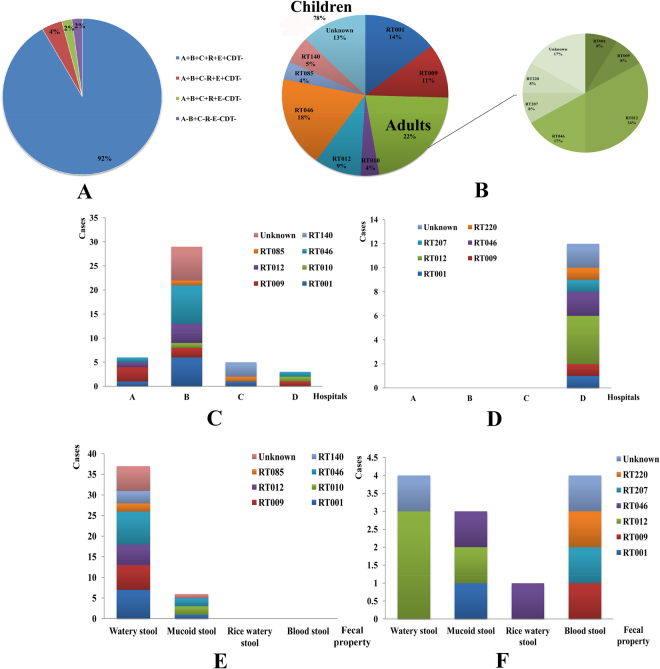
Figure 1
Figure 1
The toxin profiles and PCR ribotyping characters of C. difficile between children and adults in this study. (A) The toxin profile of isolated strains. (B) RT constituent ratio of C. difficile strains. Left: children group; right: adults group. (C) RT distribution characters of C. difficile for different hospitals in children group. (D) RT distribution characters of C. difficile for different hospitals in adults group. (E). RT distribution characters of C. difficile for fecal property in children group. (F) RT distribution characters of C. difficile for fecal property in adults group.
Figure 2
Figure 2
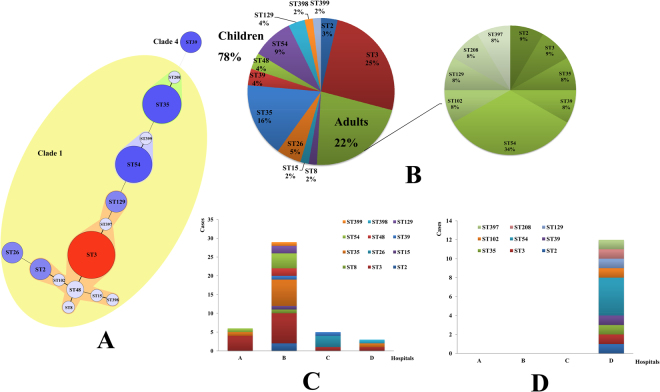
The minimum spanning tree and ST types distribution characters of C. difficile between children and adults in this study. (A) The minimum spanning tree of isolated C. difficile for MLST typing. Each circle corresponds to ST types, the number of which is indicated for the size of circles. The yellow color area belong to the Clade 1. The lines between circles indicate the similarity between profiles (bold, 5 alleles in common; normal, 4 alleles; dotted, ≤3 alleles). (B) ST constituent ratio of C. difficile strains. Left: children group; right: adults group. (C) The distribution characters of C. difficile ST types for different hospitals in children group. (D) The distribution characters of C. difficile ST types for different hospitals in adults group.

References

    1. Rupnik M, Wilcox MH, Gerding DN. Clostridium difficile infection: new developments in epidemiology and pathogenesis. Nat Rev Microbiol. 2009;7:526–536. doi: 10.1038/nrmicro2164. - DOI - PubMed
    1. Dingle KE, et al. Clinical Clostridium difficile: clonality and pathogenicity locus diversity. PLoS One. 2011;6:e19993. doi: 10.1371/journal.pone.0019993. - DOI - PMC - PubMed
    1. Tang C, et al. The incidence and drug resistance of Clostridium difficile infection in Mainland China: a systematic review and meta-analysis. Sci Rep. 2016;6:37865. doi: 10.1038/srep37865. - DOI - PMC - PubMed
    1. Heinlen L, Ballard JD. Clostridium difficile infection. Am J Med Sci. 2010;340:247–252. doi: 10.1097/MAJ.0b013e3181e939d8. - DOI - PMC - PubMed
    1. Freeman J, et al. The changing epidemiology of Clostridium difficile infections. Clin Microbiol Rev. 2010;23:529–549. doi: 10.1128/CMR.00082-09. - DOI - PMC - PubMed

LinkOut - more resources