


Demographics, tumor characteristics, treatment, and survival of patients with Klatskin tumors
- PMID: 29507471
- PMCID: PMC5825954
- DOI: 10.20524/aog.2018.0233
Demographics, tumor characteristics, treatment, and survival of patients with Klatskin tumors
Abstract
Background: The objective of this study was to investigate the incidence, demographics, tumor characteristics, treatment, and survival of patients with hilar cholangiocarcinoma.
Methods: Data on Klatskin tumors between 2004 and 2013 was extracted from the Surveillance, Epidemiology and End Results Registry. The epidemiology of these tumors was then analyzed.
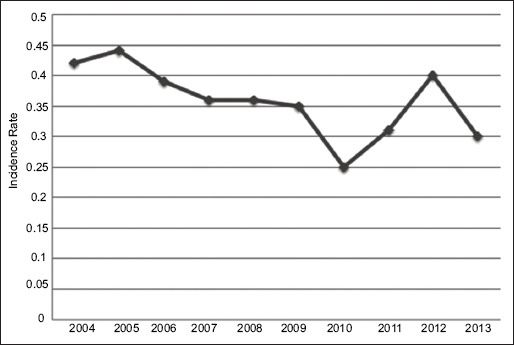
Results: A total of 254 patients with Klatskin tumors were identified. The overall age-adjusted incidence of Klatskin tumors between 2004 and 2013 was 0.38 per 1,000,000 per year. A gradual decline in the incidence was noted, with the highest (0.44) in 2005 and lowest (0.24) in 2010. Males had a higher incidence of Klatskin tumors compared to females (0.47 vs. 0.25 per 1,000,000 per year). These tumors were more common among Asian and Pacific islanders, who had an age-adjusted incidence rate of 0.48 per 1,000,000. Incidence increased with age, with the peak incidence between the ages of 80 and 84 years. The majority of the tumors were extrahepatic (67.3%). Approximately one-fourth (22.4%) of these patients had metastatic disease at presentation. Only 26.8% of patients had surgically resectable disease at presentation. One- and 5-year cause-specific survival for Klatskin tumors was 41% and 10.4%, respectively, with a median survival of 7 months. On Cox proportional hazard regression analysis, extrahepatic tumors (hazard ratio [HR] 0.54, 95% confidence interval [CI] 0.37-0.80, P=0.02) and those treated surgically (HR 0.47, 95%CI 0.29-0.77, P=0.003) had significantly better outcomes.
Conclusions: Klatskin tumors are rare and have a very poor prognosis with low survival rate. Among these tumors, extrahepatic and surgically treated tumors tend to have better outcomes.
Keywords: Hilar cholangiocarcinoma; Klatskin tumors; SEER; incidence; survival.
Conflict of interest statement
Conflict of Interest: None
Figures


References
-
- Blechacz BR, Gores GJ. Cholangiocarcinoma. Clin Liver Dis. 2008;12:131–150, ix. - PubMed
-
- Okuda K, Kubo Y, Okazaki N, Arishima T, Hashimoto M. Clinical aspects of intrahepatic bile duct carcinoma including hilar carcinoma:a study of 57 autopsy-proven cases. Cancer. 1977;39:232–246. - PubMed
-
- Klatskin G. Adenocarcinoma of the hepatic duct at its bifurcation within theporta hepatis. An unusual tumor with distinctive clinical and pathological features. Am J Med. 1965;38:241–256. - PubMed
-
- Ebata T, Kamiya J, Nishio H, Nagasaka T, Nimura Y, Nagino M. The concept of perihilar cholangiocarcinoma is valid. Br J Surg. 2009;96:926–934. - PubMed
LinkOut - more resources
Full Text Sources
Other Literature Sources