


Exploring cued and non-cued motor imagery interventions in people with multiple sclerosis: a randomised feasibility trial and reliability study
- PMID: 29507773
- PMCID: PMC5833073
- DOI: 10.1186/s40945-018-0045-0
Exploring cued and non-cued motor imagery interventions in people with multiple sclerosis: a randomised feasibility trial and reliability study
Abstract
Background: Motor imagery (MI) is increasingly used in neurorehabilitation to facilitate motor performance. Our previous study results demonstrated significantly improved walking after rhythmic-cued MI in people with multiple sclerosis (pwMS). The present feasibility study was aimed to obtain preliminary information of changes in walking, fatigue, quality of life (QoL) and MI ability following cued and non-cued MI in pwMS. The study further investigated the feasibility of a larger study and examined the reliability of a two-dimensional gait analysis system.
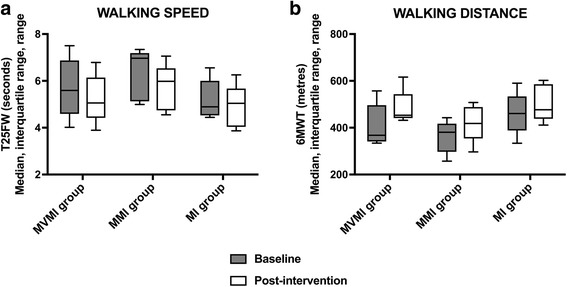
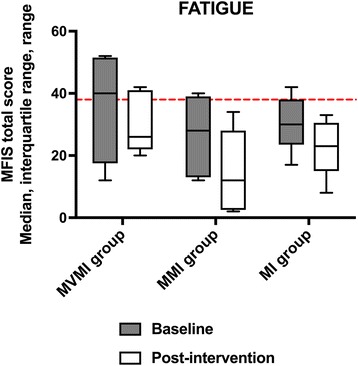
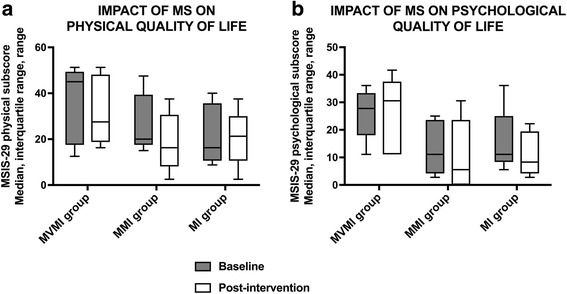
Methods: At the MS-Clinic, Department of Neurology, Medical University of Innsbruck, Austria, 15 adult pwMS (1.5-4.5 on the Expanded Disability Status Scale, 13 females) were randomised to one of three groups: 24 sessions of 17 min of MI with music and verbal cueing (MVMI), with music alone (MMI), or non-cued (MI). Descriptive statistics were reported for all outcomes. Primary outcomes were walking speed (Timed 25-Foot Walk) and walking distance (6-Minute Walk Test). Secondary outcomes were recruitment rate, retention, adherence, acceptability, adverse events, MI ability (Kinaesthetic and Visual Imagery Questionnaire, Time-Dependent MI test), fatigue (Modified Fatigue Impact Scale) and QoL (Multiple Sclerosis Impact Scale-29). The reliability of a gait analysis system used to assess gait synchronisation with music beat was tested.
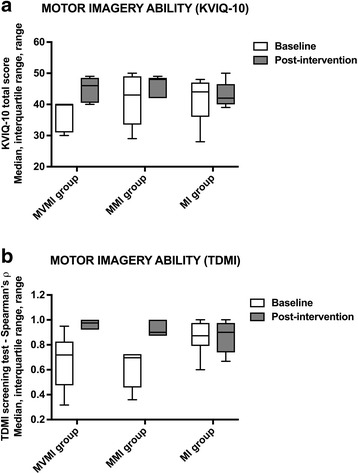
Results: Participants showed adequate MI abilities. Post-intervention, improvements in walking speed, walking distance, fatigue, QoL and MI ability were observed in all groups. Success of the feasibility criteria was demonstrated by recruitment and retention rates of 8.6% (95% confidence interval, CI 5.2, 13.8%) and 100% (95% CI 76.4, 100%), which exceeded the target rates of 5.7% and 80%. Additionally, the 83% (95% CI 0.42, 0.99) adherence rate surpassed the 67% target rate. Intra-rater reliability analysis of the gait measurement instruments demonstrated excellent Intra-Class Correlation coefficients for step length of 0.978 (95% CI 0.973, 0.982) and step time of 0.880 (95% CI 0.855, 0.902).
Conclusion: Results from our study suggest that cued and non-cued MI are valuable interventions in pwMS who were able to imagine movements. A larger study appears feasible, however, substantial improvements to the methods are required such as stratified randomisation using a computer-generated sequence and blinding of the assessors.
Trial registration: ISRCTN ISRCTN92351899. Registered 10 December 2015.
Keywords: Fatigue; Feasibility; Motor imagery; Motor imagery ability; Multiple sclerosis; Physiotherapy; Quality of life; Reliability two-dimensional gait analysis; Rhythmic cueing; Walking.
Conflict of interest statement
This study was approved by the Tier 2 College Research Ethics Committee (CREC) of the University of Brighton on 17 December 2015 (no reference number) and the Ethics Committee of the Medical University of Innsbruck on 26 February 2016 (reference number AN2014–0052 334/4.14358/5.13 (3743a)). All participants provided written informed consent to the participant consent form and were reimbursed for travel expenses only.Not applicable.The authors declare that they have no competing interests. As this is part of a PhD study, all intellectual property related to this study belongs to the University of Brighton, according to the University of Brighton’s Doctoral College (2012) research code of practice.Springer Nature remains neutral with regard to jurisdictional claims in published maps and institutional affiliations.
Figures


Comment in
-
Motor imagery in multiple sclerosis: exploring applications in therapeutic treatment.J Neurophysiol. 2019 Feb 1;121(2):347-349. doi: 10.1152/jn.00291.2018. Epub 2018 Sep 12. J Neurophysiol. 2019. PMID: 30207860
References
-
- Compston A, Confavreux C, Lassmann H, McDonald I, Miller D, Noseworthy J, Smith K, Wekerle H. McAlpine’s multiple sclerosis. 4th edn. London: Elsevier; 2006.
-
- Leone C, Severijns D, Dolezalova V, Baert I, Dalgas U, Romberg A, Bethoux F, Gebara B, Santoyo Medina C, Maamagi H, et al. Prevalence of walking-related motor fatigue in persons with multiple sclerosis: decline in walking distance induced by the 6-minute walk test. Neurorehabil Neural Repair. 2016;30:373–383. doi: 10.1177/1545968315597070. - DOI - PubMed
LinkOut - more resources
Full Text Sources
Other Literature Sources