Review
. 2018 Feb 23:3:6.
doi: 10.1038/s41536-018-0044-5. eCollection 2018.

Comparative regenerative mechanisms across different mammalian tissues

Affiliations
Review

Comparative regenerative mechanisms across different mammalian tissues

Siiri E Iismaa et al. NPJ Regen Med. .

Abstract

Stimulating regeneration of complex tissues and organs after injury to effect complete structural and functional repair, is an attractive therapeutic option that would revolutionize clinical medicine. Compared to many metazoan phyla that show extraordinary regenerative capacity, which in some instances persists throughout life, regeneration in mammalians, particularly humans, is limited or absent. Here we consider recent insights in the elucidation of molecular mechanisms of regeneration that have come from studies of tissue homeostasis and injury repair in mammalian tissues that span the spectrum from little or no self-renewal, to those showing active cell turnover throughout life. These studies highlight the diversity of factors that constrain regeneration, including immune responses, extracellular matrix composition, age, injury type, physiological adaptation, and angiogenic and neurogenic capacity. Despite these constraints, much progress has been made in elucidating key molecular mechanisms that may provide therapeutic targets for the development of future regenerative therapies, as well as previously unidentified developmental paradigms and windows-of-opportunity for improved regenerative repair.


Conflict of interest statement

The authors declare no competing interests.

Figures
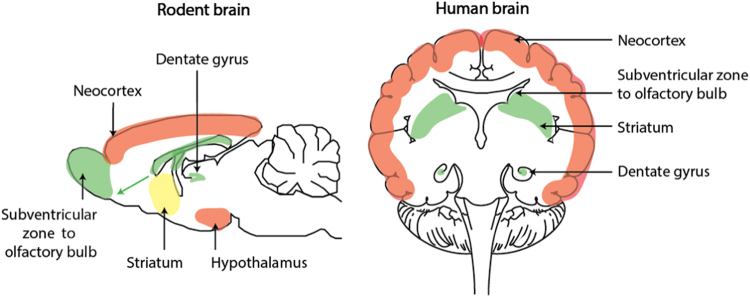
Fig. 1
Fig. 1
Sites of neurogenesis in the adult rodent and human brain. Regions in which neurogenesis occurs throughout life, in response to injury or regions in which neurogenesis does not occur are indicated in green, yellow, and red, respectively. Figure adapted, with permission from Company of Biologists, from Magnusson and Frisen.
Fig. 2
Fig. 2
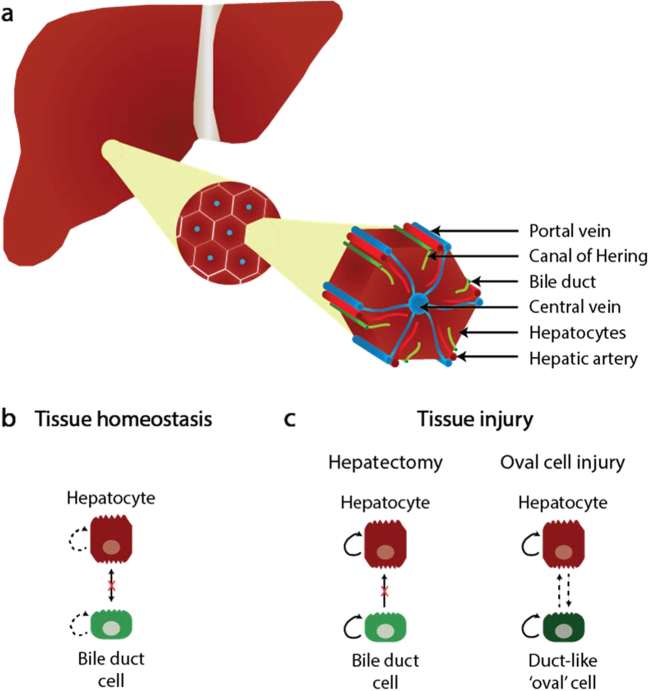
Architecture of the adult liver. a Hepatocytes are perfused by blood from the portal vein and hepatic artery, which flows into the central vein. Bile, secreted by hepatocytes, is transported through the canal of Hering to the bile duct. b Tissue homeostasis involves limited self-renewal (dashed arrows) of hepatocytes and bile duct cells, with no interconversion between these cell types. c After hepatectomy, both bile duct cells and hepatocytes can self-renew, but bile duct cells do not become hepatocytes. In the oval cell response, adult hepatocytes and periportal ductal ‘oval’ cells in the canal of Hering proliferate; oval cells differentiate into hepatocytes to replenish hepatocyte numbers when hepatocyte replication is impaired. Figure adapted, with permission from Springer Nature, from Kopp et al.
Fig. 3
Fig. 3
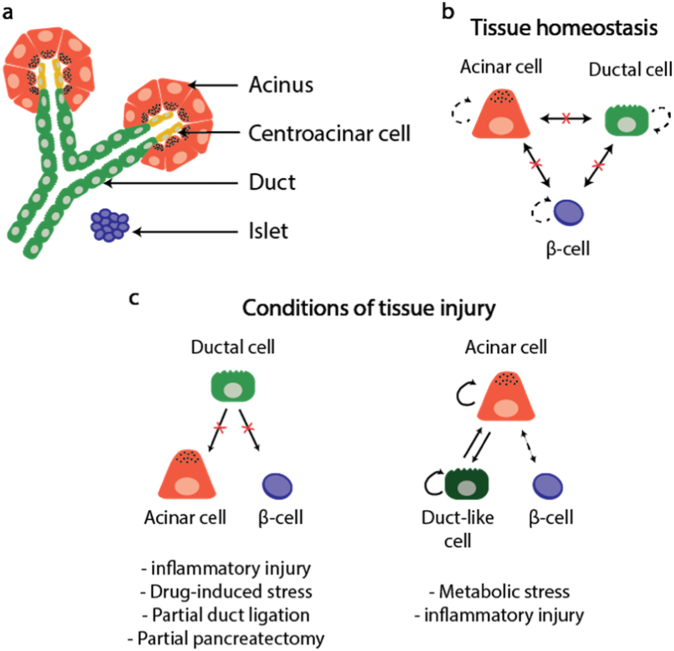
Architecture of the pancreas. a Functional units of the adult pancreas are made up of acinar, centroacinar, and ductal cells and are interspersed with islets of endocrine cells (β-cells). b During tissue homeostasis, acinar, ductal and β-cells are capable of some self-renewal (dashed arrows), but there is no transdifferentiation between the cell types. c Cell responses to injury depend on the injury type. Clonogenic ductal cells are unable to convert onto acinar cells or β-cells. Acinar cells convert to duct-like cells, which then return to an acinar cell phenotype. Figure adapted, with permission from Springer Nature, from Kopp et al.
Fig. 4
Fig. 4
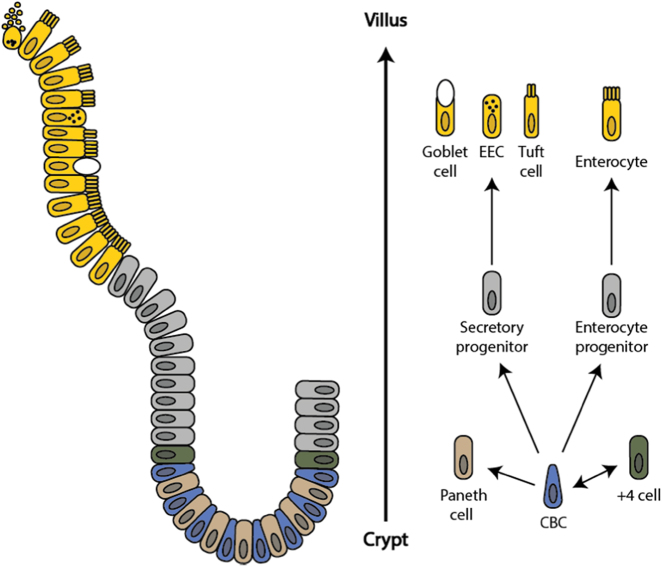
The intestinal crypt-villus unit. The intestinal crypt-villus unit is maintained by multipotent crypt base columnar (CBC; Lgr5+) and +4 cells (Hopx+, Bmi1+, mTert+, Lrig+). These stem cells are found at the crypt and supply the villus with specialized intestinal cells, including enterocytes, goblet cells, enteroendocrine cells (EEC), and tuft cells, which are eventually shed at the villus tip. Conversely, Paneth cells are mature cells that remain at the crypt and modulate the stem cell environment. Figure adapted, with permission from Company of Biologists, from Beumer et al.
Fig. 5
Fig. 5
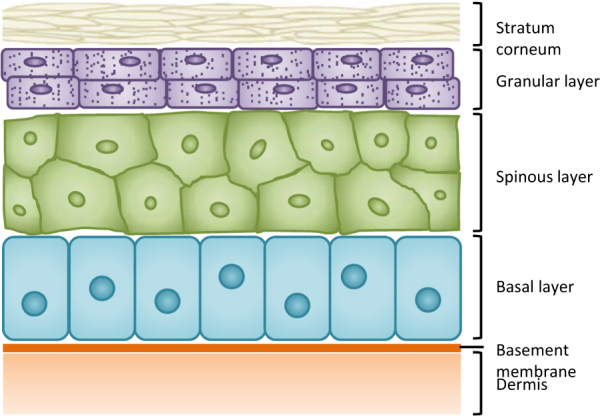
The interfollicular epidermis. The interfollicular epidermis is stratified into four layers: the basal, spinous, and granular layers and stratum corneum. Basal progenitor cells differentiate as they lose contact with the basement membrane and migrate toward the skin’s surface where they are eventually shed. Figure adapted, with permission from Springer Nature, from Hsu et al.
Fig. 6
Fig. 6
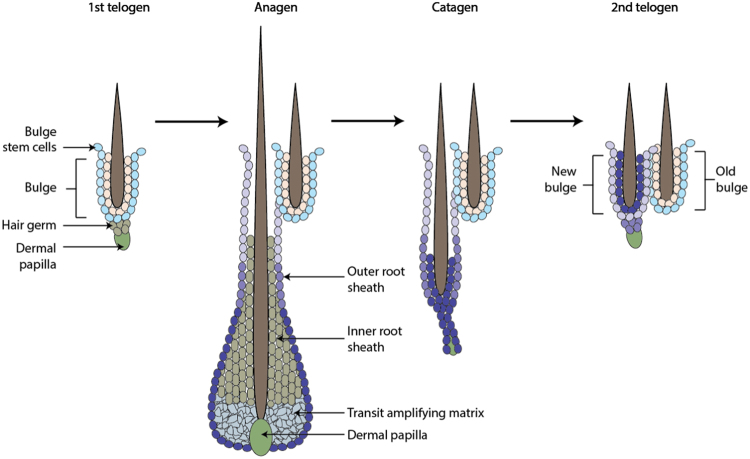
The hair follicle. The hair follicle cycles through three phases: anagen (growth), catagen (regression) and telogen (rest). Bulge stem cells supply the outer root sheath, while hair germ cells at the dermal papilla generate the hair shaft and inner root sheath. During catagen, the inner root sheath and much of the outer root sheath regresses. However, some of the upper, middle, and lower cells of the outer root sheath generate a new bulge adjacent to the old bulge, contributing to the outer bulge, hair germ, and inner bulge, respectively. Figure adapted, with permission from Springer Nature, from Hsu et al.

References

    1. Lenhoff, H. M. & Lenhoff, S. G. in A history of regeneration research: milestones in the evolution of a science (ed C. E. Dinsmore) (Cambridge University Press, Canada, 1991).
    1. Gawriluk TR, et al. Comparative analysis of ear-hole closure identifies epimorphic regeneration as a discrete trait in mammals. Nat. Commun. 2016;7:11164. doi: 10.1038/ncomms11164. - DOI - PMC - PubMed
    1. Goss, R. Principles of regeneration. (Academic Press, New York, 1969).
    1. Martin P, Parkhurst SM. Parallels between tissue repair and embryo morphogenesis. Development. 2004;131:3021–3034. doi: 10.1242/dev.01253. - DOI - PubMed
    1. Yokoyama H. Initiation of limb regeneration: the critical steps for regenerative capacity. Dev. Growth Differ. 2008;50:13–22. doi: 10.1111/j.1440-169X.2007.00973.x. - DOI - PubMed