


Cango Lyec (Healing the Elephant): Gender Differences in HIV Infection in Post-conflict Northern Uganda
- PMID: 29509587
- PMCID: PMC6012052
- DOI: 10.1097/QAI.0000000000001671
Cango Lyec (Healing the Elephant): Gender Differences in HIV Infection in Post-conflict Northern Uganda
Abstract
Background: As previously encamped resettle, potential for rapid HIV transmission in post-conflict Northern Uganda is concerning. Women in particular may be experiencing heightened vulnerability resulting from war-related sexual violence.
Setting: Cango Lyec (Healing the Elephant) Project is a cohort involving conflict-affected people in 3 districts in Northern Uganda.
Methods: Eight randomly selected communities were mapped, and a census was conducted. Participants aged 13-49 years completed questionnaires in Luo on war-related experiences, mental health, sexual vulnerabilities, and sociodemographics. Blood samples were tested for HIV and syphilis. Baseline data from all sexually active participants was used to determine gender differences in HIV prevalence. Multivariate modeling determined correlates of HIV by gender.
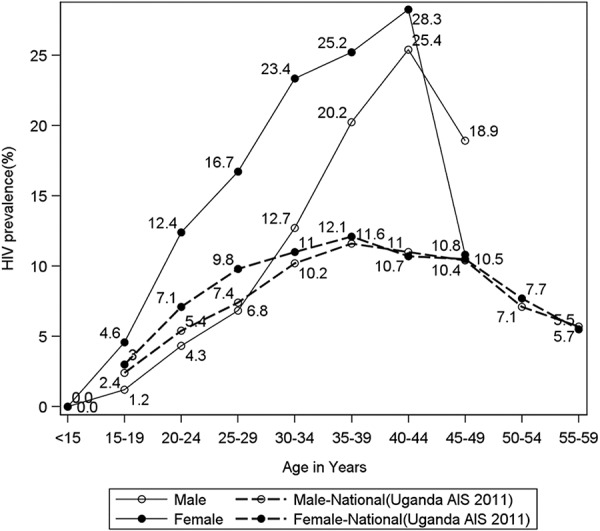
Results: Among 2008 participants, HIV prevalence was higher among women [17.2; 95% confidence interval (CI): 14.7 to 19.7] compared to men (10.6; 95% CI: 8.0 to 13.2, <0.001). Among women, correlates of HIV included: war-related sexual assault [adjusted odds ratio (AOR): 1.95; 95% CI: 1.16 to 3.26]; probable depression (AOR: 2.22; 95% CI: 1.46 to 3.37); probable post-traumatic stress disorder (AOR: 2.03; 95% CI: 1.45 to 2.84); experiencing ≥12 traumatic events (AOR: 2.04; 95% CI: 1.31 to 3.18); suicide ideation (AOR: 1.67; 95% CI: 1.22 to 2.28); living in a female-headed household (AOR: 2.76; 95% CI: 1.70 to 4.49); first sexual partner ≥10 years older (AOR: 1.69; 95% CI: 1.07 to 2.67); sex for exchange (AOR: 5.51; 95% CI: 1.76 to 17.31); having 2 (AOR: 2.54; 95% CI: 1.23 to 5.23) or 3+ (AOR: 4.65; 95% CI: 2.65 to 8.18) sexual partners; inconsistent condom use (AOR: 0.40; 95% CI: 0.29 to 0.57); genital ulcers (AOR: 3.08; 95% CI: 2.16 to 4.38); active syphilis (AOR: 4.33; 95% CI: 1.22 to 15.40); and ill health without medical care (AOR: 2.02; 95% CI: 1.22 to 3.34). Among men, correlates of HIV included no condom at sexual debut (AOR: 1.92; 95% CI: 1.30 to 2.83) and genital ulcers (AOR: 4.40; 95% CI: 1.35 to 14.40).
Conclusion: Women are disproportionately impacted by HIV, trauma, and depression in this conflict-affected population. Trauma-informed HIV prevention and culturally safe mental health initiatives are urgently required.
Conflict of interest statement
The authors have no funding or conflicts of interest to disclose.
Figures
References
-
- Spittal P, Muyinda H, Patel S, et al. The Wayo Programme: Building on Traditional Assets in Supporting Young Women and Girls in the Context of HIV, War, and Post Conflict in Northern Uganda. Ottawa, Canada: CIDA Child Protection Fund; 2008.
-
- Republic of Uganda Ministry of Health, World Health Organization. Health and Mortality Survey Among Internally Displaced Persons in Gulu, Kitgum and Pader Districts, Northern Uganda. Geneva, Switzerland: World Health Organization; 2005.
-
- World Health Organization. Health Action in Crisis: Taking Stock of WHO's Work in Crises in Uganda. Geneva, Switzerland: World Health Organization; 2007.
-
- Reuters Staff. EU Joins National Donors in Freezing Aid to Uganda over Graft. London, United Kingdom: Reuters; 2012.
-
- Patel S, Schechter MT, Sewankambo NK, et al. War and HIV: sex and gender differences in risk behaviour among young men and women in post-conflict Gulu District, Northern Uganda. Glob Public Health. 2014;9:325–341. - PubMed
Publication types
MeSH terms
Grants and funding
LinkOut - more resources
Full Text Sources
Other Literature Sources
Medical
Research Materials
