


Investigation of household contacts of pulmonary tuberculosis patients increases case detection in Mwanza City, Tanzania
- PMID: 29510670
- PMCID: PMC5840829
- DOI: 10.1186/s12879-018-3036-6
Investigation of household contacts of pulmonary tuberculosis patients increases case detection in Mwanza City, Tanzania
Abstract
Background: Tuberculosis (TB) contact tracing is a key strategy for containing TB and provides addition to the passive case finding approach. However, this practice has not been implemented in Tanzania, where there is unacceptably high treatment gap of 62.1% between cases estimated and cases detected. Therefore calls for more aggressive case finding for TB to close this gap. We aimed to determine the magnitude and predictors of bacteriologically-confirmed pulmonary TB among household contacts of bacteriologically-confirmed pulmonary TB index cases in the city of Mwanza, Tanzania.
Methods: This study was carried out from August to December 2016 in Mwanza city at the TB outpatient clinics of Tertiary Hospital of the Bugando Medical Centre, Sekou-Toure Regional Hospital, and Nyamagana District Hospital. Bacteriologically-confirmed TB index cases diagnosed between May and July 2016 were identified from the laboratory registers book. Contacts were traced by home visits by study TB nurses, and data were collected using a standardized TB screening questionnaire. To detect the bacterioriologically-confirmed pulmonary TB, two sputum samples per household contact were collected under supervision for all household contacts following standard operating procedures. Samples were transported to the Bugando Medical Centre TB laboratory for investigation for TB using fluorescent smear microscopy, GeneXpert MTB/RIF and Löwenstein-Jensen (LJ) culture. Logistic regression was used to determine predictors of bacteriologically-confirmed pulmonary TB among household contacts.
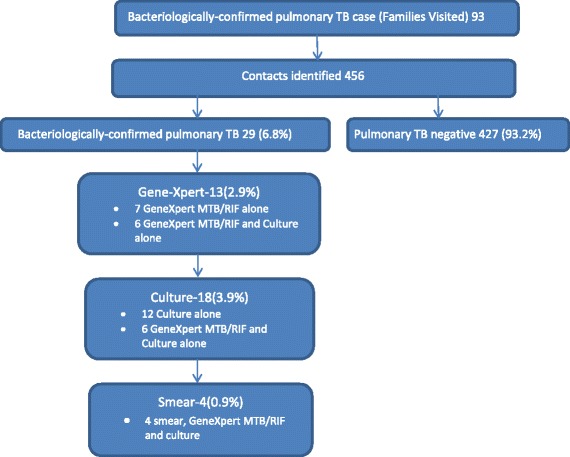
Results: During the study period, 456 household contacts from 93 TB index cases were identified. Among these 456 household contacts, 13 (2.9%) were GeneXpert MTB/RIF positive, 18 (3.9%) were MTB-culture positive and four (0.9%) were AFB-smear positive. Overall, 29 (6.4%) of contacts had bacteriologically-confirmed pulmonary TB. Predictors of bacteriologically-confirmed pulmonary TB among household contacts were7being married (Odds ratio [OR], 3.3; 95% confidence interval [CI], 1.4-8.0; p = 0.012) and consuming less than three meals a day (OR, 3.7; 95% CI, 1.6-8.7; p = 0.009).
Conclusions: Our data suggest that in Mwanza, Tanzania, seven in 100 contacts living in the same house with a TB patient develop bacteriologically-confirmed pulmonary TB. These results therefore underscore the need to implement routine TB contact tracing to control tuberculosis in high TB burden countries such as Tanzania.
Keywords: Active TB case finding; Bacteriologically-confirmed pulmonary tuberculosis; Household TB contacts; Mwanza; Tanzania; Tuberculosis.
Conflict of interest statement
Ethics approval and consent to participate
All study participants were clearly informed on the aims and benefits of the study as well as the procedures involved before being enrolled into the study. Written informed consent was obtained before sample collection for adults and for children, their parents or guardian signed the written consent form on their behalf. The study was approved by the Joint Bugando Medical Centre and Catholic University of Health and Allied Sciences Ethical Committee in Mwanza, Tanzania as well as approved by the Ethical Committee Stellenbosch University in Capetown, South Africa.
Consent for publication
Not applicable.
Competing interests
We declare that we have no competing interest to report.
Publisher’s Note
Springer Nature remains neutral with regard to jurisdictional claims in published maps and institutional affiliations.
Figures
References
-
- Morrison J, Pai M, Hopewell PC. Tuberculosis and latent tuberculosis infection in close contacts of people with pulmonary tuberculosis in low-income and middle-income countries: a systematic review and meta-analysis. Lancet Infect Dis. 2008;8(6):359–368. doi: 10.1016/S1473-3099(08)70071-9. - DOI - PubMed
-
- Ntinginya E, Squire S, Millington K, Mtafya B, Saathoff E, Heinrich N, Rojas-Ponce G, Kowuor D, Maboko L, Reither K. Performance of the Xpert® MTB/RIF assay in an active case-finding strategy: a pilot study from Tanzania [short communication] Int J Tuberc Lung Dis. 2012;16(11):1468–1470. doi: 10.5588/ijtld.12.0127. - DOI - PubMed
-
- World Health Organization: Global tuberculosis report. 2016. Geneva, Switzerland. http://www.who.int/tb/publications/global_report/en/. Accessed 10 Jan 2017.
Publication types
MeSH terms
LinkOut - more resources
Full Text Sources
Other Literature Sources
Miscellaneous
