Review
. 2018 Feb 26;7(1):1438720.
doi: 10.1080/20013078.2018.1438720. eCollection 2018.

Extracellular vesicles: the growth as diagnostics and therapeutics; a survey

Affiliations
Review

Extracellular vesicles: the growth as diagnostics and therapeutics; a survey

Sabrina Roy et al. J Extracell Vesicles. .

Abstract

This article aims to document the growth in extracellular vesicle (EV) research. Here, we report the growth in EV-related studies, patents, and grants as well as emerging companies with major intent on exosomes. Four different databases were utilized for electronic searches of published literature: two general databases - Scopus/Elsevier and Web of Science (WoS), as well as two specialized US government databases - the USA Patent and Trademark Office and National Institutes of Health (NIH) of the Department of Health and Human Services. The applied combination of key words was carefully chosen to cover the most commonly used terms in titles of publications, patents and grants dealing with conceptual areas of EVs. Within the time frame from 1 January 2000 to 31 December 2016, limited to articles published in English, we identified output using search strategies based upon Scopus/Elsevier and WoS, patent filings and NIH Federal Reports of funded grants. Consistently, USA and UK universities are the most frequent among the top 15 affiliations/organizations of the authors of the identified records. There is clear evidence of upward streaming of EV-related publications. By documenting the growth of the EV field, we hope to encourage a roster of independent authorities skilled to provide peer review of manuscripts, evaluation of grant applications, support of foundation initiatives and corporate long-term planning. It is important to encourage EV research to further identify biomarkers in diseases and allow for the development of adequate diagnostic tools that could distinguish disease subpopulations and enable personalized treatment of patients.

Keywords: exosome; extracellular vesicle; growth; key word.


Conflict of interest statement

Dr. Hochberg is President of CASCENT Inc. and TAVEC Inc (both exosome therapeutic companies without conflict).

Figures
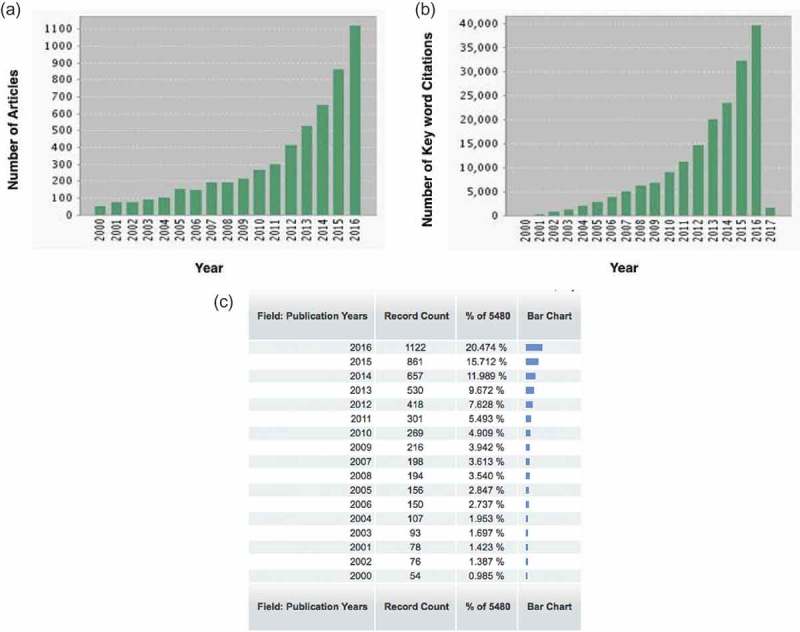
Figure 1.
Figure 1.
Evolution of EV articles and citations (source: Web of Science/Journal Citation Reports). Bar graphs indicate: (a) number of articles published (5,480) and (b) the number of times key words were cited (182,845) each year for the study period (2000-­2016). (c) Data from graph A as a table to demonstrate increasing record counts per year, culminating in 20.47% of records published in 2016.
Figure 2.
Figure 2.
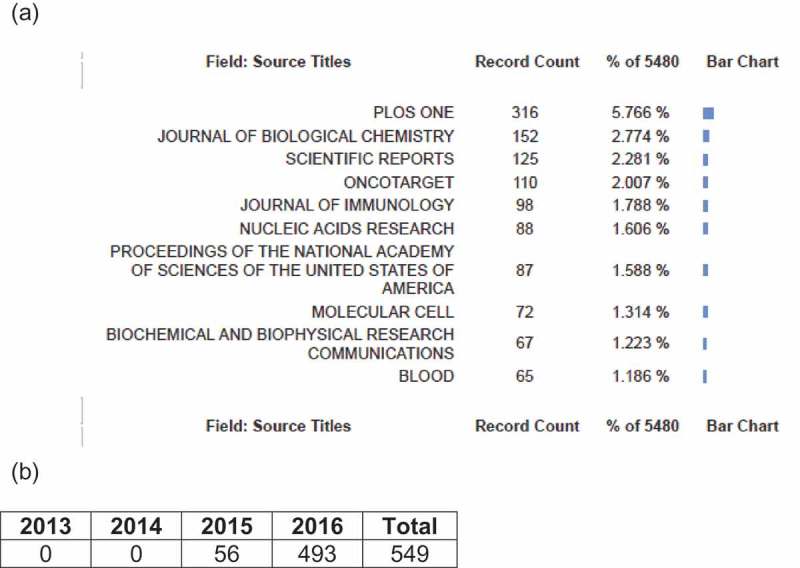
Titles of source journals for data (source: Web of Science/Journal Citation Reports). (a) 10 journals holding the highest number of articles containing EV-key words indexed by JCR/WoS; (b) citations of articles in J ournal of Extracellular Vesicles (JEV) throughout the study period (2000–2016).
Figure 3.
Figure 3.
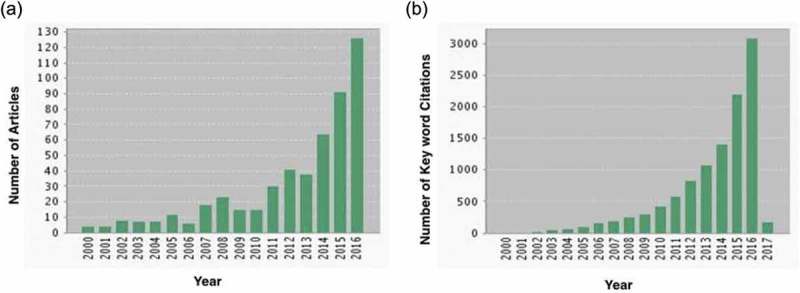
Evolution in the number of EV articles and citations (source: Web of Science/Journal Citation Reports). Bar graphs provide: (a) number of articles published (509) as well as the (b) frequency of key words juxtaposed to terms of analytic technology (10,963) for the study period (2000–2016).
Figure 4.
Figure 4.
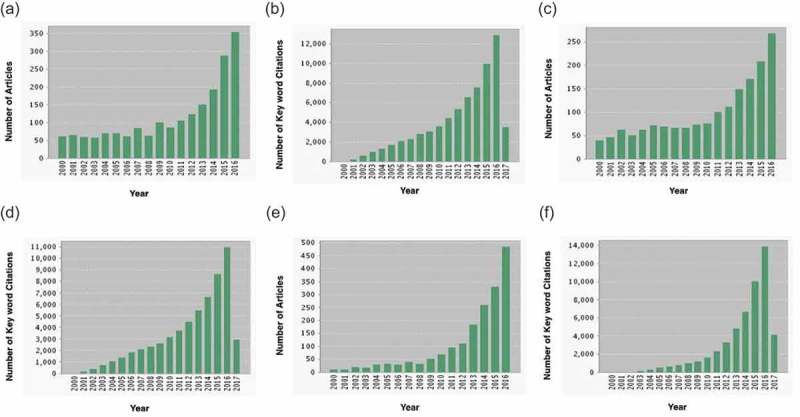
Evolution in the number of EV articles and citations (source: Web of Science/Journal Citation Reports). Bar graphs of (a) the number of articles published (2,002) as well as (b) the number of times key words were juxtaposed to analytic biofluid terms (69,250); (c) number of articles published (1,699) as well as (d) the number of times key words were juxtaposed to analytic cell type terms (59,185); (e) number of articles published (1,819) as well as (f) the number of times key words were juxtaposed to analytic token disease terms (51,913) of the study period (2000–2016).
Figure 5.
Figure 5.
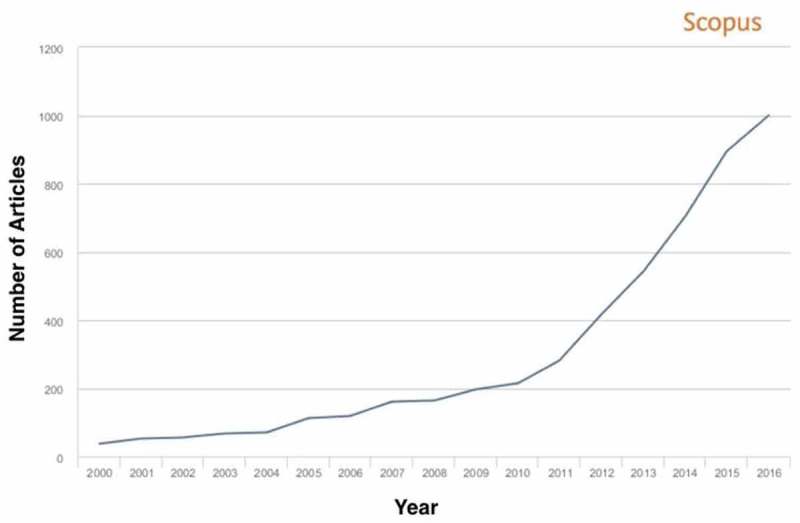
Evolution in the number of articles and citations (source: Scopus): line graph of the frequency of combined EV terms cited over the last 16 years (59,185).
Figure 6.
Figure 6.
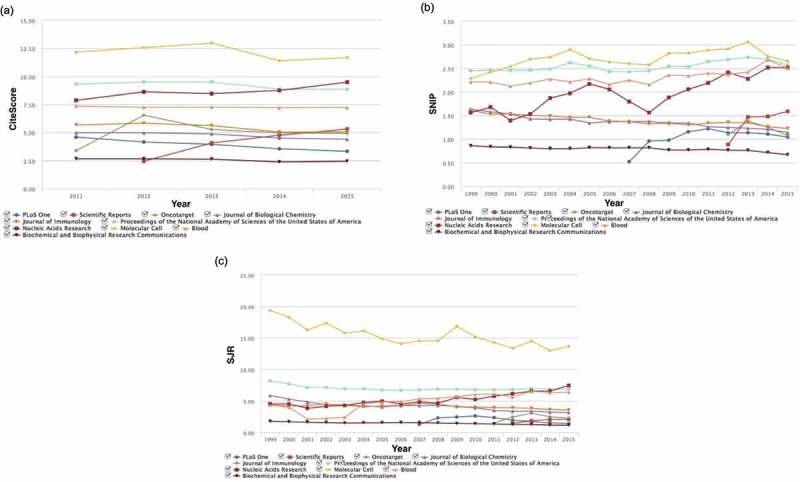
Scopus visual analyses (for the top 10 journals with the highest record counts). Visual analyses provided by Scopus depict line graphs relative to sources: (a) CiteScore, a measure of the citation impact of sources including journal articles; (b) SJR (source: Journal Ranking), which provides insight into a journal’s “prestige”, which influences the subject field, journal citation quality and reputation; and (c) SNIP (source: Normalized Impact per Paper), which more or less demonstrates annual increases for the majority of sources, particularly the journal Molecular Cell, which stands at first place. Generally, journals with the highest CiteScores (A) also corresponded to journals with the highest SJRs (b) and SNIPs (c). Trends depicted are consistent: Molecular Cell as being the journal with the highest CiteScore, SJR and SNIP since the year 2000; followed by the Proceedings of the National Academy of Sciences of the USA of America. Journals occupying subsequent places include Proceedings of the National Academy of Sciences of the USA, Blood and Nucleic Acids Research (respectively).
Figure 7.
Figure 7.
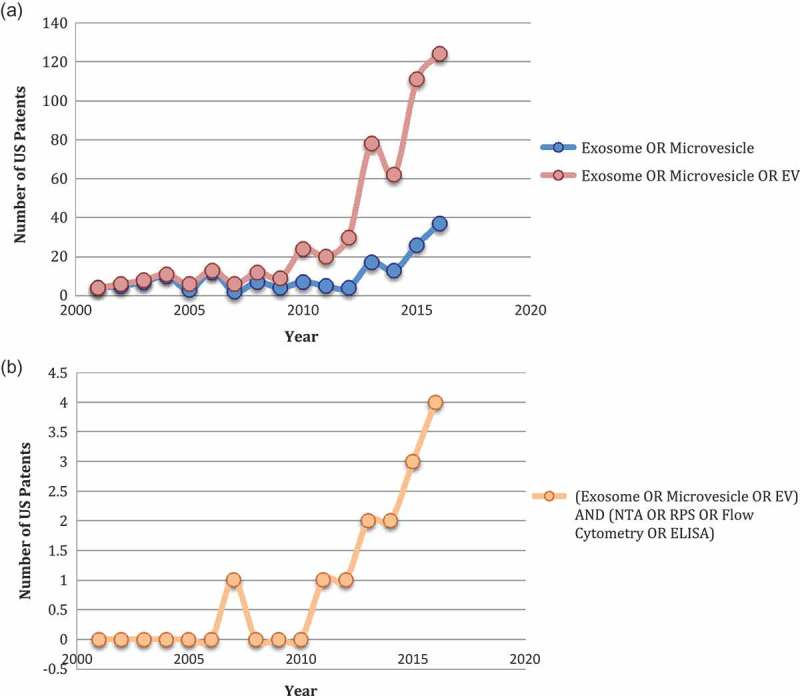
Evolution in the number of EV patents and intellectual property (indexed by UTSPO). Line graphs of the number of EV-related US patents published citing (a) key words (524) and (b) key words juxtaposed to analytic technology terms (14) year of the study period (2000–2016).
Figure 8.
Figure 8.
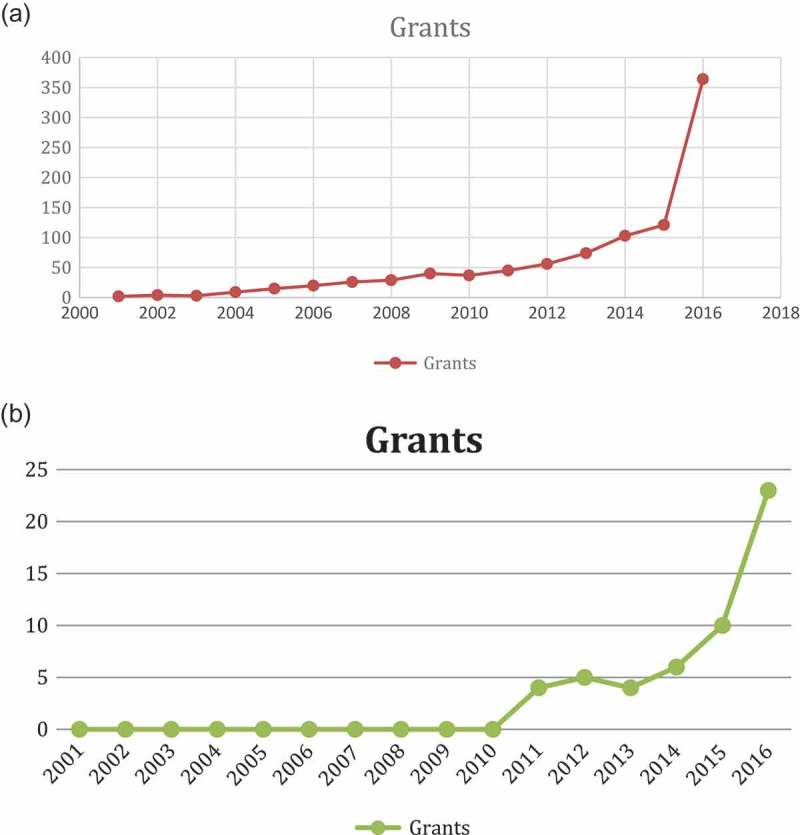
Evolution in the number of EV grants (indexed by NIH Reporter). Line graphs of the number of EV-related NIH grants published citing (a) key words (948) and (b) key words juxtaposed to analytic technology terms (52) each year of the study period (2000–2016).

References

    1. Merchant ML, Rood IM, Deegens JK, et al. Isolation and characterization of urinary extracellular vesicles: implications for biomarker discovery. Nat Rev Nephrol. 2017. DOI:10.1038/nrneph.2017.148 - DOI - PMC - PubMed
    1. Pap E, Falus A, Buzás EI.. Membrane vesicles, current state‐of‐the‐ art: emerging role of extracellular vesicles. Cell Mol Life Sci. 2011;68(16):2667‐88. - PMC - PubMed
    1. Simons M, Raposo G. Exosomes‐vesicular carriers for intercellular communication. Curr Opin Cell Biol. 2009;21(4):575‐81. - PubMed
    1. Corrado C, Raimondo S, Chiesi A, et al. Exosomes as intercellular signaling organelles involved in health and disease: basic science and clinical applications. Int J Mol Sci. 2013;14(3):5338‐66. - PMC - PubMed
    1. Théry C, Ostrowski M, Segura E. Membrane vesicles as conveyors of immune responses. Nat Rev Immunol. 2009;9(8):581‐93. - PubMed