


Comparison of Glycomacropeptide with Phenylalanine Free-Synthetic Amino Acids in Test Meals to PKU Patients: No Significant Differences in Biomarkers, Including Plasma Phe Levels
- PMID: 29511574
- PMCID: PMC5817308
- DOI: 10.1155/2018/6352919
Comparison of Glycomacropeptide with Phenylalanine Free-Synthetic Amino Acids in Test Meals to PKU Patients: No Significant Differences in Biomarkers, Including Plasma Phe Levels
Abstract
Introduction: Management of phenylketonuria (PKU) is achieved through low-phenylalanine (Phe) diet, supplemented with low-protein food and mixture of free-synthetic (FS) amino acid (AA). Casein glycomacropeptide (CGMP) is a natural peptide released in whey during cheese-making and does not contain Phe. Lacprodan® CGMP-20 used in this study contained a small amount of Phe due to minor presence of other proteins/peptides.
Objective: The purpose of this study was to compare absorption of CGMP-20 to FSAA with the aim of evaluating short-term effects on plasma AAs as well as biomarkers related to food intake.
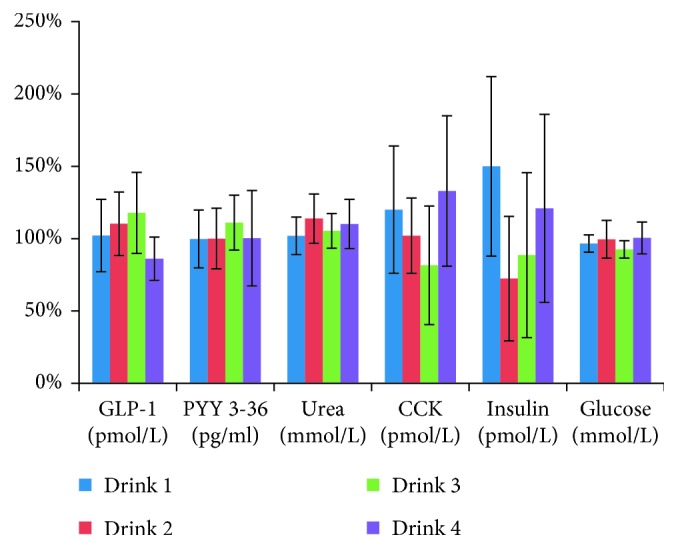
Methods: This study included 8 patients, who had four visits and tested four drink mixtures (DM1-4), consisting of CGMP, FSAA, or a combination. Plasma blood samples were collected at baseline, 15, 30, 60, 120, and 240 minutes (min) after the meal. AA profiles and ghrelin were determined 6 times, while surrogate biomarkers were determined at baseline and 240 min. A visual analogue scale (VAS) was used for evaluation of taste and satiety.
Results: The surrogate biomarker concentrations and VAS scores for satiety and taste were nonsignificant between the four DMs, and there were only few significant results for AA profiles (not Phe).
Conclusion: CGMP and FSAA had the overall same nonsignificant short-term effect on biomarkers, including Phe. This combination of FSAA and CGMP is a suitable supplement for PKU patients.
Figures
References
LinkOut - more resources
Full Text Sources
Other Literature Sources
