


Emotion Control Predicts Internalizing and Externalizing Behavior Problems in Boys With and Without an Autism Spectrum Disorder
- PMID: 29512017
- PMCID: PMC6061024
- DOI: 10.1007/s10803-018-3519-8
Emotion Control Predicts Internalizing and Externalizing Behavior Problems in Boys With and Without an Autism Spectrum Disorder
Abstract
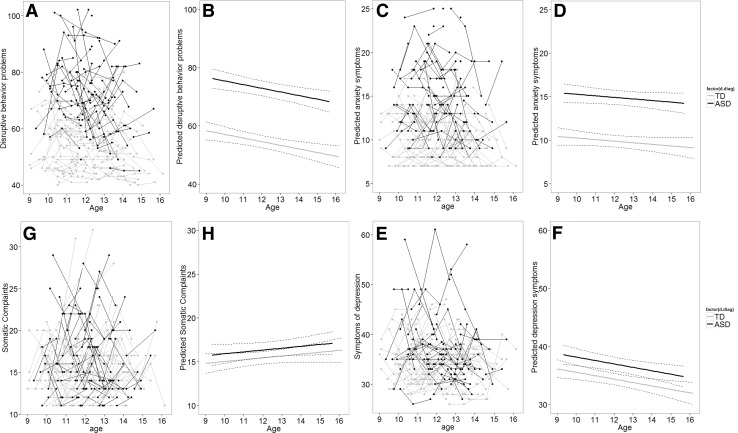
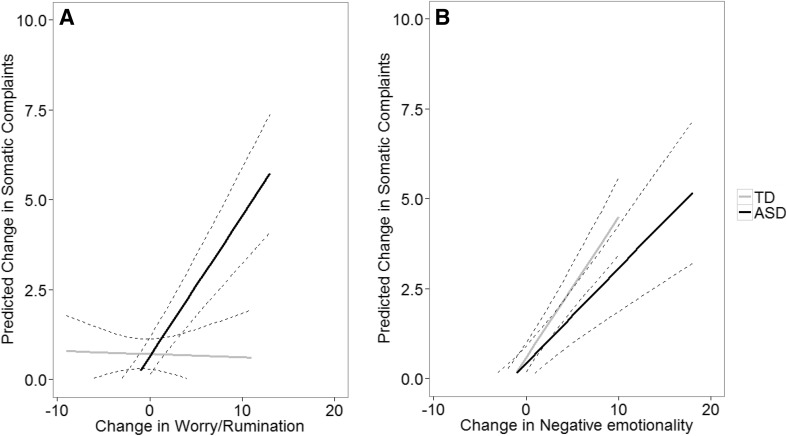
Children and adolescents with Autism Spectrum Disorder (ASD) often show comorbid emotional and behavior problems. The aim of this longitudinal study is to examine the relation between emotion control (i.e., negative emotionality, emotion awareness, and worry/rumination) and the development of internalizing and externalizing problems. Boys with and without ASD (N = 157; age 9-15) were followed over a period of 1.5 years (3 waves). We found that baseline levels of worry/rumination was a specific predictor of later externalizing problems for boys with ASD. Furthermore, the developmental trajectory of worry/rumination predicted the development of internalizing and externalizing problems in both groups. Our findings suggest that worry/rumination may constitute a transdiagnostic factor underlying both internalizing and externalizing problems in boys with and without ASD.
Keywords: Autism Spectrum Disorders (ASD); Comorbid psychopathology; Emotion regulation; Emotional control; Longitudinal study.
Conflict of interest statement
The authors declare that they have no conflict of interest.
Figures
References
-
- Akaike H. A new look at the statistical model identification. IEEE Transactions on Automatic Control. 1974;19:716–723. doi: 10.1109/TAC.1974.1100705. - DOI
-
- American Psychiatric Association . Diagnostic and statistical manual of mental disorders (DSM-IV) 4. Washington, DC: American Psychiatric Association; 1994.
-
- American Psychiatric Association . Diagnostic and statistical manual of mental disorders. 5. Washington, DC: American Psychiatric Association; 2013.
-
- Andersen PN, Skogli EW, Hovik KT, Egeland J, Øie M. Associations among symptoms of autism, symptoms of depression and executive functions in children with high-functioning autism: A 2 year follow-up study. Journal of Autism and Developmental Disorders. 2015;45:2497–2507. doi: 10.1007/s10803-015-2415-8. - DOI - PubMed
MeSH terms
LinkOut - more resources
Full Text Sources
Other Literature Sources
Medical
