


Exposure to childhood adversity and deficits in emotion recognition: results from a large, population-based sample
- PMID: 29512866
- PMCID: PMC6041167
- DOI: 10.1111/jcpp.12881
Exposure to childhood adversity and deficits in emotion recognition: results from a large, population-based sample
Abstract
Background: Emotion recognition skills are essential for social communication. Deficits in these skills have been implicated in mental disorders. Prior studies of clinical and high-risk samples have consistently shown that children exposed to adversity are more likely than their unexposed peers to have emotion recognition skills deficits. However, only one population-based study has examined this association.
Methods: We analyzed data from children participating in the Avon Longitudinal Study of Parents and Children, a prospective birth cohort (n = 6,506). We examined the association between eight adversities, assessed repeatedly from birth to age 8 (caregiver physical or emotional abuse; sexual or physical abuse; maternal psychopathology; one adult in the household; family instability; financial stress; parent legal problems; neighborhood disadvantage) and the ability to recognize facial displays of emotion measured using the faces subtest of the Diagnostic Assessment of Non-Verbal Accuracy (DANVA) at age 8.5 years. In addition to examining the role of exposure (vs. nonexposure) to each type of adversity, we also evaluated the role of the timing, duration, and recency of each adversity using a Least Angle Regression variable selection procedure.
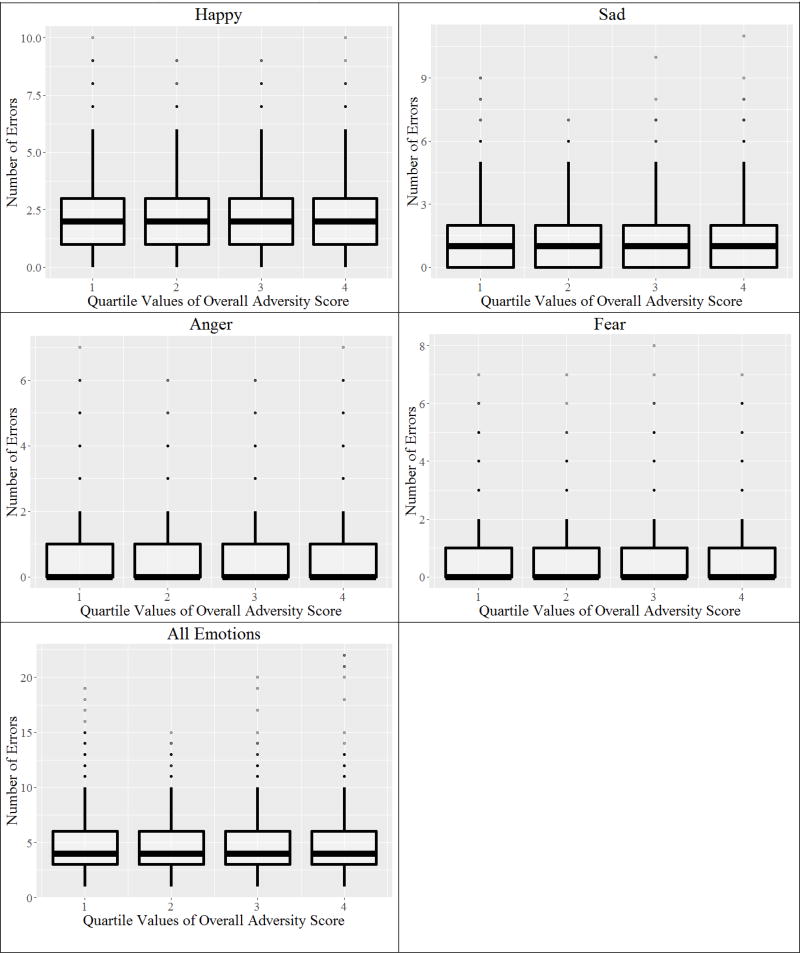
Results: Over three-quarters of the sample experienced at least one adversity. We found no evidence to support an association between emotion recognition deficits and previous exposure to adversity, either in terms of total lifetime exposure, timing, duration, or recency, or when stratifying by sex.
Conclusions: Results from the largest population-based sample suggest that even extreme forms of adversity are unrelated to emotion recognition deficits as measured by the DANVA, suggesting the possible immutability of emotion recognition in the general population. These findings emphasize the importance of population-based studies to generate generalizable results.
Keywords: ALSPAC; Sensitive periods; adversity; children; emotion recognition.
© 2018 Association for Child and Adolescent Mental Health.
Conflict of interest statement
The authors have declared that they have no competing or potential conflicts of interest.
Figures
References
-
- Ben-Shlomo Y, Kuh D. A life course approach to chroic disease epidemiology: conceptual models, empirical challenges, and interdisciplinary perspectives. International Journal of Epidemiology. 2002;31:285–293. - PubMed
-
- Bouhuys AL, Geerts E, Gordijn MC. Depressed patients' perceptions of facial emotions in depressed and remitted states are associated with relapse: a longitudinal study. J Nerv Ment Dis. 1999;187:595–602. - PubMed
Publication types
MeSH terms
Grants and funding
LinkOut - more resources
Full Text Sources
Other Literature Sources
Medical
