


Effects of leaf wetness duration and temperature on infection of Prunus by Xanthomonas arboricola pv. pruni
- PMID: 29513713
- PMCID: PMC5841804
- DOI: 10.1371/journal.pone.0193813
Effects of leaf wetness duration and temperature on infection of Prunus by Xanthomonas arboricola pv. pruni
Abstract
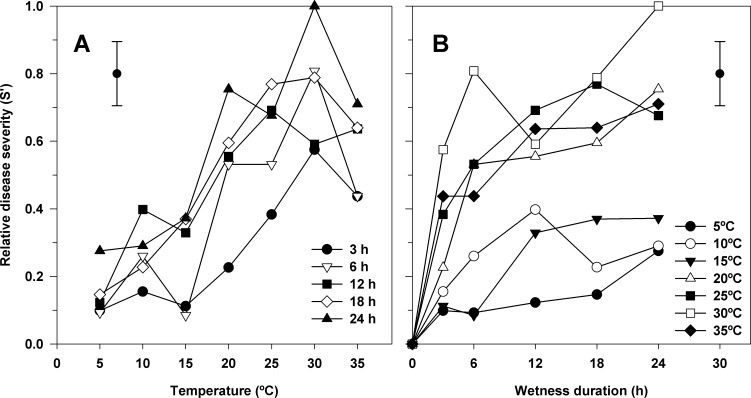
Xanthomonas arboricola pv. pruni is the causal agent of bacterial spot disease of stone fruits and almond. The bacterium is distributed throughout the major stone-fruit-producing areas of the World and is considered a quarantine organism in the European Union according to the Council Directive 2000/29/EC, and by the European and Mediterranean Plant Protection Organization. The effect of leaf wetness duration and temperature on infection of Prunus by X. arboricola pv. pruni was determined in controlled environment experiments. Potted plants of the peach-almond hybrid GF-677 were inoculated with bacterial suspensions and exposed to combinations of six leaf wetness durations (from 0 to 24 h) and seven fixed temperatures (from 5 to 35°C) during the infection period. Then, plants were transferred to a biosafety greenhouse, removed from bags, and incubated at optimal conditions for disease development. Although leaf wetness was required for infection of Prunus by X. arboricola pv. pruni, temperature had a greater effect than leaf wetness duration on disease severity. The combined effect of wetness duration and temperature on disease severity was quantified using a modification of the Weibull equation proposed by Duthie. The reduced-form of Duthie's model obtained by nonlinear regression analysis fitted well to data (R = 0.87 and R2adj = 0.85), and all parameters were significantly different from 0. The estimated optimal temperature for infection by X. arboricola pv. pruni was 28.9°C. Wetness periods longer than 10 h at temperatures close to 20°C, or 5 h at temperatures between 25 and 35°C were necessary to cause high disease severity. The predictive capacity of the model was evaluated using an additional set of data obtained from new wetness duration-temperature combinations. In 92% of the events the observed severity agreed with the predicted level of infection risk. The risk chart derived from the reduced form of Duthie's model can be used to estimate the potential risk for infection of Prunus by X. arboricola pv. pruni based on observed or forecasted temperature and wetness duration.
Conflict of interest statement
Figures


References
-
- EPPO/CABI. Xanthomonas arboricola pv. pruni In: Smith IM, McNamara DG, Scott PR, Holderness M editors. Quarantine Pests for Europe. 2nd ed CAB International, Wallingford, UK; 1997. pp. 1096–1100.
-
- Palacio-Bielsa A, Roselló M, Cambra MA, López MM. First report on almond in Europe of bacterial spot disease of stone fruits caused by Xanthomonas arboricola pv. pruni. Plant Dis. 2010; 94:786. - PubMed
-
- Lamichhane JR. Xanthomonas arboricola diseases of stone fruit, almond, and walnut trees: progress toward understanding and management. Plant Dis. 2014; 98:1600–1610. - PubMed
-
- Smith EF. Observation on a hitherto unreported bacterial disease, the cause of which enters the plant through ordinary stomata. Science. 1903; 17:456–457.
-
- EPPO. Xanthomonas arboricola pv. pruni (XANTPR). EPPO Global Database. 2017. Available from: https://gd.eppo.int
Publication types
MeSH terms
Substances
LinkOut - more resources
Full Text Sources
Other Literature Sources
