


Quantitative MRI comparison of multifidus muscle degeneration in thoracolumbar fractures treated with open and minimally invasive approach
- PMID: 29514622
- PMCID: PMC5842610
- DOI: 10.1186/s12891-018-2001-2
Quantitative MRI comparison of multifidus muscle degeneration in thoracolumbar fractures treated with open and minimally invasive approach
Abstract
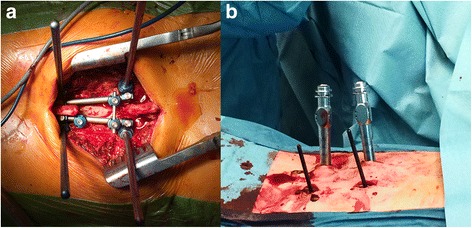
Background: Minimally invasive pedicle screw fixation has less approach-related morbidity than open screw placement and is allegedly less traumatizing on paravertebral muscles, as there is no requirement to mobilize and retract the adjacent muscle portion. The approach-related long-term effects to the morphology of the paravertebral muscles are unknown. The purpose of this study was to compare the long-term amount of fatty degeneration of the multifidus muscle in patients treated with a classical open or a minimally invasive approach.
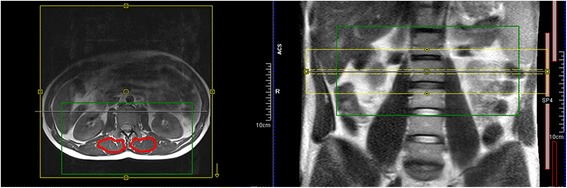
Methods: Fourteen Patients meeting inclusion criteria were selected. In all patients a singular fracture of the thoracolumbar spine with a two-level posterior instrumentation was treated, either using an open approach or a minimally invasive approach. All patients underwent quantitative MRI spectroscopy for quantification of the fatty degeneration in the multifidus muscle as a long-term proof for muscle loss after minimum 4-year follow-up. Clinical outcome was assessed using Oswestry Low Back Pain Disability Questionnaire, SF-36 and VA-scale for pain.
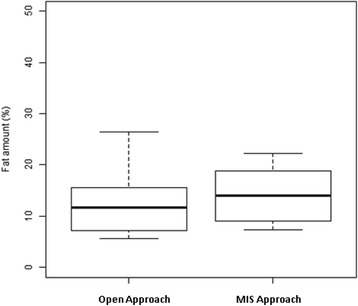
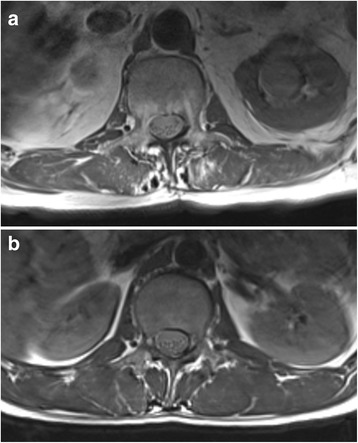
Results: The minimally invasive approach group failed to show less muscle degeneration in comparison to the open group. Total amount of fatty degeneration was 14.22% in the MIS group and 12.60% in the open group (p = 0.64). In accordance to MRI quantitative results there was no difference in the clinical outcome after a mean follow up of 5.9 years (±1.8).
Conclusion: As short-term advantages of minimal invasive screw placement have been widely demonstrated, no advantage of the MIS, displaying a significant difference in the amount of fatty degeneration and resulting in a better clinical outcome could be found. Besides the well-known short-term advantage of minimally invasive pedicle screw placement, a long-term advantage, such as less muscle degeneration and thus superior clinical results, compared to the open approach could not be shown.
Keywords: Dorsal instrumentation; Minimal invasive surgery; Muscle degeneration; Spine trauma.
Conflict of interest statement
Ethics approval and consent to participate
We declare that the study has been performed in accordance with the Declaration of Helsinki and has been approved by the ethical Committee of the University of Würzburg (Ethical Committee Approval: Nr: 55/15 Date 1st Februar 2015).
Written informed consent to participate in the study was obtained from each participant.
Consent for publication
Not applicable
Competing interests
The authors declare that they have no competing interests.
Publisher’s Note
Springer Nature remains neutral with regard to jurisdictional claims in published maps and institutional affiliations.
Figures
References
-
- Crawford RJ, Elliott JM, Volken T. Change in fatty infiltration of lumbar multifidus, erector spinae, and psoas muscles in asymptomatic adults of Asian or Caucasian ethnicities. Eur Spine J. 2017;1–9. Available from: https://link.springer.com/article/10.1007%2Fs00586-017-5212-6. [cited 2017 Nov 6]. - PubMed
-
- Fan S, Hu Z, Zhao F, Zhao X, Huang Y, Fang X. Multifidus muscle changes and clinical effects of one-level posterior lumbar interbody fusion: minimally invasive procedure versus conventional open approach. Eur Spine J. 2010;19(2):316–24. Available from: https://link.springer.com/article/10.1007%2Fs00586-009-1191-6. [cited 2015 Jan 16]. - PMC - PubMed
-
- Fischer MA, Nanz D, Shimakawa A, Schirmer T, Guggenberger R, Chhabra A, et al. Quantification of muscle fat in patients with low back pain: comparison of multi-Echo MR imaging with single-voxel MR spectroscopy. Radiology. 2013;266:555–63. Available from: http://pubs.rsna.org/doi/10.1148/radiol.12120399?url_ver=Z39.88-2003&rfr.... - DOI - PubMed
-
- Gilbert F, Böhm D, Eden L, Schmalzl J, Meffert RH, Köstler H, et al. Comparing the MRI-based Goutallier classification to an experimental quantitative MR spectroscopic fat measurement of the supraspinatus muscle. BMC Musculoskelet Disord. 2016:1–7. Available from: 10.1186/s12891-016-1216-3doi:10.1186/s12891-016-1216-3 - PMC - PubMed
Publication types
MeSH terms
LinkOut - more resources
Full Text Sources
Other Literature Sources
Medical
Research Materials
