


Prevalence of bovine tuberculosis in cattle, goats, and camels of traditional livestock raising communities in Eritrea
- PMID: 29514650
- PMCID: PMC5842630
- DOI: 10.1186/s12917-018-1397-0
Prevalence of bovine tuberculosis in cattle, goats, and camels of traditional livestock raising communities in Eritrea
Abstract
Background: The aim of the current study was to assess the prevalence of bovine tuberculosis (BTB) in cattle, goats, and camels, and its zoonotic potential within the traditional livestock raising communities in four regions of Eritrea. The Single Intradermal Comparative Tuberculin Test (SICTT) as indicator of M. bovis infection was conducted on 1077 cattle, 876 goats, and 195 camels. To elucidate possible risk factors for BTB transmission between animals and its potential zoonotic implication, questionnaire based face-to-face interviews were conducted in households of which 232 raised cattle, 128 goats, and 29 camels.
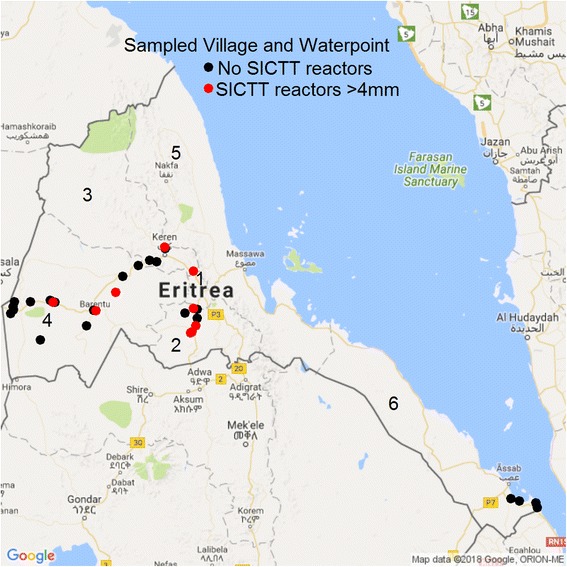
Results: The results of the SCITT were interpreted using the OIE standard (> 4 mm cut-off) for positive responses. In cattle, individual animal (n = 1077) and herd (n = 413) prevalences were 1.2% (n = 13) [Confidence Interval (CI) 95% CI, 1.0-1.3%] and 3.2% (n = 13) (95% CI, 3.0-3.4%), respectively. In goats (n = 876), none of the animals was positive. In camels, individual animal (n = 195) and herd (n = 70), BTB prevalences were 1.5% (n = 3) (95% CI,1.4-1.6%) and 2.9(n = 2) (95% CI, 0.9-4.6%), respectively. Overall, male animals were more at risk (OR = 2.6; 95% CI:1.0-8.7) when compared to females. Sharing of water points, introduction of new animals into herds and migration of animals over large distances were common events that may contribute to intra and inter-species transmission of BTB. Consumption of raw milk, lack of BTB transmission awareness, and low levels of education were common in the farming communities.
Conclusion: The current study highlighted a low prevalence of M. bovis in cattle, goats and camels in extensive traditional livestock in Eritrea. Despite this, the spatial distribution of affected animals across most of the sampled regions and consumption of unpasteurized milk warrants surveillance, cautious and timely control measures for the disease.
Keywords: Bovine tuberculosis; Camels; Eritrea; Goats; Mixed crop-livestock system; Pastoral system; Single intradermal comparative tuberculin test (SICTT).
Conflict of interest statement
Ethics approval and consent to participate
Participation in the study by the farmers was on a voluntary basis and those farmers who volunteered to participate have given their oral consent to include their animals in the study.
Bovine tuberculosis is one of the priority diseases for control and eradication by the government of Eritrea. Skin testing is an official method for diagnosis of BTB in the country. The skin testing in the current study was conducted with the involvement of the Ministry of Agriculture, animal health unit staff, and all the datasets included in this study were issued from animals analyzed within an official context. No deliberate killing of animals was performed for this study. For the human component, this study was submitted to and got approval by the ‘Health Research proposal review and Ethical committee’, unit of planning policy and HRD, Ministry of Health, Asmara, Eritrea, on 16/05/2013.
Consent for publication
Not applicable. Information that may compromise the farmers’ identities are de-identified in all the files.
Competing interests
The authors declare that they have no competing interests.
Publisher’s Note
Springer Nature remains neutral with regard to jurisdictional claims in published maps and institutional affiliations.
Figures
References
-
- Manal MY, Gobran RA. Some studies on tuberculosis in camel, Egypt. J Comp Path Clinic Path. 2008;21(4):58–74.
MeSH terms
Grants and funding
LinkOut - more resources
Full Text Sources
Other Literature Sources
