


Antidepressant use and risk of adverse outcomes in people aged 20-64 years: cohort study using a primary care database
- PMID: 29514662
- PMCID: PMC5842559
- DOI: 10.1186/s12916-018-1022-x
Antidepressant use and risk of adverse outcomes in people aged 20-64 years: cohort study using a primary care database
Abstract
Background: Antidepressants are one of the most commonly prescribed medications in young and middle-aged adults, but there is relatively little information on their safety across a range of adverse outcomes in this age group. This study aimed to assess associations between antidepressant treatment and several adverse outcomes in people aged 20-64 years diagnosed with depression.
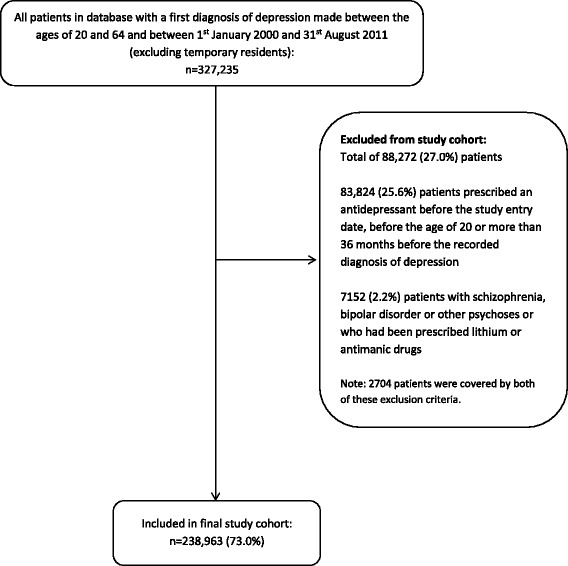
Methods: We conducted a cohort study in 238,963 patients aged 20-64 years registered with practices across the UK contributing to the QResearch primary care database. Only patients with a first diagnosis of depression were included. Outcomes were falls, fractures, upper gastrointestinal bleed, road traffic accidents, adverse drug reactions and all-cause mortality recorded during follow-up. Cox proportional hazards models were used to estimate hazard ratios associated with antidepressant exposure adjusting for potential confounding variables.
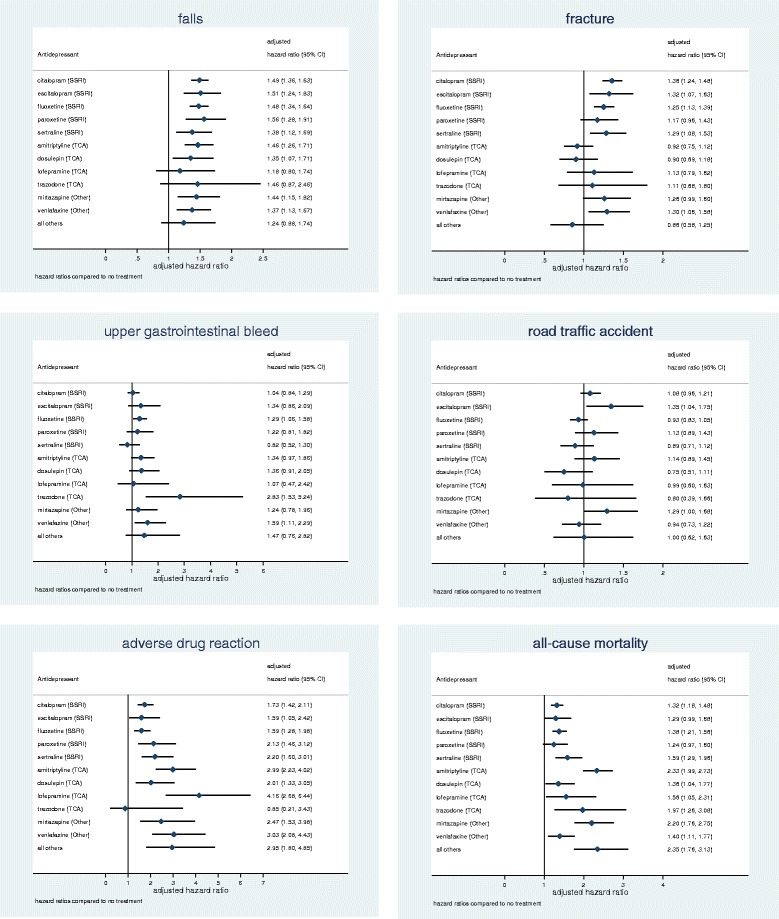
Results: During 5 years of follow-up, 4651 patients had experienced a fall, 4796 had fractures, 1066 had upper gastrointestinal bleeds, 3690 had road traffic accidents, 1058 had experienced adverse drug reactions, and 3181 patients died. Fracture rates were significantly increased for selective serotonin reuptake inhibitors (adjusted hazard ratio 1.30, 95% CI 1.21-1.39) and other antidepressants (1.28, 1.11-1.48) compared with periods when antidepressants were not used. All antidepressant drug classes were associated with significantly increased rates of falls. Rates of adverse drug reactions were significantly higher for tricyclic and related antidepressants (1.54, 1.25-1.88) and other antidepressants (1.61, 1.22-2.12) compared with selective serotonin reuptake inhibitors. Trazodone was associated with a significantly increased risk of upper gastrointestinal bleed. All-cause mortality rates were significantly higher for tricyclic and related antidepressants (1.39, 1.22-1.59) and other antidepressants (1.26, 1.08-1.47) than for selective serotonin reuptake inhibitors over 5 years but not 1 year, and were significantly reduced after 85 or more days of treatment with selective serotonin reuptake inhibitors. Mirtazapine was associated with significantly increased mortality rates over 1 and 5 years of follow-up.
Conclusions: Selective serotonin reuptake inhibitors had higher rates of fracture than tricyclic and related antidepressants but lower mortality and adverse drug reaction rates than the other antidepressant drug classes. The association between mirtazapine and increased mortality merits further investigation. These risks should be carefully considered and balanced against potential benefits for individual patients when the decision to prescribe an antidepressant is made.
Keywords: Adverse effects; Antidepressants; Depression; Falls; Fracture; Gastrointestinal bleed; Mortality.
Conflict of interest statement
Ethics approval and consent to participate
The project was independently peer reviewed and accepted by the QResearch Scientific board and approved in accordance with the agreed procedure with the Trent Research Ethics Committee (reference number: MREC/03/4/021).
Consent for publication
Not applicable.
Competing interests
The authors of this manuscript have the following competing interests: financial support from the National Institute for Health Research (NIHR) for the submitted work; JHC is director of QResearch, which is a not-for-profit venture between the University of Nottingham and EMIS (commercial supplier of GP clinical systems). RM’s contribution to the study has been funded through the NIHR Collaboration for Leadership in Applied Health Research and Care East Midlands (CLAHRC EM).
Publisher’s Note
Springer Nature remains neutral with regard to jurisdictional claims in published maps and institutional affiliations.
Figures
References
-
- Vos T, Barber RM, Bell B, Bertozzi-Villa A, Biryukov S, et al. Global, regional, and national incidence, prevalence, and years lived with disability for 301 acute and chronic diseases and injuries in 188 countries, 1990–2013: a systematic analysis for the Global Burden of Disease Study. Lancet. 2013;386:743–800. doi: 10.1016/S0140-6736(15)60692-4. - DOI - PMC - PubMed
-
- Pratt L, Brody D, Gu Q. Antidepressant use in persons aged 12 and over: United States, 2005–2008. NCHS Data Brief. 2011;76:1–8. - PubMed
Publication types
MeSH terms
Substances
Grants and funding
LinkOut - more resources
Full Text Sources
Other Literature Sources
Medical
