


Maternal and offspring intelligence in relation to BMI across childhood and adolescence
- PMID: 29515207
- PMCID: PMC6002784
- DOI: 10.1038/s41366-018-0009-1
Maternal and offspring intelligence in relation to BMI across childhood and adolescence
Abstract
Objective: The present study tested the association between both mothers' and offspring's intelligence and offspring's body mass index (BMI) in youth.
Method: Participants were members of the National Longitudinal Survey of Youth 1979 (NLSY-79) Children and Young Adults cohort (n = 11,512) and their biological mothers who were members of the NLSY-79 (n = 4932). Offspring's IQ was measured with the Peabody Individual Achievement Test (PIAT). Mothers' IQ was measured with the Armed Forces Qualification Test (AFQT). A series of regression analyses tested the association between IQ and offspring's BMI by age group, while adjusting for pre-pregnancy BMI and family SES. The analyses were stratified by sex and ethnicity (non-Black and non-Hispanic, Black, and Hispanic).
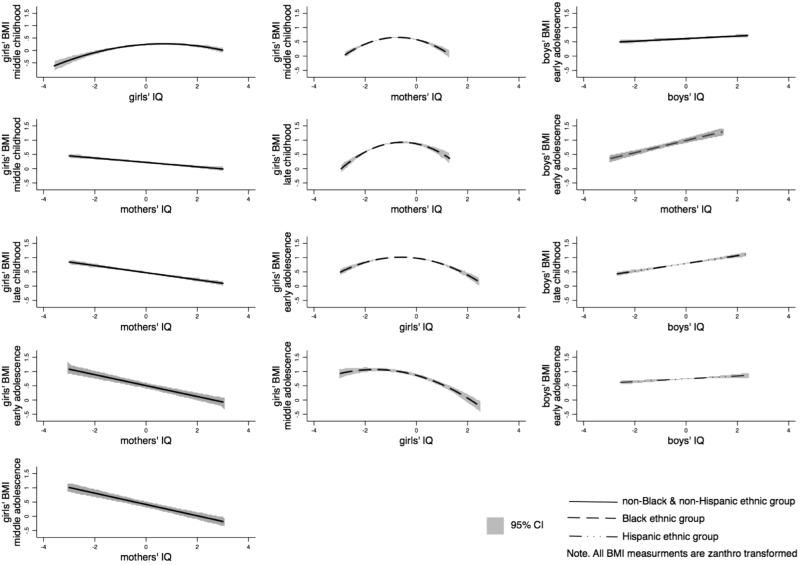
Results: The following associations were observed in the fully adjusted analyses. For the non-Blacks and non-Hispanics, a SD increment in mothers' IQ was negatively associated with daughters' BMI across all age-groups, ranging from β = -0.12 (95% CI -0.22 to -0.02, p = 0.021) in late childhood, to β = -0.17 (95% C.I. -0.27 to -0.07, p = 0001), in early adolescence and a SD increment in boys' IQ was positively associated with their BMI in early adolescence β = 0.09 (95% CI 0.01-0.18, p = 0.031). For Blacks, there was a non-linear relationship between mothers' IQ and daughters' BMI across childhood and between girls' IQ and BMI across adolescence. There was a positive association between mothers' IQ and sons' BMI in early adolescence (β = 0.17, 95% CI 0.02-0.32, p = 0.030). For Hispanic boys, there was a positive IQ-BMI association in late childhood (β = 0.19, 95% CI 0.05-0.33, p = 0.008) and early adolescence (β = 0.17, 95% CI 0.04-0.31, p = 0.014).
Conclusion: Mothers' IQ and offspring's IQ were associated with offspring's BMI. The relationships varied in direction and strength across ethnicity, age group and sex. Obesity interventions may benefit from acknowledging the heterogeneous influence that intelligence has on childhood BMI.
Conflict of interest statement
The authors declare that they have no conflict of interest.
Figures
References
-
- National Center for Health Statistics, United States, 2011: With special features on socioeconomic status and health. Vol. 2003. (Hyattsville, MD, 2012). - PubMed
-
- Li Y, Dai Q, Jackson JC, Zhang J. Overweight is associated with decreased cognitive functioning among school-age children and adolescents. Behav Psychol. 2008;16:1809–1815. - PubMed
Publication types
MeSH terms
Grants and funding
- MC_UU_12017/13/MRC_/Medical Research Council/United Kingdom
- MC_U147585827/MRC_/Medical Research Council/United Kingdom
- MC_UU_12011/2/MRC_/Medical Research Council/United Kingdom
- BB_/Biotechnology and Biological Sciences Research Council/United Kingdom
- MC_U147585819/MRC_/Medical Research Council/United Kingdom
- MC_UP_A620_1014/MRC_/Medical Research Council/United Kingdom
- MC_UU_12011/1/MRC_/Medical Research Council/United Kingdom
- G0400491/MRC_/Medical Research Council/United Kingdom
- MC_U147585824/MRC_/Medical Research Council/United Kingdom
- MR/K026992/1/MRC_/Medical Research Council/United Kingdom
- SPHSU13/CSO_/Chief Scientist Office/United Kingdom
LinkOut - more resources
Full Text Sources
Other Literature Sources
