Multivariate Associations Among Behavioral, Clinical, and Multimodal Imaging Phenotypes in Patients With Psychosis
- PMID: 29516092
- PMCID: PMC5875357
- DOI: 10.1001/jamapsychiatry.2017.4741
Multivariate Associations Among Behavioral, Clinical, and Multimodal Imaging Phenotypes in Patients With Psychosis
Abstract
Importance: Alterations in multiple neuroimaging phenotypes have been reported in psychotic disorders. However, neuroimaging measures can be influenced by factors that are not directly related to psychosis and may confound the interpretation of case-control differences. Therefore, a detailed characterization of the contribution of these factors to neuroimaging phenotypes in psychosis is warranted.
Objective: To quantify the association between neuroimaging measures and behavioral, health, and demographic variables in psychosis using an integrated multivariate approach.
Design, setting, and participants: This imaging study was conducted at a university research hospital from June 26, 2014, to March 9, 2017. High-resolution multimodal magnetic resonance imaging data were obtained from 100 patients with schizophrenia, 40 patients with bipolar disorder, and 50 healthy volunteers; computed were cortical thickness, subcortical volumes, white matter fractional anisotropy, task-related brain activation (during working memory and emotional recognition), and resting-state functional connectivity. Ascertained in all participants were nonimaging measures pertaining to clinical features, cognition, substance use, psychological trauma, physical activity, and body mass index. The association between imaging and nonimaging measures was modeled using sparse canonical correlation analysis with robust reliability testing.
Main outcomes and measures: Multivariate patterns of the association between nonimaging and neuroimaging measures in patients with psychosis and healthy volunteers.
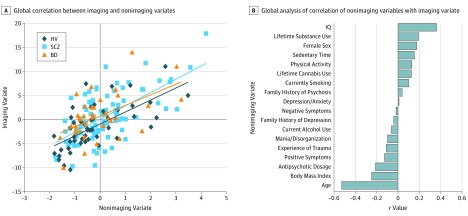
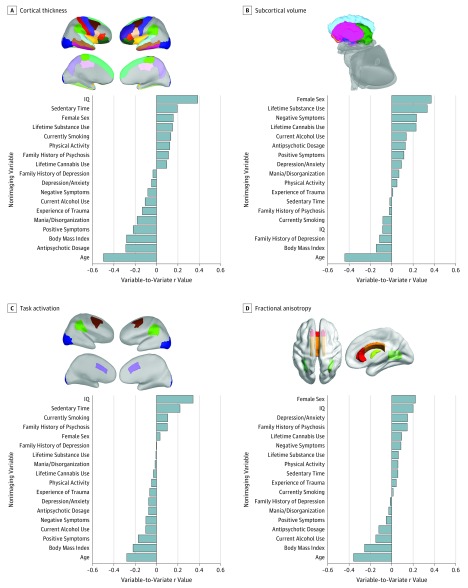
Results: The analyses were performed in 92 patients with schizophrenia (23 female [25.0%]; mean [SD] age, 27.0 [7.6] years), 37 patients with bipolar disorder (12 female [32.4%]; mean [SD] age, 27.5 [8.1] years), and 48 healthy volunteers (20 female [41.7%]; mean [SD] age, 29.8 [8.5] years). The imaging and nonimaging data sets showed significant covariation (r = 0.63, P < .001), which was independent of diagnosis. Among the nonimaging variables examined, age (r = -0.53), IQ (r = 0.36), and body mass index (r = -0.25) were associated with multiple imaging phenotypes; cannabis use (r = 0.23) and other substance use (r = 0.33) were associated with subcortical volumes, and alcohol use was associated with white matter integrity (r = -0.15). Within the multivariate models, positive symptoms retained associations with the global neuroimaging (r = -0.13), the cortical thickness (r = -0.22), and the task-related activation variates (r = -0.18); negative symptoms were mostly associated with measures of subcortical volume (r = 0.23), and depression/anxiety was associated with measures of white matter integrity (r = 0.12).
Conclusions and relevance: Multivariate analyses provide a more accurate characterization of the association between brain alterations and psychosis because they enable the modeling of other key factors that influence neuroimaging phenotypes.
Conflict of interest statement
Figures
References
-
- Peralta V, Moreno-Izco L, Calvo-Barrena L, Cuesta MJ. The low- and higher-order factor structure of symptoms in patients with a first episode of psychosis. Schizophr Res. 2013;147(1):116-124. - PubMed
Publication types
MeSH terms
Grants and funding
LinkOut - more resources
Full Text Sources
Other Literature Sources
Medical