


Interventions for autumn exacerbations of asthma in children
- PMID: 29518252
- PMCID: PMC6494188
- DOI: 10.1002/14651858.CD012393.pub2
Interventions for autumn exacerbations of asthma in children
Abstract
Background: Asthma exacerbations in school-aged children peak in autumn, shortly after children return to school following the summer holiday. This might reflect a combination of risk factors, including poor treatment adherence, increased allergen and viral exposure, and altered immune tolerance. Since this peak is predictable, interventions targeting modifiable risk factors might reduce exacerbation-associated morbidity and strain upon health resources. The peak occurs in September in the Northern Hemisphere and in February in the Southern Hemisphere.
Objectives: To assess the effects of pharmacotherapy and behavioural interventions enacted in anticipation of school return during autumn that are designed to reduce asthma exacerbations in children during this period.
Search methods: We searched the Cochrane Airways Group Trials Register, ClinicalTrials.gov, the World Health Organization International Clinical Trials Registry Platform, reference lists of primary studies and existing reviews, and manufacturers' trial registries (Merck, Novartis and Ono Parmaceuticals). We searched databases from their inception to 1 December 2017, and imposed no restriction on language of publication.
Selection criteria: We included all randomised controlled trials comparing interventions aimed specifically at reducing autumn exacerbations with usual care, (no systematic change in management in preparation for school return). We included studies providing data on children aged 18 years or younger.
Data collection and analysis: We used standard methodological procedures expected by Cochrane. Two review authors independently screened records identified by the search and then extracted data and assessed bias for trials meeting the inclusion criteria. A third review author checked for accuracy and mediated consensus on disagreements. The primary outcome was proportion of children experiencing one or more asthma exacerbations requiring hospitalisation or oral corticosteroids during the autumn period.
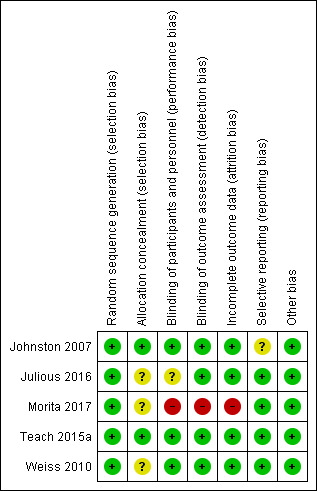
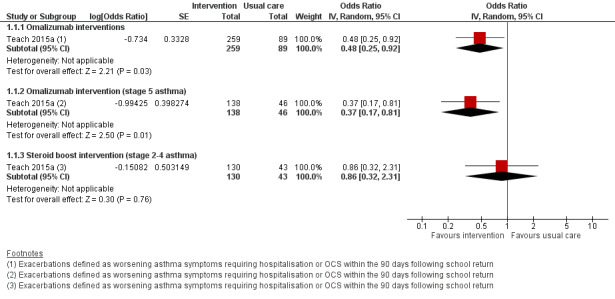
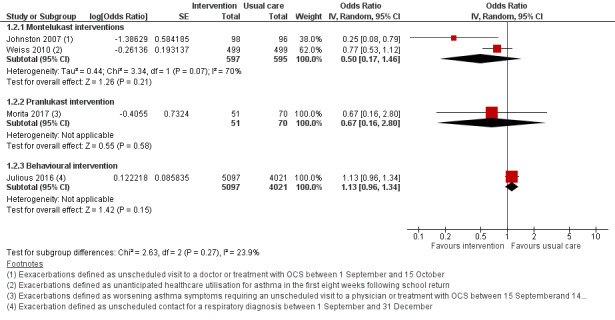
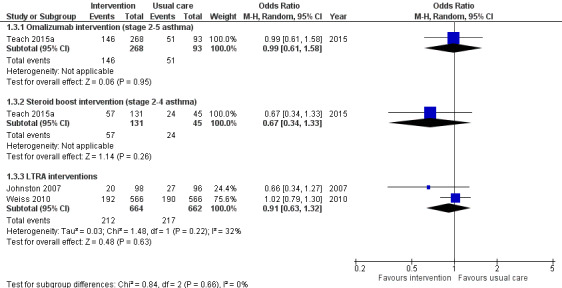
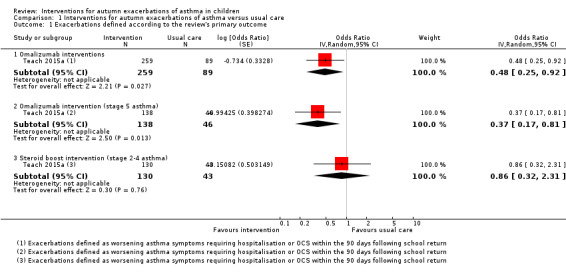
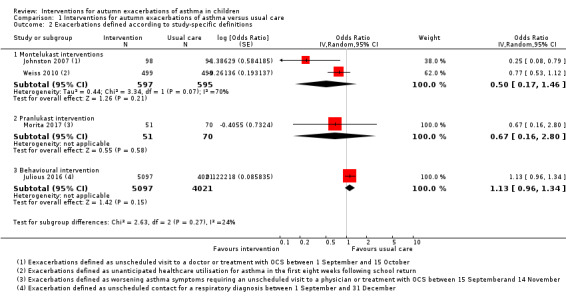
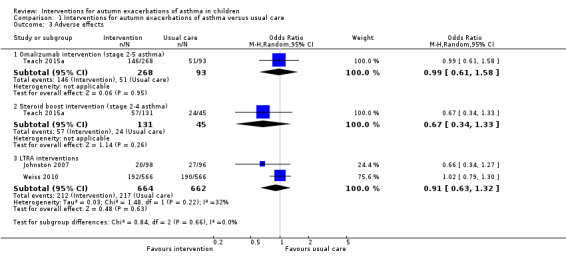
Main results: Our searches returned 546 trials, of which five met our inclusion criteria. These studies randomised 14,252 children to receive either an intervention or usual care. All studies were conducted in the Northern Hemisphere. Three interventions used a leukotriene receptor antagonist, one used omalizumab or a boost of inhaled corticosteroids, and the largest study, (12,179 children), used a medication reminder letter. Whilst the risk of bias within individual studies was generally low, we downgraded the evidence quality due to imprecision associated with low participant numbers, poor consistency between studies, and indirect outcome ascertainment.A US study of 513 children with mild/severe asthma and allergic sensitisation was the only study to provide data for our primary outcome. In this study, the proportion of participants experiencing an exacerbation requiring oral corticosteroids or hospital admission in the 90 days after school return was significantly reduced to 11.3% in those receiving omalizumab compared to 21.0% in those receiving placebo (odds ratio 0.48, 95% confidence interval 0.25 to 0.92, moderate-quality evidence). The remaining studies used alternative exacerbation definitions. When data from two leukotriene receptor antagonist studies with comparable outcomes were combined in a random-effects model, there was no evidence of an effect upon exacerbations. There was no evidence that a seasonal medication reminder letter decreased unscheduled contacts for a respiratory diagnosis between September and December.Four studies recorded adverse events. There was no evidence that the proportion of participants experiencing at least one adverse event differed between intervention and usual care groups. Lack of data prevented planned subgroup and sensitivity analyses.
Authors' conclusions: Seasonal omalizumab treatment from four to six weeks before school return might reduce autumn asthma exacerbations. We found no evidence that this strategy is associated with increased adverse effects other than injection site pain, but it is costly. There were no data upon which to judge the effect of this or other seasonal interventions on asthma control, quality of life, or asthma-related death. In future studies definitions of exacerbations should be provided, and standardised where possible. To investigate possible differential effects according to subgroup, participants in future trials should be well characterised with respect to baseline asthma severity and exacerbation history in addition to age and gender.
Conflict of interest statement
KCP: none known.
MA: none known.
DK: none known.
KMH: none known.
Figures

Update of
References
References to studies included in this review
Johnston 2007 {published data only}
-
- Johnston NW, Mandhane PJ, Dai J, Duncan JM, Greene JM, Lambert K, et al. Attenuation of the September epidemic of asthma exacerbations in children: a randomized, controlled trial of montelukast added to usual therapy. Pediatrics 2007;120(3):e702‐12. - PubMed
Julious 2016 {published data only}
-
- Julious SA, Horspool MJ, Davis S, Bradburn M, Norman P, Shephard N, et al. PLEASANT: Preventing and Lessening Exacerbations of Asthma in School‐age children Associated with a New Term ‐ a cluster randomised controlled trial and economic evaluation. Health Technology Assessment (Winchester, England) 2016;20(93):1‐154. - PMC - PubMed
Morita 2017 {published data only}
Teach 2015a {published data only}
Weiss 2010 {published data only}
-
- Weiss KB, Gern JE, Johnston NW, Sears MR, Jones CA, Jia G, et al. The Back to School asthma study: the effect of montelukast on asthma burden when initiated prophylactically at the start of the school year. Annals of Allergy, Asthma & Immunology: official publication of the American College of Allergy, Asthma & Immunology 2010;105(2):174‐81. - PubMed
References to studies excluded from this review
Anah 1980 {published data only}
-
- Anah CO, Jarike LN, Baig HA. High dose ascorbic acid in Nigerian asthmatics. Tropical and Geographical Medicine 1980;32(2):132‐7. - PubMed
Bruce 1977 {published data only}
-
- Bruce CA, Norman PS, Rosenthal RR, Lichtenstein LM. The role of ragweed pollen in autumnal asthma. Journal of Allergy and Clinical Immunology 1977;59(6):449‐59. - PubMed
Bueving 2004 {published data only}
-
- Bueving HJ, Wouden JC, Raat H, Bernsen RMD, Jongste JC, Suijlekom‐Smit LWA, et al. Influenza vaccination in asthmatic children: effects on quality of life and symptoms. European Respiratory Journal 2004;24(6):925‐31. - PubMed
Busse 2011 {published data only}
Coffman 1971 {published data only}
-
- Coffman DA. A controlled trial of disodium cromoglycate in seasonal allergic rhinitis. British Journal of Clinical Practice 1971;25(9):403‐6. - PubMed
Corren 1992 {published data only}
-
- Corren J, Adinoff AD, Buchmeier AD, Irvin CG. Nasal beclomethasone prevents the seasonal increase in bronchial responsiveness in patients with allergic rhinitis and asthma. Journal of Allergy and Clinical Immunology 1992;90(2):250‐6. - PubMed
Crane 1998 {published data only}
-
- Crane J, Ellis I, Siebers R, Grimmet D, Lewis S, Fitzharris P. A pilot study of the effect of mechanical ventilation and heat exchange on house‐dust mites and Der p 1 in New Zealand homes. Allergy 1998;53(8):755‐62. - PubMed
Engstrom 1970 {published data only}
-
- Engstrom I, Vejmolova J. The effect of disodium cromoglycate on allergen challenge in children with bronchial asthma. Acta Allergologica 1970;25(5):382‐91. - PubMed
Esquivel 2016 {published and unpublished data}
-
- Esquivel AT, Busse WW, Calatroni A, Gergen PJ, Grindle K, Gruchalla RS, et al. Omalizumab decreases rates of cold symptoms in inner‐city children with allergic asthma. Annual Meeting of the American Academy of Allergy, Asthma and Immunology (AAAAI); 2016 Mar 4‐7; Los Angeles. ., 2016.
Fang 2001 {published data only}
-
- Fang Z, Cai Y, Wang L. The efficacy of controlling of house dusts in attacks of mite sensitive asthmatics. Zhonghua jie he he hu xi za zhi [Chinese Journal of Tuberculosis and Respiratory Diseases] 2001;24(11):685‐9. - PubMed
Ford 1969a {published data only}
-
- Ford RM. Disodium cromoglycate in the treatment of seasonal and perennial asthma. Medical Journal of Australia 1969;2(11):537‐40. - PubMed
Ford 1969b {published data only}
-
- Ford RM. 'Intal' in the treatment of asthma. Medical Journal of Australia 1969;1(13):706. - PubMed
Gerald 2012 {published data only}
Grant 1995 {published data only}
-
- Grant JA, Nicodemus CF, Findlay SR, Glovsky MM, Grossman J, Kaiser H, et al. Cetirizine in patients with seasonal rhinitis and concomitant asthma: prospective, randomized, placebo‐controlled trial. Journal of Allergy and Clinical Immunology 1995;95(5 Pt 1):923‐32. - PubMed
Halterman 2002 {published data only}
-
- Halterman JS, McConnochie K, Yoos L, Conn KM, Kaczorowski J, Holzhauer R, et al. Year 1 results from a school‐based randomized trial for urban children with asthma. Pediatric Research 2002;51(4):1027.
Halterman 2004 {published data only}
-
- Halterman JS, Szilagyi PG, Yoos HL, Conn KM, Kaczorowski JM, Holzhauer RJ, et al. Benefits of a school‐based asthma treatment program in the absence of secondhand smoke exposure: results of a randomized clinical trial. Archives of Pediatrics and Adolescent Medicine 2004;158(5):460‐7. - PubMed
Halterman 2005 {published and unpublished data}
-
- Halterman JS, McConnochie KM, Conn KM, Yoos HL, Callahan PM, Neely TL, et al. A randomized trial of primary care provider prompting to enhance preventive asthma therapy. Archives of Pediatrics and Adolescent Medicine 2005;159(5):422‐7. - PubMed
Joseph 2005 {published data only}
-
- Joseph CLM, Havstad S, Anderson EW, Brown R, Johnson CC, Clark NM. Effect of asthma intervention on children with undiagnosed asthma. Journal of Pediatrics 2005;146(1):96‐104. - PubMed
Levy 2006 {published data only}
-
- Levy M, Heffner B, Stewart T, Beeman G. The efficacy of asthma case management in an urban school district in reducing school absences and hospitalizations for asthma. Journal of School Health 2006;76(6):320‐4. - PubMed
Lewis 2012 {published data only}
-
- Lewis E, Fernandez C, Nella A, Hopp R, Gallagher JC, Casale TB. Relationship of 25‐hydroxyvitamin D and asthma control in children. Annals of Allergy, Asthma & Immunology 2012;108(4):281‐2. - PubMed
Prazma 2015 {published data only}
-
- Prazma CM, Gern JE, Weinstein SF, Prillaman BA, Stempel DA. The association between seasonal asthma exacerbations and viral respiratory infections in a pediatric population receiving inhaled corticosteroid therapy with or without long‐acting beta‐adrenoceptor agonist: a randomized study. Respiratory Medicine 2015;109(10):1280‐6. - PMC - PubMed
Yoshihara 2014 {published data only}
-
- Yoshihara S, Yamada Y, Fukuda H, Tsuchiya T, Ono M, Fukuda N, et al. Prophylactic effectiveness of suplatast tosilate in children with asthma symptoms in the autumn: a pilot study. Allergology International 2014;63(2):199‐203. - PubMed
Additional references
Asher 2006
-
- Asher MI, Montefort S, Bjorksten B, Lai CKW, Strachan DP, Weiland SK, et al. Worldwide time trends in the prevalence of symptoms of asthma, allergic rhinoconjunctivitis, and eczema in childhood: ISAAC Phases One and Three repeat multicountry cross‐sectional surveys. Lancet 2006;368(9537):733‐43. - PubMed
Asher 2014
-
- Asher I, Pearce N. Global burden of asthma among children. International Journal of Tuberculosis and Lung Disease 2014;18(11):1269‐78. - PubMed
Asthma UK 2016
-
- Asthma UK. Asthma facts and statistics. www.asthma.org.uk/about/media/facts‐and‐statistics/ (accessed 1 September 2016).
Bahadori 2009
Baraldo 2012
-
- Baraldo S, Contoli M, Bazzan E, Turato G, Padovani A, Marku B, et al. Deficient antiviral immune responses in childhood: distinct roles of atopy and asthma. Journal of Allergy and Clinical Immunology 2012;130(6):1307‐14. - PubMed
Beck 2004
-
- Beck LA, Marcotte GV, MacGlashan D, Togias Al, Saini S. Omalizumab‐induced reductions in mast cell Fce psilon RI expression and function. Journal of Allergy and Clinical Immunology 2004;114(3):527‐30. - PubMed
Bhogal 2006
Borrelli 2007
-
- Borrelli B, Riekert K, Weinstein A, Rathier L. Brief motivational interviewing as a clinical strategy to promote asthma medication adherence. Journal of Allergy and Clinical Immunology 2007;120(5):1023‐30. - PubMed
Brandt 2015
BTS 2016
-
- British Thoracic Society/Scottish Intercollegiate Guidelines Network. British Guideline on the Management of Asthma 2016. A national clinical guideline. brit‐thoracic.org.uk/document‐library/clinical‐information/asthma/btssign‐ast... (accessed prior to 9 October 2017).
Cai 2011
-
- Cai G‐H, Hashim JH, Hashim Z, Ali F, Bloom E, Larsson L, et al. Fungal DNA, allergens, mycotoxins and associations with asthmatic symptoms among pupils in schools from Johor Bahru, Malaysia. Pediatric Allergy and Immunology 2011;22(3):290‐7. - PubMed
Corne 2002
-
- Corne JM, Marshall C, Smith S, Schreiber J, Sanderson G, Holgate ST, et al. Frequency, severity, and duration of rhinovirus infections in asthmatic and non‐asthmatic individuals: a longitudinal cohort study. Lancet 2002;359(9309):831‐4. [PUBMED: 11897281] - PubMed
de Ana 2006
-
- Ana SG, Torres‐Rodriguez JM, Ramirez EA, Garcia SM, Belmonte‐Soler J. Seasonal distribution of Alternaria, Aspergillus, Cladosporium and Penicillium species isolated in homes of fungal allergic patients. Journal of Investigational Allergology and Clinical Immunology 2006;16(6):357‐63. [PUBMED: 17153883] - PubMed
Durrani 2012
EPPI‐Reviewer 4 2010 [Computer program]
-
- Thomas J, Brunton J, Graziosi S. EPPI‐Reviewer 4: software for research synthesis. Version accessed prior to 9 October 2017. London, UK: Social Science Research Unit, UCL Institute of Education, 2010.
Feldman 2012
-
- Feldman J, Kutner H, Matte L, Lupkin M, Steinberg D, Sidora‐Arcoleo K, et al. Prediction of peak flow values followed by feedback improves perception of lung function and adherence to inhaled corticosteroids in children with asthma. Thorax 2012;67(12):1040‐5. - PubMed
Fleming 2000
Gergen 2002
-
- Gergen PJ, Mitchell H, Lynn H. Understanding the seasonal pattern of childhood asthma: results from the National Cooperative Inner‐City Asthma Study (NCICAS). Journal of Pediatrics 2002;141(5):631‐6. [PUBMED: 12410190] - PubMed
Gill 2010
GINA 2017
-
- Global Initiative for Asthma. 2017 GINA Report, Global Strategy for Asthma Management and Prevention. ginasthma.org/2017‐gina‐report‐global‐strategy‐for‐asthma‐management‐and... (accessed prior to 9 October 2017).
GRADEpro GDT [Computer program]
-
- Brozek J, Oxman A, Schünemann H. GRADEpro GDT. Version accessed prior to 9 October 2017. Hamilton (ON): McMaster University (developed by Evidence Prime), 2015.
Guevara 2003
Higgins 2011
-
- Higgins JPT, Green S (editors). Cochrane Handbook for Systematic Reviews of Interventions Version 5.1.0 [updated March 2011]. The Cochrane Collaboration, 2011. Available from handbook.cochrane.org.
Hoskins 2000
Ismaila 2013
Ito 2015
-
- Ito K, Weinberger KR, Robinson GS, Sheffield PE, Lall R, Mathes R, et al. The associations between daily spring pollen counts, over‐the‐counter allergy medication sales, and asthma syndrome emergency department visits in New York City, 2002‐2012. Environmental Health: a Global Access Science Source 2015;14:71. - PMC - PubMed
Johnston 1996
-
- Johnston SL, Pattemore PK, Sanderson G, Smith S, Campbell MJ, Josephs LK, et al. The relationship between upper respiratory infections and hospital admissions for asthma: a time‐trend analysis. American Journal of Respiratory and Critical Care Medicine 1996;154(3 Pt 1):654‐60. [PUBMED: 8810601] - PubMed
Johnston 2001
-
- Johnston NW, Sears MR. A national evaluation of geographic and temporal patterns of hospitalization of children for asthma in Canada. American Journal of Respiratory and Critical Care Medicine 2001;163:A359.
Johnston 2005
Johnston 2006
Jonasson 2000
Kiotseridis 2013
-
- Kiotseridis H, Cilio CM, Bjermer L, Aurivillius M, Jacobsson H, Dahl A, et al. Quality of life in children and adolescents with respiratory allergy, assessed with a generic and disease‐specific instrument. Clinical Respiratory Journal 2013;7(2):168‐75. - PubMed
Krop 2014
Larsen 2016
-
- Larsen K, Zhu J, Feldman LY, Simatovic J, Dell S, Gershon AS, et al. The annual September peak in asthma exacerbation rates. Still a reality?. Annals of the American Thoracic Society 2016;13(2):231‐9. [PUBMED: 26636481] - PubMed
Lierl 2003
-
- Lierl MB, Hornung RW. Relationship of outdoor air quality to pediatric asthma exacerbations. Annals of Allergy, Asthma & Immunology 2003;90(1):28‐33. - PubMed
Lincoln 2006
-
- Lincoln D, Morgan G, Sheppeard V, Jalaludin B, Corbett S, Beard J. Childhood asthma and return to school in Sydney, Australia. Public Health 2006;120(9):854‐62. [PUBMED: 16904142] - PubMed
Lister 2001
-
- Lister S, Sheppeard V, Morgan G, Corbett S, Kaldor J, Henry R. February asthma outbreaks in NSW: a case control study. Australian and New Zealand Journal of Public Health 2001;25(6):514‐9. [PUBMED: 11824986] - PubMed
Mantel 1959
-
- Mantel N, Haenszel W. Statistical aspects of the analysis of data from retrospective studies of disease. Journal of the National Cancer Institute 1959;22(4):719‐48. - PubMed
Moher 2009
Murray 2006
NAEPP 2007
-
- National Asthma Education and Prevention Program. Expert Panel Report 3 (EPR‐3): Guidelines for the Diagnosis and Management of Asthma ‐ Summary Report 2007. Journal of Allergy and Clinical Immunology 2007;120(5 Suppl):S94‐138. - PubMed
Olenec 2010
Pruteanu 2014
-
- Pruteanu AI, Chauhan BF, Zhang L, Prietsch SOM, Ducharme FM. Inhaled corticosteroids in children with persistent asthma: dose‐response effects on growth. Evidence‐based Child Health: a Cochrane review journal 2014;9(4):931‐1046. - PubMed
Randolph 2013
-
- Randolph C. Pediatric exercise‐induced bronchoconstriction: contemporary developments in epidemiology, pathogenesis, presentation, diagnosis, and therapy. Current Allergy and Asthma Reports 2013;13(6):662‐71. - PubMed
RevMan 2014 [Computer program]
-
- Nordic Cochrane Centre, The Cochrane Collaboration. Review Manager 5 (RevMan 5). Version 5.3. Copenhagen: Nordic Cochrane Centre, The Cochrane Collaboration, 2014.
Schildcrout 2006
-
- Schildcrout JS, Sheppard L, Lumley T, Slaughter JC, Koenig JQ, Shapiro GG. Ambient air pollution and asthma exacerbations in children: an eight‐city analysis. American Journal of Epidemiology 2006;164(6):505‐17. - PubMed
Sears 2008
-
- Sears MR. Epidemiology of asthma exacerbations. Journal of Allergy and Clinical Immunology 2008;122(4):662‐8; quiz 669‐70. [PUBMED: 19014756] - PubMed
Szefler 2008
Teach 2015b
Teyhan 2015
Thumerelle 2003
-
- Thumerelle C, Deschildre A, Bouquillon C, Santos C, Sardet A, Scalbert M, et al. Role of viruses and atypical bacteria in exacerbations of asthma in hospitalized children: a prospective study in the Nord‐Pas de Calais region (France). Pediatric Pulmonology 2003;35(2):75‐82. [PUBMED: 12526066] - PMC - PubMed
Tovey 2011
-
- Tovey ER, Rawlinson WD. A modern miasma hypothesis and back‐to‐school asthma exacerbations. Medical Hypotheses 2011;76(1):113‐6. - PubMed
van Maanen 2013
-
- Maanen A, Wijga AH, Gehring U, Postma DS, Smit HA, Oort FJ, et al. Sleep in children with asthma: results of the PIAMA study. European Respiratory Journal 2013;41(4):832‐7. - PubMed
Vuillermin 2011
-
- Vuillermin PJ, Robertson CF, South M. The role of parent‐initiated oral corticosteroids in preschool wheeze and school‐aged asthma. Current Opinion in Allergy and Clinical Immunology 2011;11(3):187‐91. [PUBMED: 21464710] - PubMed
Wark 2005
WHO 2007
-
- Bousquet J, Khaltaev N (editors). World Health Organization: Global surveillance, prevention and control of chronic respiratory diseases: a comprehensive approach. who.int/gard/publications/GARD%20Book%202007.pdf?ua=1 (accessed prior to 2 March 2018).
Wong 2000
-
- Wong CA, Walsh LJ, Smith CJ, Wisniewski AF, Lewis SA, Hubbard R, et al. Inhaled corticosteroid use and bone‐mineral density in patients with asthma. Lancet 2000;355(9213):1399‐403. - PubMed
Publication types
MeSH terms
Substances
LinkOut - more resources
Full Text Sources
Other Literature Sources
Medical
Miscellaneous
