


Prostate cancer involving bilateral seminal vesicles along with bone and testicular metastases: a case report
- PMID: 29519246
- PMCID: PMC5844096
- DOI: 10.1186/s13256-017-1551-5
Prostate cancer involving bilateral seminal vesicles along with bone and testicular metastases: a case report
Abstract
Background: In the past 20 years, the incidence of prostate cancer has risen rapidly. It has been ranked as the third most common malignant tumor of the male genitourinary system. Testicular metastasis is uncommon in prostate cancer. Most cases are incidentally found in the treatment of prostate cancer with orchiectomy. Therefore, we believed it was necessary to report the case of our patient with this disease.
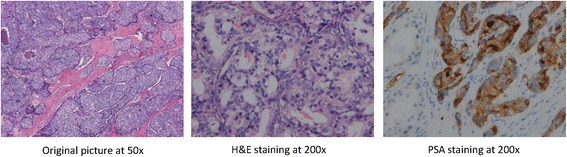
Case presentation: We present a case of a 69-year-old Han Chinese man with a high total prostate-specific antigen level. A transrectal ultrasound-guided prostate biopsy was performed. A pathology report showed prostate cancer tissue with a Gleason score of 4 + 4 = 8/10. Imaging findings suggested that the prostate cancer tissue involved bilateral seminal vesicles and multiple bones. Next, radioactive seed implantation was carried out, and endocrine therapy was continued after the operation. Then enlargement of the left scrotum was found along with a total prostate-specific antigen level of 19.21 ng/ml. Computed tomography of the middle abdomen and pelvic cavity revealed 2.0 × 1.3-cm lesions of the left testis. The patient underwent a left testicular high resection and right orchiectomy. The postoperative pathology report showed metastatic prostate cancer cells in the left testis.
Conclusions: Testicular metastasis of prostate cancer is rare. Therefore, a testicular physical examination is necessary for patients without relapse to avoid a missed diagnosis. Testicular metastasis should be treated according to the principle of treatment for advanced prostate adenocarcinoma if testicular metastasis of prostate adenocarcinoma is detected.
Keywords: Prostate cancer; Testicular metastases.
Conflict of interest statement
Ethics approval and consent to participate
This study was approved by the ethics committee of Nanjing Drum Tower Hospital.
Consent for publication
Written informed consent was obtained from the patient for publication of this case report and any accompanying images. A copy of the written consent is available for review by the Editor-in-Chief of this journal.
Competing interests
The authors declare that they have no competing interests.
Publisher’s Note
Springer Nature remains neutral with regard to jurisdictional claims in published maps and institutional affiliations.
Figures
References
Publication types
MeSH terms
Substances
LinkOut - more resources
Full Text Sources
Other Literature Sources
Medical
Miscellaneous
