Fibroblast Growth Factor 23 Associates with Death in Critically Ill Patients
- PMID: 29519954
- PMCID: PMC5969465
- DOI: 10.2215/CJN.10810917
Fibroblast Growth Factor 23 Associates with Death in Critically Ill Patients
Abstract
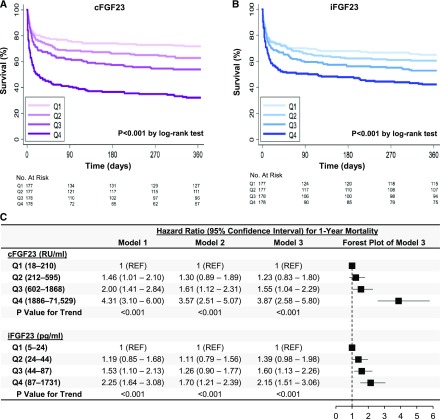
Background and objectives: Dysregulated mineral metabolism is a common and potentially maladaptive feature of critical illness, especially in patients with AKI, but its association with death has not been comprehensively investigated. We sought to determine whether elevated plasma levels of the osteocyte-derived, vitamin D-regulating hormone, fibroblast growth factor 23 (FGF23), are prospectively associated with death in critically ill patients with AKI requiring RRT, and in a general cohort of critically ill patients with and without AKI.
Design, setting, participants, & measurements: We measured plasma FGF23 and other mineral metabolite levels in two cohorts of critically ill patients (n=1527). We included 817 patients with AKI requiring RRT who enrolled in the ARF Trial Network (ATN) study, and 710 patients with and without AKI who enrolled in the Validating Acute Lung Injury biomarkers for Diagnosis (VALID) study. We hypothesized that higher FGF23 levels at enrollment are independently associated with higher 60-day mortality.
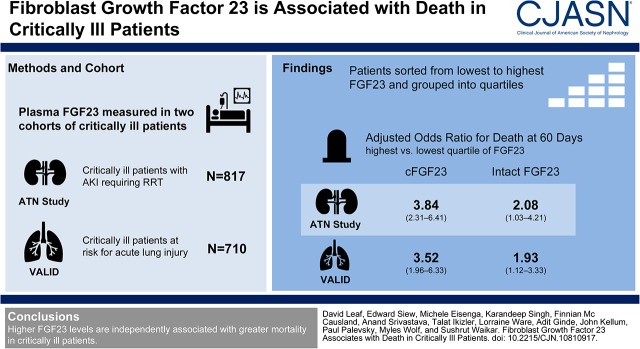
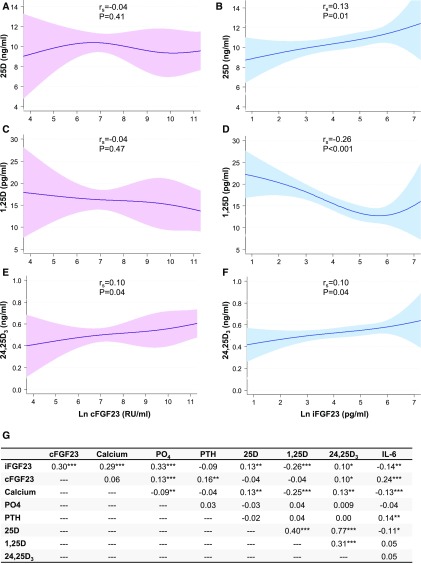
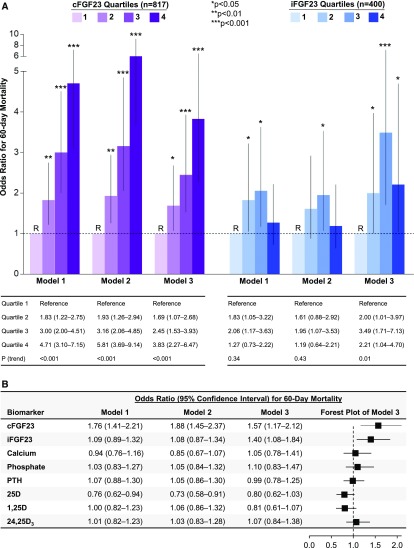
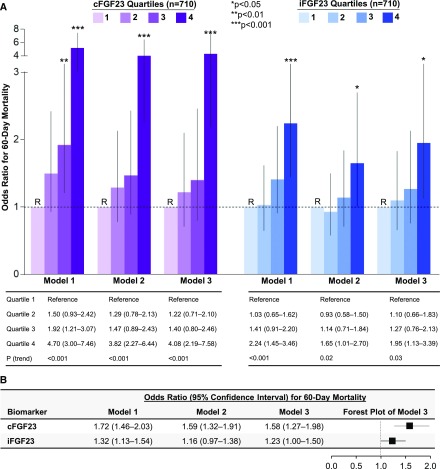
Results: In the ATN study, patients in the highest compared with lowest quartiles of C-terminal (cFGF23) and intact FGF23 (iFGF23) had 3.84 (95% confidence interval, 2.31 to 6.41) and 2.08 (95% confidence interval, 1.03 to 4.21) fold higher odds of death, respectively, after adjustment for demographics, comorbidities, and severity of illness. In contrast, plasma/serum levels of parathyroid hormone, vitamin D metabolites, calcium, and phosphate were not associated with 60-day mortality. In the VALID study, patients in the highest compared with lowest quartiles of cFGF23 and iFGF23 had 3.52 (95% confidence interval, 1.96 to 6.33) and 1.93 (95% confidence interval, 1.12 to 3.33) fold higher adjusted odds of death.
Conclusions: Higher FGF23 levels are independently associated with greater mortality in critically ill patients.
Keywords: Acute Kidney Injury; Acute Lung Injury; Biomarkers; Calcium, Dietary; Cohort Studies; Comorbidity; Confidence Intervals; Critical Illness; Demography; Fibroblast Growth Factors; Humans; Minerals; Osteocytes; Phosphates; Renal Replacement Therapy; Vitamin D; acute renal failure; fibroblast growth factor 23; parathyroid hormone; renal dialysis.
Copyright © 2018 by the American Society of Nephrology.
Figures
References
-
- Zivin JR, Gooley T, Zager RA, Ryan MJ: Hypocalcemia: A pervasive metabolic abnormality in the critically ill. Am J Kidney Dis 37: 689–698, 2001 - PubMed
-
- Lee P, Eisman JA, Center JR: Vitamin D deficiency in critically ill patients. N Engl J Med 360: 1912–1914, 2009 - PubMed
-
- Hewison M: Antibacterial effects of vitamin D. Nat Rev Endocrinol 7: 337–345, 2011 - PubMed
-
- ADHR Consortium : Autosomal dominant hypophosphataemic rickets is associated with mutations in FGF23. Nat Genet 26: 345–348, 2000 - PubMed
Publication types
MeSH terms
Substances
Grants and funding
LinkOut - more resources
Full Text Sources
Other Literature Sources