. 2018 Mar 8;8(1):4168.
doi: 10.1038/s41598-018-22343-4.

Genetic and metabolic regulation of Mycobacterium tuberculosis acid growth arrest

Affiliations

Genetic and metabolic regulation of Mycobacterium tuberculosis acid growth arrest

Jacob J Baker et al. Sci Rep. .

Abstract

Mycobacterium tuberculosis (Mtb) senses and adapts to acidic environments during the course of infection. Acidic pH-dependent adaptations include the induction of metabolic genes associated with anaplerosis and growth arrest on specific carbon sources. Here we report that deletion of isocitrate lyase or phosphoenolpyruvate carboxykinase results in reduced growth at acidic pH and altered metabolite profiles, supporting that remodeling of anaplerotic metabolism is required for pH-dependent adaptation. Mtb cultured at pH 5.7 in minimal medium containing glycerol as a single carbon source exhibits an acid growth arrest phenotype, where the bacterium is non-replicating but viable and metabolically active. The bacterium assimilates and metabolizes glycerol and maintains ATP pools during acid growth arrest and becomes tolerant to detergent stress and the antibiotics isoniazid and rifampin. A forward genetic screen identified mutants that do not arrest their growth at acidic pH, including four enhanced acid growth (eag) mutants with three distinct mutations in the proline-proline-glutamate (PPE) gene MT3221 (also named ppe51). Overexpression of the MT3221(S211R) variant protein in wild type Mtb results in enhanced acid growth and reduced drug tolerance. These findings support that acid growth arrest is a genetically controlled, adaptive process and not simply a physiological limitation associated with acidic pH.


Conflict of interest statement

The authors declare no competing interests.

Figures
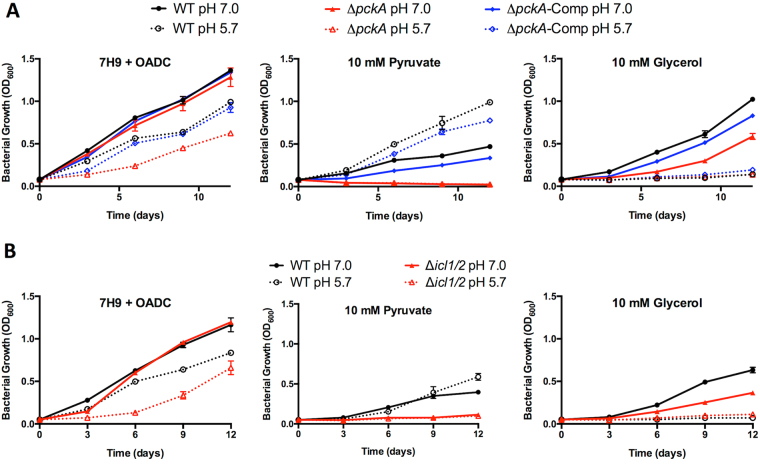
Figure 1
Figure 1
pckA and ∆icl1/2 mutants exhibit altered growth profiles at acidic pH and in minimal media. (A) Growth of CDC1551 WT, ∆pckA, and ∆pckA complemented (∆pckA-Comp) strains in the rich medium 7H9 + OADC (0.05% Tween) and in minimal medium containing either pyruvate or glycerol as a single carbon source, buffered to pH 7.0 or pH 5.7. The ∆pckA strain exhibits reduced growth at pH 5.7 in rich medium compared to the WT and complemented strains, and in minimal medium supplemented with pyruvate the OD of ∆pckA cultures decreases over time, consistent with bacterial lysis. ∆pckA growth on glycerol is reduced compared to the WT and complemented strains at pH 7.0, and is arrested for growth like the WT and complemented strains at pH 5.7. (B) Growth of Erdman WT and ∆icl1/2 mutant strains in rich and minimal media buffered to pH 7.0 and pH 5.7. The ∆icl1/2 strain exhibits reduced growth at pH 5.7 in rich medium compared to the WT. In minimal medium supplemented with pyruvate, growth is reduced at both pH 7.0 and pH 5.7 in the ∆icl1/2 mutant.
Figure 2
Figure 2
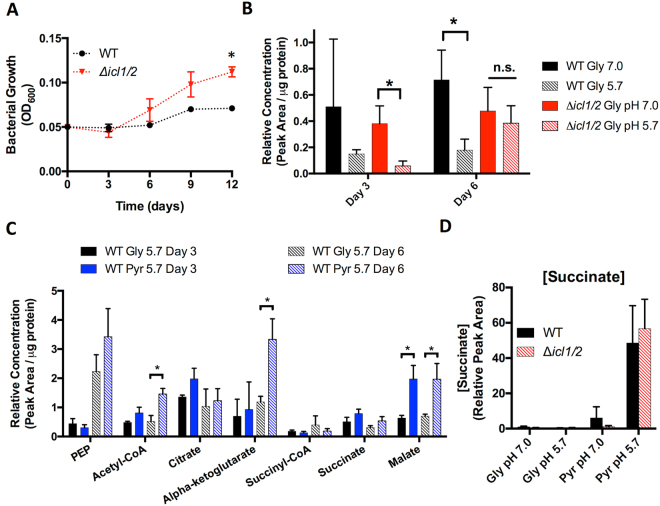
Changes in metabolic profiles associated with growth at acidic pH. (A) The ∆icl1/2 mutant incubated in glycerol at pH 5.7 exhibits arrested growth at day 3 but enhanced growth after day 6 as compared to the WT. *P < 0.01, using a Student’s t-test. (B) Relative concentration of succinyl-CoA in WT and ∆icl1/2 mutant in minimal medium with glycerol as a single carbon source buffered to pH 7.0 or pH 5.7. Acidic pH is associated with reduced succinyl-CoA levels in WT Mtb. The ∆icl1/2 mutant exhibited decreased succinyl-CoA levels at day 3, but by day 6 there was no difference in metabolite concentration between pH 7.0 and 5.7. *P < 0.05, MANOVA followed by post-hoc pairwise comparisons Bonferroni adjusted for false discovery. (C) Relative concentration of selected central carbon metabolites at acidic pH with either glycerol (Gly) or pyruvate (Pyr) as the single carbon source. Mtb has increased concentrations of acetyl-CoA and α-ketoglutarate at day 6, and increased concentrations of malate on day 3 and day 6. *P < 0.05, MANOVA followed by post-hoc pairwise comparisons Bonferroni adjusted for false discovery. (D) Succinate concentration in supernatant after 3 days culture in minimal medium with Gly or Pyr as single carbon sources buffered to pH 7.0 or pH 5.7. Succinate secretion is relative to WT Mtb cultured in glycerol at pH 7.0. Mtb secretes succinate specifically at pH 5.7 with pyruvate as a single carbon source. Similar levels of succinate accumulation in the supernatant are observed in the ∆icl1/2 mutant.
Figure 3
Figure 3
Metabolic profiling of the ∆pckA mutant reveals a transient role for pckA in metabolic adaptations at acidic pH. Concentration of TCA cycle intermediates in the ∆pckA mutant relative to WT Mtb at pH 5.7 with either glycerol (A) or glycerol and pyruvate (B) as the carbon source(s). Significant differences in the mutant compared to the WT were observed in accumulation of the metabolites citrate, succinate and malate in both carbon sources at day 3, however, the differences resolved by day 3 for citrate and succinate. This finding suggests that initial adaptations to acidic pH may rely upon gluconeogenesis. (C) Relative concentration of succinate secreted by WT and ∆pckA Mtb. Succinate secretion is relative to WT Mtb cultured in glycerol at pH 7.0. The ∆pckA mutant exhibits enhanced succinate secretion at Day 3. *P < 0.05, MANOVA followed by post-hoc pairwise comparisons Bonferroni adjusted for false discovery.
Figure 4
Figure 4
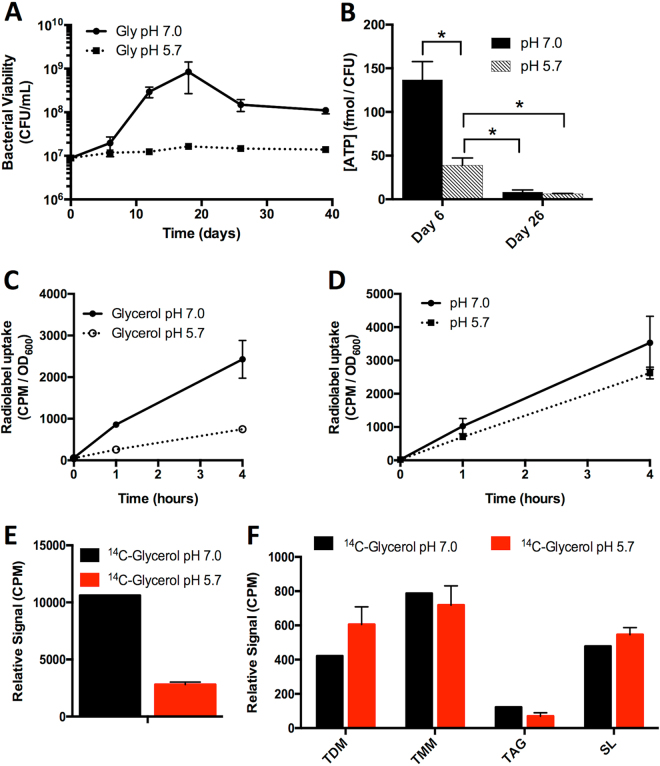
Mtb remains viable and metabolically active during acid growth arrest. (A) Mtb remains viable during culture in minimal medium buffered to pH 5.7 with glycerol as a single carbon source in the absence of growth. (B) The concentration of ATP in Mtb under acid growth arrest is reduced compared to pH 7.0, but still higher than that observed on Day 26 at pH 7.0 or pH 5.7. Error bars represent the standard deviation. *P < 0.05, using a Student’s t-test. (C) Mtb was incubated in minimal medium with glycerol as a single carbon source at pH 7.0 and pH 5.7 and the uptake of 14C-glycerol was monitored over time. Mtb uptakes 14C-glycerol during acid growth arrest, albeit at a reduced rate. (D) Uptake of 14C-glycerol. Mtb cultures were conditioned to minimal medium with glycerol as a single carbon source for 3 days, pelleted, and resuspended in PBS + 0.05% Tween-80. Accumulation of 14C-glyerol was measured over time, with no significant difference in accumulation observed based on two-way ANOVA (p = 0.239). Error bars represent standard deviation. (E) Incorporation of 14C-glycerol into Mtb lipids. Following 10 days of culture with 14C-glycerol, lipids were extracted and total radioactivity of the samples was measured. Mtb cultured at pH 5.7 had reduced incorporation of 14C in lipids, although this difference may be in part attributable to increased bacterial numbers over time at pH 7.0. (F) Relative radiolabeled lipid species abundance. Thin layer chromatography (TLC) was performed by spotting 5,000 CPM of 14C-labelled lipids at the origin and developing the TLC in the necessary solvents for separation of trehalose di- and monomycolate (TDM, TMM), and sulfolipid (SL) as described in the methods. For each lipid species, bars indicate relative signal of each lipid species.
Figure 5
Figure 5
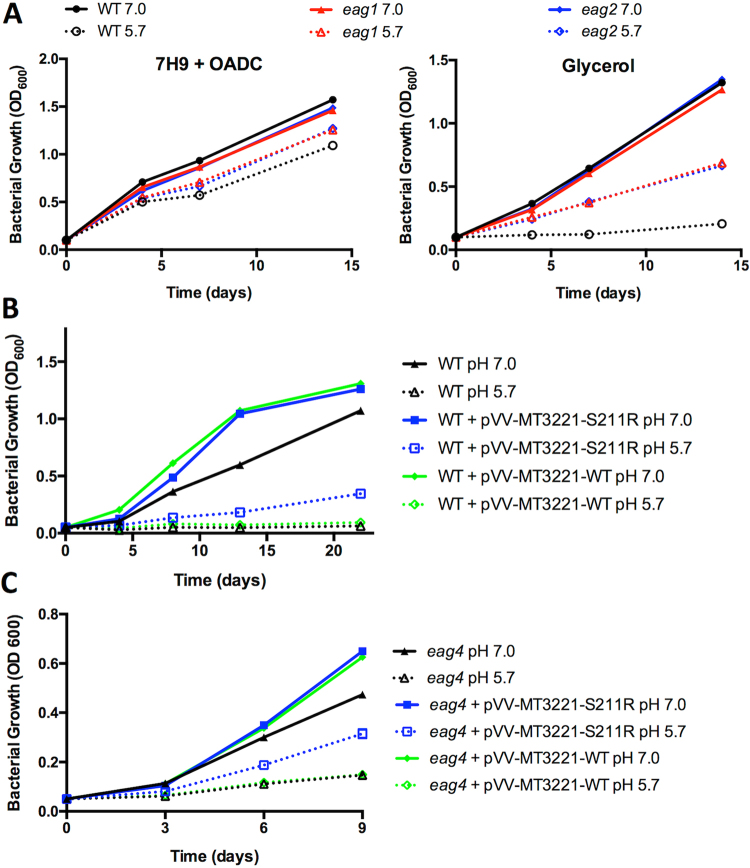
The S211R-encoding mutant allele of MT3221 enhances Mtb growth at acidic pH on glycerol. (A) Growth curves in rich medium (7 H9-OADC-0.05% Tween) and in minimal medium with glycerol as a single carbon source with two spontaneous eag mutants. Notably, the enhanced growth of eag mutants is only observed at pH 5.7 and not at pH 7.0. (B) Growth curve of wild type Mtb (black) and wild type Mtb containing a plasmid overexpressing either the wild type or S211R-encoding mutant allele of MT3221 (blue and green, respectively). Both overexpression constructs increase Mtb growth at pH 7.0, but only the mutant allele promotes Mtb growth at pH 5.7. (C) Growth of the Mtb eag4 mutant containing spontaneous S211R-encoding mutation in MT3221. Overexpression of the wild type allele does not arrest growth at pH 5.7, and overexpression of the mutant MT3221 allele increases growth in the eag4 mutant. Both overexpression constructs increase growth of the eag4 strain at pH 7.0. Error bars represent the standard deviation.
Figure 6
Figure 6
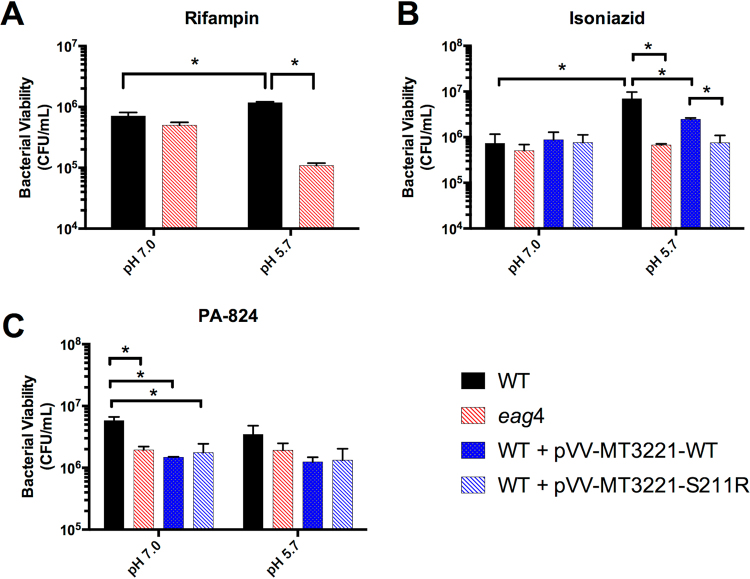
Increased sensitivity of enhanced acid growth mutants to antibiotics. Wild type Mtb (WT), an eag4 mutant, and WT Mtb expressing either the wild type allele or S211R-encoding mutant allele of MT3221 (WT + pVV-MT3221-WT and WT + pVV-MT3221-S211R, respectively) were acclimated to minimal medium containing glycerol as a single carbon source for 3 days before adding either 0.6 µM rifampin (A), 20 µM isoniazid (B), or 10 µM PA-824 (C). The eag4 mutant exhibited increased sensitivity to both rifampin and isoniazid at pH 5.7 but not pH 7.0, and the strain overexpressing the S211R-encoding MT3221 mutant allele also had increased sensitivity to isoniazid at pH 5.7. Both the mutant strain and the MT3221 overexpression strains demonstrated increased sensitivity to PA-824 at pH 7.0, but no significant tolerance was observed at pH 5.7. *P < 0.05 based on a student’s t-test.
Figure 7
Figure 7
A Model of metabolic adaptations at acidic pH. (A) Highlighted in blue, at acidic pH, the transcriptional induction of isocitrate lyase (icl) and decreased concentration of succinyl-CoA suggest that Mtb increases metabolic flux through the glyoxylate shunt and decreases flux through the oxidative TCA cycle. This remodeling limits production of NADPH and ATP via irreversible oxidative decarboxylation and additionally increases the production of reductive TCA cycle intermediates (succinate and malate). (B) Highlighted in green, growth at acidic pH is associated with secretion of succinate. The ∆icl1/2 mutant still secretes succinate, suggesting that Mtb can utilize a route other than the glyoxylate shunt for succinate secretion. (C) Highlighted in orange, the transcriptional induction of pckA at acidic pH, as well as the observed accumulation of succinate, malate, and citrate in the ∆pckA mutant at acidic pH suggests that Mtb utilizes the gluconeogenic reaction of pckA to divert the increased reductive TCA cycle intermediates away from citrate synthase. The decrease of these intermediates in the ∆pckA mutant to WT levels by day 6 suggests that Mtb can compensate metabolically for loss of pckA, possibly by succinate secretion.

References

    1. Flynn JL, Chan J. Tuberculosis: latency and reactivation. Infection and Immunity. 2001;69:4195–4201. doi: 10.1128/IAI.69.7.4195-4201.2001. - DOI - PMC - PubMed
    1. WHO. Treatment of tuberculosis: guidelines (World Health Organization, 2010). - PubMed
    1. McKinney JD. In vivo veritas: the search for TB drug targets goes live. Nat Med. 2000;6:1330–3. doi: 10.1038/82142. - DOI - PubMed
    1. Barry CE, III, et al. The spectrum of latent tuberculosis: rethinking the biology and intervention strategies. Nat Rev Microbiol. 2009;7:845–55. doi: 10.1038/nrmicro2236. - DOI - PMC - PubMed
    1. Turapov O, et al. Phenotypically adapted Mycobacterium tuberculosis populations from sputum are tolerant to first-line drugs. Antimicrobial Agents and Chemotherapy. 2016;60:2476–2483. doi: 10.1128/AAC.01380-15. - DOI - PMC - PubMed

Publication types

MeSH terms

Substances