


Overview of the development of quinolone resistance in Salmonella species in China, 2005-2016
- PMID: 29520157
- PMCID: PMC5833789
- DOI: 10.2147/IDR.S157460
Overview of the development of quinolone resistance in Salmonella species in China, 2005-2016
Abstract
Purpose: Several factors contribute to the complexity of quinolone resistance in Salmonella, including >2000 different Salmonella serotypes, a variety of hosts for Salmonella, and wide use of quinolones in human beings and animals. We thus aimed to obtain an overview of the development of quinolone resistance and relevant molecular mechanisms of such a resistance in Salmonella species.
Materials and methods: A total of 1,776 Salmonella isolates were collected in Ningbo, China, between 2005 and 2016. Antimicrobial susceptibility to quinolone and relevant genetic mechanisms in these isolates were retrospectively analyzed.
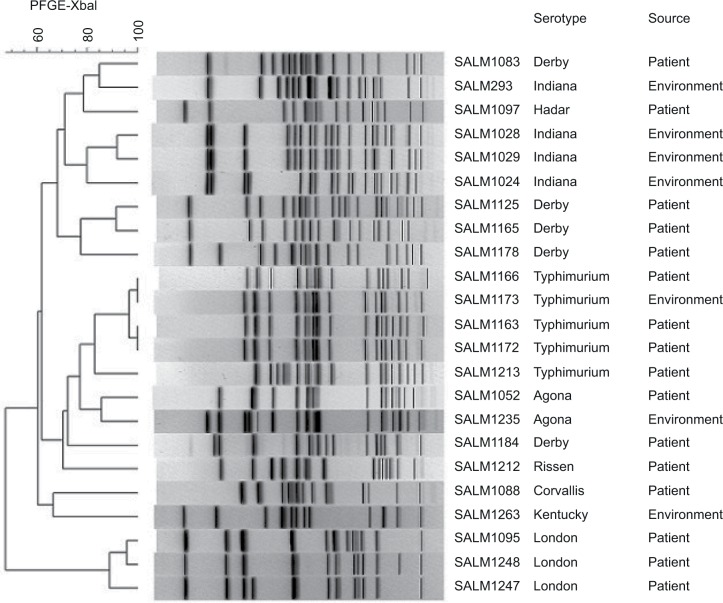
Results: The ratio for ciprofloxacin (CIP) resistant:reduced CIP susceptible:CIP susceptible was 26:522:1,228. CIP resistance was found in nine of 51 serotypes: Derby, London, Kentucky, Indiana, Corvallis, Rissen, Hadar, Typhimurium, and Agona. Of 26 CIP-resistant isolates, all were concurrently resistant to ampicillin and 21 were also concurrently resistant to cefotaxime and produced extended-spectrum β-lactamase (ESBL). The minimal inhibitory concentration values were at three levels: 2-4 μg/mL (serotypes except for Kentucky and Indiana), 16 μg/mL (one Kentucky isolate), and >32 μg/mL (Indiana isolates). As with the three most common serotypes, Salmonella Typhi showed quickly increased prevalence of reduced CIP susceptibility in recent years, Salmonella Enteritidis remained at a high prevalence of reduced CIP susceptibility throughout the study period, and several isolates of Salmonella Typhimurium were resistant to CIP. Transferable plasmid-mediated quinolone resistance gene qnrB was only found in all CIP-resistant isolates. In contrast, gyrA mutations were often found in reduced CIP-susceptible isolates and were not necessarily found in all CIP-resistant isolates.
Conclusion: We conclude that in Salmonella, there exists a high prevalence of reduced CIP susceptibility and a low prevalence of CIP resistance, which focuses on several serotypes. Our study also demonstrates that, rather than gyrA mutations, qnrB is the most common indicator for CIP resistance.
Keywords: Salmonella species; ciprofloxacin-resistant Salmonella isolates; genetic determinant of quinolone resistance; quinolone resistance.
Conflict of interest statement
Disclosure The authors report no conflicts of interest in this work.
Figures
References
-
- Majowicz SE, Musto J, Scallan E, et al. International Collaboration on Enteric Disease ‘Burden of Illness’ Studies The global burden of nontyphoidal Salmonella gastroenteritis. Clin Infect Dis. 2010;50(6):882–889. - PubMed
-
- Centres for Disease Control and Prevention . Foodborne Diseases Active Surveillance Network (FoodNet): FoodNet Surveillance Report for 2012 (Final Report) Atlanta, Georgia: U.S. Department of Health and Human Services, CDC; 2014.
-
- Centres for Disease Control and Prevention . An Atlas of Salmonella in the United States, 1968–2011: Laboratory-based Enteric Disease Surveillance. Atlanta, Georgia: US Department of Health and Human Services, CDC; 2013.
-
- Andersson MI, MacGowan AP. Development of the quinolones. J Antimicrob Chemother. 2003;51(suppl 1):1–11. - PubMed
LinkOut - more resources
Full Text Sources
Other Literature Sources
Research Materials
