Case Reports
. 2018 Feb 22:9:49.
doi: 10.3389/fgene.2018.00049. eCollection 2018.

Rathke's Cleft Cyst as Origin of a Pediatric Papillary Craniopharyngioma

Affiliations
Case Reports

Rathke's Cleft Cyst as Origin of a Pediatric Papillary Craniopharyngioma

Sven-Martin Schlaffer et al. Front Genet. .

Abstract

A 6-year old patient presented with an intra and suprasellar cystic lesion accompanied with impairment of the hypothalamic-pituitary axis and partial hypopituitarism. The most likely cause of sellar lesions in this age group are adamantinomatous craniopharyngioma (adaCP) or Rathke´s cleft cysts (RCCs). AdaCP are characterized by CTNNB1 mutations accompanied with aberrant nuclear beta-catenin expression. RCC show neither nuclear beta-catenin expression nor BRAF mutation. The latter is a hallmark of papillary craniopharyngiomas (papCP) that exhibit remarkable histological similarity with metaplasia of RCC. Diagnosis of the patient was elucidated by CTNNB1 and BRAF mutation screening, utilizing different approaches, as well as histological examination of markers, e.g., beta-catenin, claudin-1, EpCAM and the mutated BRAFV600E protein, which are known to be differentially expressed in sellar lesions. The case presented reveals extraordinary aspects for two reasons. Firstly, the lesion appeared clinically, on MRI, intraoperatively and histologically as RCC with prominent squamous metaplasia, but showing an expression pattern of markers also found in papCP, whilst exhibiting a hitherto undescribed BRAFV600E mutation. This important result documents a supposable transition of RCC metaplasia into a papillary craniopharyngioma (papCP). Secondly, this intriguing case shows unexpectedly that although papCP usually occurs almost exclusively in adults, it can also arise in childhood.

Keywords: BRAF mutation; Rathke's cleft cyst; childhood; metaplasia; papillary craniopharyngioma.


Figures
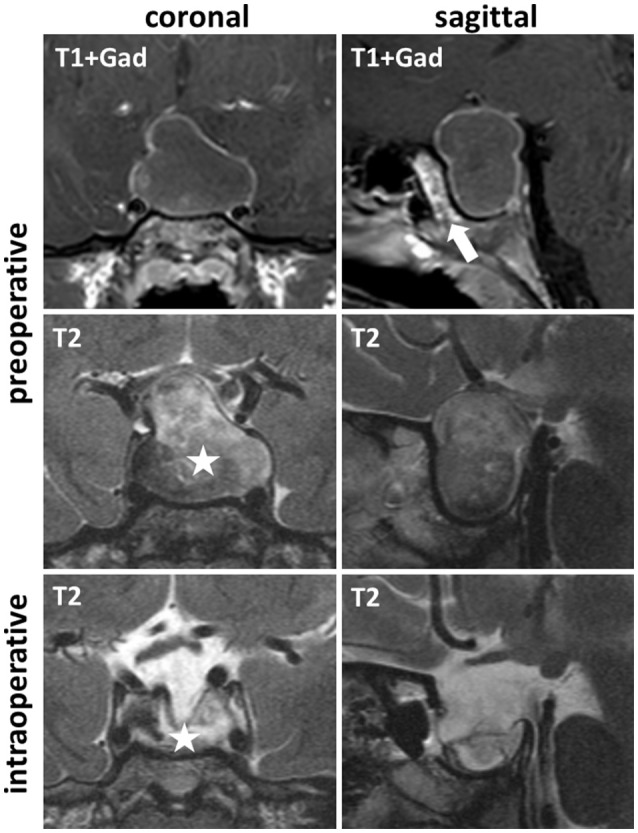
Figure 1
Figure 1
Pre- and intraoperative MRI; T1-weighted MR images after gadolinium contrast medium application (T1+Gad) and T2-weighted MRI showed in coronal and sagittal orientation a preoperative intra and suprasellar cystic tumor, lacking sphenoid sinus pneumatization (T1+Gad, sagittal, arrow). Intraoperative imaging confirmed complete drainage of the cyst (T2 coronal, asterisk).
Figure 2
Figure 2
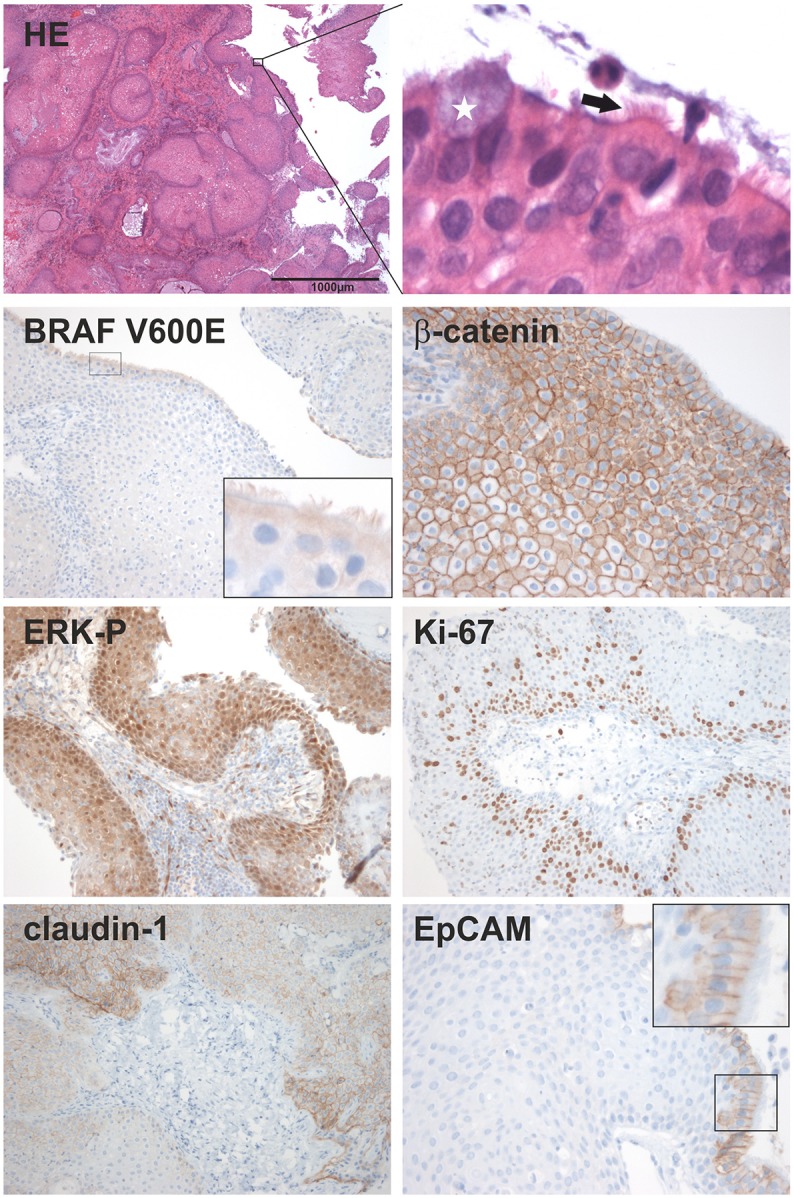
Histological characterization; HE staining shows a lesion of squamous couple stone differentiated epithelium. Magnification revealed a superficial cell layer harboring kinocilia (arrow) and goblet cells (white star). The following immunohistochemical stainings show the evidence and expression pattern of the mutated BRAF V600E protein, beta-catenin; the phosphorylated ERK (ERK-P) and the proliferation marker Ki-67; as well as the distribution of the cell-cell contact proteins, claudin-1 and EpCAM. In a higher resolution, EpCAM is only detectable in ciliated cells of the superficial cell layer.
Figure 3
Figure 3
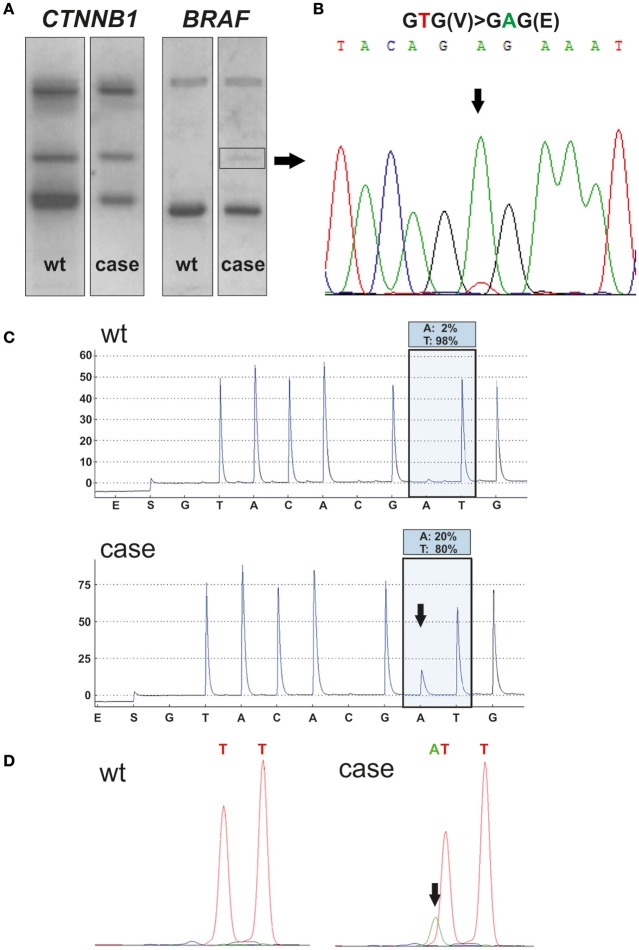
Mutational analysis; SSCP analysis of the hot spot region of CTNNB1 (exon 3) and BRAF (exon 15) was performed using DNA extracted from the formalin fixed, paraffin embedded resected tissue of the child (case line) (A). Wildtype DNA (wt line) was used as a control and to compare mutation induced aberrant bands. Only BRAF showed a shifted band (square), revealing in Sanger sequencing a BRAFV600E mutation with a thymine (T) to adenine (A) transversion (B). Pyrosequencing (C) confirmed BRAFV600E mutation (allele frequency of A: 20%), compared to the wt control (allele frequency of A: 3%). Pyrosequencing was performed twice in the department of neuropathology and department of pathology with comparable results. SNapShot analysis (D) confirms thymine to adenine transversion (arrow) in relation to wt control, which leads to an amino acid exchange of valine to glutamic acid at codon 600 within the BRAF gene.

References

    1. Aylwin S. J., Bodi I., Beaney R. (2015). Pronounced response of papillary craniopharyngioma to treatment with vemurafenib, a BRAF inhibitor. Pituitary 19, 544–546. 10.1007/s11102-015-0663-4 - DOI - PMC - PubMed
    1. Brastianos P. K., Santagata S. (2016). ENDOCRINE TUMORS: BRAF V600E mutations in papillary craniopharyngioma. Eur. J. Endocrinol. 174, R139–R144. 10.1530/EJE-15-0957 - DOI - PMC - PubMed
    1. Brastianos P. K., Shankar G. M., Gill C. M., Taylor-Weiner A., Nayyar N., Panka D. J., et al. (2016). Dramatic response of BRAF V600E mutant papillary craniopharyngioma to targeted therapy. J. Natl. Cancer Inst. 108:djv310. 10.1093/jnci/djv310 - DOI - PMC - PubMed
    1. Brastianos P. K., Taylor-Weiner A., Manley P. E., Jones R. T., Dias-Santagata D., Thorner A. R., et al. (2014). Exome sequencing identifies BRAF mutations in papillary craniopharyngiomas. Nat. Genet. 46, 161–165. 10.1038/ng.2868 - DOI - PMC - PubMed
    1. Buslei R., Nolde M., Hofmann B., Meissner S., Eyupoglu I. Y., Siebzehnrubl F., et al. (2005). Common mutations of beta-catenin in adamantinomatous craniopharyngiomas but not in other tumours originating from the sellar region. Acta Neuropathol. 109, 589–597. 10.1007/s00401-005-1004-x - DOI - PubMed

Publication types