Review
. 2018 Mar 9;10(3):118.
doi: 10.3390/v10030118.

Natural Variation in Resistance to Virus Infection in Dipteran Insects

Affiliations
Review

Natural Variation in Resistance to Virus Infection in Dipteran Insects

William H Palmer et al. Viruses. .

Abstract

The power and ease of Drosophila genetics and the medical relevance of mosquito-transmitted viruses have made dipterans important model organisms in antiviral immunology. Studies of virus-host interactions at the molecular and population levels have illuminated determinants of resistance to virus infection. Here, we review the sources and nature of variation in antiviral immunity and virus susceptibility in model dipteran insects, specifically the fruit fly Drosophila melanogaster and vector mosquitoes of the genera Aedes and Culex. We first discuss antiviral immune mechanisms and describe the virus-specificity of these responses. In the following sections, we review genetic and microbiota-dependent variation in antiviral immunity. In the final sections, we explore less well-studied sources of variation, including abiotic factors, sexual dimorphism, infection history, and endogenous viral elements. We borrow from work on other pathogen types and non-dipteran species when it parallels or complements studies in dipterans. Understanding natural variation in virus-host interactions may lead to the identification of novel restriction factors and immune mechanisms and shed light on the molecular determinants of vector competence.

Keywords: Aedes aegypti; Drosophila melanogaster; IMD; JAK-STAT; RNAi; Toll; antiviral defense; endogenous viral elements; microbiota; vector mosquitoes.


Conflict of interest statement

The authors declare no conflicts of interest.

Figures
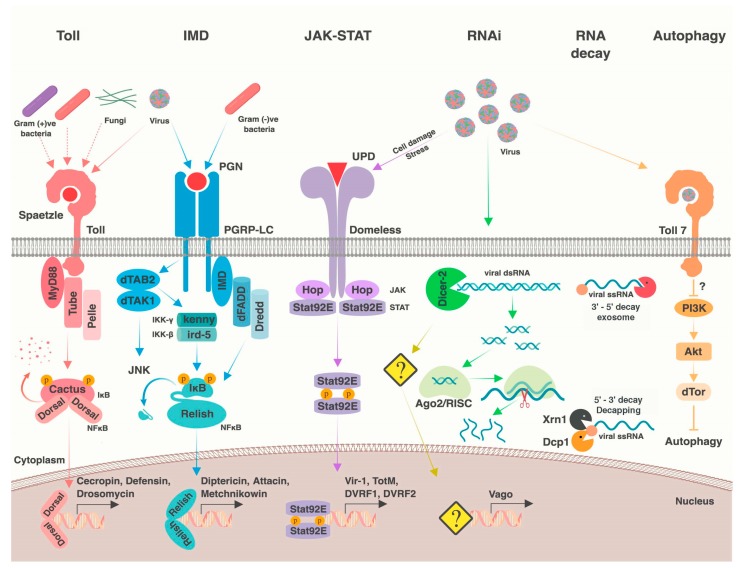
Figure 1
Figure 1
Antiviral innate immune pathways in dipteran insects. Toll pathway: Detection of pathogen-associated molecular patterns (PAMPs) by pathogen recognition-receptors leads to the proteolytic maturation of Spätzle, which binds to and activates Toll (dotted arrows). Activated Toll recruits adapter proteins MyD88, Tube and Pelle which targets Cactus for proteasomal degradation via phosphorylation. Cactus degradation releases the transcription factor Dorsal (Rel1 in mosquitoes) or Dif (Dorsal-related immune factor) when activated in response to bacterial infection. These translocate to the nucleus and activates the transcription of Toll pathway-regulated genes (e.g., cecropin, defensin and drosomycin). IMD pathway: Gram-negative PAMPs (e.g., peptidoglycan) bind to peptidoglycan recognition protein, PGRP-LC (or PGRP-LE) and signal through the adapter molecules IMD (Immune Deficiency) and dFADD (Drosophila Fas-associated death domain). This stimulates the caspase Dredd (Death-related ced-3/Nedd2-like protein), dTAK1 (Drosophila transforming growth factor β-activated kinase 1), and dTAK1 adapter protein dTAB2 (TAK1-binding protein 2). These proteins signal through the JNK pathway, and activate the IκB kinases kenny and ird-5, which phosphorylate the C-terminal tail of the transcription factor Relish (Rel2 in mosquitoes), leading to its subsequent activation via proteolytic cleavage by Dredd. Activated Relish translocates to the nucleus and drives the expression of genes regulated by the IMD-pathway (e.g., diptericin, attacin and metchnikowin). JAK-STAT pathway: Virus infection, possibly through induction of stress or cellular damage, triggers the activation of the JAK (Janus kinase)-STAT (signal transducers and activators of transcription) pathway, which begins with the binding of a cytokine of the unpaired (upd) family to the dimeric receptor, domeless. Subsequently, the receptor-associated JAK-tyrosine kinase hopscotch phosphorylates the cytoplasmic tail of domeless, leading to the recruitment of Stat92E. After Jak-mediated phosphorylation, Stat92E proteins dimerize and shuttle to the nucleus to activate the transcription of genes such as vir-1, TotM, DVRF1 and DVRF2. RNAi pathway: Double-stranded RNA derived from virus replication intermediates are recognized and processed by Dicer-2 into 21 nt small-interfering RNAs (siRNAs), which are then loaded onto an Argonaute-2 (Ago2)-containing RNA-induced silencing complex (RISC). This complex degrades one of the two strands and uses the other strand as a guide RNA to target complementary viral sequences. Dicer-2 can also activate the expression of the cytokine Vago through an unknown pathway (visualized as ‘?’ in the figure). RNA decay pathways: Single-stranded viral mRNA can be targeted in the 3′–5′ direction through the RNA exosome degradation pathway. 5′–3′ degradation occurs through decapping enzymes Dcp1 and Dcp2 and the RNA exonuclease Xrn1. Autophagy: Some viruses can bind to the transmembrane receptor Toll-7, resulting in the induction of autophagy. This is most likely in an indirect manner by negatively regulating the PI3K (phosphatidylinositol 3-kinase)-Akt pathway.

References

    1. Merkling S.H., van Rij R.P. Beyond RNAi: Antiviral defense strategies in Drosophila and mosquito. J. Insect Physiol. 2013;59:159–170. doi: 10.1016/j.jinsphys.2012.07.004. - DOI - PubMed
    1. Kingsolver M.B., Huang Z., Hardy R.W. Insect antiviral innate immunity: Pathways, effectors, and connections. J. Mol. Biol. 2013;425:4921–4936. doi: 10.1016/j.jmb.2013.10.006. - DOI - PMC - PubMed
    1. Bronkhorst A.W., van Rij R.P. The long and short of antiviral defense: Small RNA-based immunity in insects. Curr. Opin. Virol. 2014;7:19–28. doi: 10.1016/j.coviro.2014.03.010. - DOI - PubMed
    1. Lamiable O., Imler J.L. Induced antiviral innate immunity in Drosophila. Curr. Opin. Microbiol. 2014;20:62–68. doi: 10.1016/j.mib.2014.05.006. - DOI - PMC - PubMed
    1. Sim S., Jupatanakul N., Dimopoulos G. Mosquito immunity against arboviruses. Viruses. 2014;6:4479–4504. doi: 10.3390/v6114479. - DOI - PMC - PubMed

Publication types

MeSH terms

LinkOut - more resources
