


Health economic evaluations of non-pharmacological interventions for persons with dementia and their informal caregivers: a systematic review
- PMID: 29523090
- PMCID: PMC5845149
- DOI: 10.1186/s12877-018-0751-1
Health economic evaluations of non-pharmacological interventions for persons with dementia and their informal caregivers: a systematic review
Abstract
Background: This systematic review aims to review the literature on trial-based economic evaluations of non-pharmacological interventions directly targeted at persons with dementia as well as persons with mild cognitive impairment and their respective caregivers.
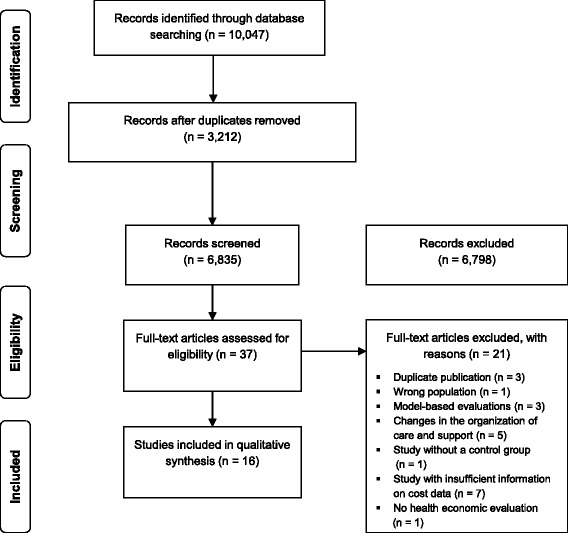
Methods: A systematic literature research was conducted for the timeframe from 2010 to 2016 in the following databases: Centre for Reviews and Dissemination, EconLit, Embase, Cochrane Library, PsycINFO and PubMed. Study quality was assessed according to the Drummond criteria.
Results: In total sixteen publications were identified. Health economic evaluations indicated the cost-effectiveness of physical exercise interventions and occupational therapy. There was also evidence to suggest that psychological and behavioral therapies are cost-effective. Health economic studies investigating psychosocial interventions mainly targeted towards informal caregivers showed inconsistent results.
Conclusions: Due to the increasing prevalence of dementia non-pharmacological interventions and their health economic impact are of increasing importance for health care decision-makers and HTA agencies.
Keywords: Cost-effectiveness; Costs; Dementia; Economic evaluation; Non-pharmacological interventions.
Conflict of interest statement
Ethics approval and consent to participate
Not applicable.
Consent for publication
Not applicable.
Competing interests
The authors declare that they have no competing interests.
Publisher’s Note
Springer Nature remains neutral with regard to jurisdictional claims in published maps and institutional affiliations.
References
-
- Prince M, Wimo A, Guerchet M, Ali G-C, Wu Y-T, Prina M. World Alzheimer Report 2015: The global impact of dementia. An analysis of prevalence, incidence, cost and trends. London: Alzheimer's Disease International; 2015.
-
- Versijpt J. Effectiveness and cost-effectiveness of the pharmacological treatment of Alzheimer's disease and vascular dementia. J Alzheimers Dis. 2014;42(Suppl 3):S19–S25. - PubMed
-
- Oyebode JR, Parveen S. Psychosocial interventions for people with dementia: an overview and commentary on recent developments. Dementia. 2016:1471301216656096. - PubMed
Publication types
MeSH terms
LinkOut - more resources
Full Text Sources
Other Literature Sources
Medical
