


Loss-to-follow-up and delay to treatment initiation in Pakistan's national tuberculosis control programme
- PMID: 29523100
- PMCID: PMC5845151
- DOI: 10.1186/s12889-018-5222-2
Loss-to-follow-up and delay to treatment initiation in Pakistan's national tuberculosis control programme
Abstract
Background: Researchers and policy-makers have identified loss to follow-up as a major programmatic problem. Therefore, the objective of this study is to quantify TB related pre-treatment loss to follow up and treatment delay in private sector health care facilities in Pakistan.
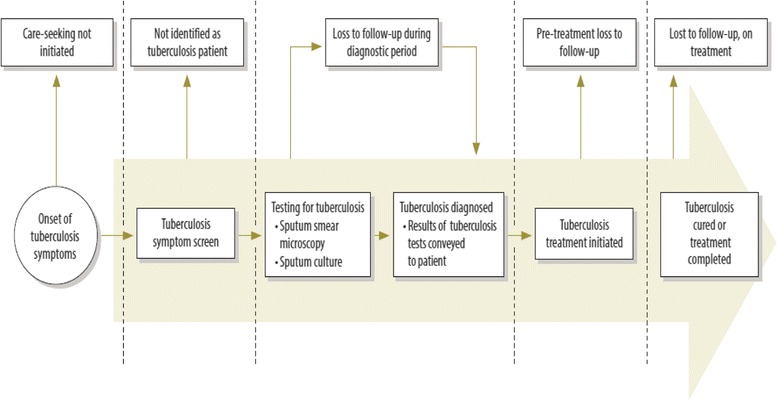
Methods: This was a retrospective, descriptive cohort study using routinely collected programmatic data from TB referral, diagnosis and treatment registers. Data from 48 private healthcare facilities were collected using an online questionnaire prepared in ODK Collect, for the period October 2015 to March 2016. Data were analysed using SPSS. We calculated the: (1) number and proportion of patients who were lost to follow-up during the diagnostic period, (2) number and proportion of patients with pre-treatment loss to follow-up, and (3) the number of days between diagnosis and initiation of treatment.
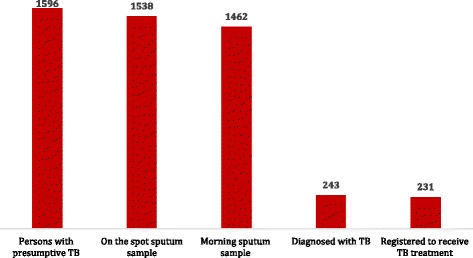
Results: One thousand five hundred ninety-six persons with presumptive TB were referred to the laboratory. Of these, 96% (n = 1538) submitted an on-the-spot sputum sample. Of the 1538 people, 1462 (95%) people subsequently visited the laboratory to submit the early morning (i.e. the second) sample. Hence, loss to follow-up during the diagnostic process was 8% overall (n = 134). Of the 1462 people who submitted both sputum samples, 243 (17%) were diagnosed with sputum smear-positive pulmonary TB and 231 were registered for anti-TB treatment, hence, loss in the pre-treatment phase was 4.9% (n = 12). 152 persons with TB (66%) initiated TB treatment either on the day of TB diagnosis or the next day. A further 79 persons with TB (34%) commenced TB treatment within a mean time of 7 days (range 2 to 64 days).
Conclusion: Concentrated efforts should be made by the National TB Control Programme to retain TB patients and innovative methods such as text reminders and behavior change communication may need to be used and tested.
Keywords: Lost to follow-up during diagnosis; Pakistan’s TB control program; Pre-treatment loss to follow up; Treatment delay; Tuberculosis.
Conflict of interest statement
Ethics approval and consent to participate
This study involved a review of routine programmatic data and no participants were involved therefore, ethical approval was not required. Data was also de-identified.
Consent for publication
Not applicable
Competing interest
The authors declare that they have no competing interest.
Publisher’s Note
Springer Nature remains neutral with regard to jurisdictional claims in published maps and institutional affiliations.
Figures
References
-
- World Health Organization. WHO Global Tuberculosis Report 2016. 2016. http://www.who.int/tb/publications/global_report/en/. Accessed 22 February, 2017.
-
- World Health Organization. WHO Implementing the WHO Stop TB Strategy: a Handbook for National TB Control Programme. 2008. http://www.who.int/tb/publications/tb-control-strategy/en/. Accessed 23 February, 2017. - PubMed
-
- World Health Organization. WeHO Treatment of Tuberculosis Guidelines. 4 Ed. 2010. http://www.who.int/tb/publications/2010/9789241547833/en/. Accessed 23 February, 201e7.
-
- Harries AD, Rusen ID, Chiang CY, Hinderaker SG, Enarson DA. Registering initial defaulters and reporting on their treatment outcomes. Int J Tuberc Lung Dis. 2009;13(7):801–803. - PubMed
MeSH terms
LinkOut - more resources
Full Text Sources
Other Literature Sources
