


Predictors of Sexual Intercourse Frequency Among Couples Trying to Conceive
- PMID: 29523477
- PMCID: PMC5882561
- DOI: 10.1016/j.jsxm.2018.02.005
Predictors of Sexual Intercourse Frequency Among Couples Trying to Conceive
Abstract
Background: Little is known about the predictors of sexual intercourse frequency (SIF) among couples trying to conceive despite the well-established link between SIF and fecundity.
Aim: To evaluate men's and women's demographic, occupational, and lifestyle predictors of SIF among couples.
Methods: 469 Couples without a history of infertility participating in the Longitudinal Investigation of Fertility and the Environment Study (2005-2009) were followed up for ≤1 year while trying to conceive. At enrollment, both partners were interviewed about demographic, occupational, lifestyle, and psychological characteristics using standardized questionnaires. Multivariable generalized linear mixed models with Poisson distribution were used to estimate the adjusted percent difference in SIF across exposure categories.
Outcomes: SIF was recorded in daily journals and summarized as average SIF/mo.
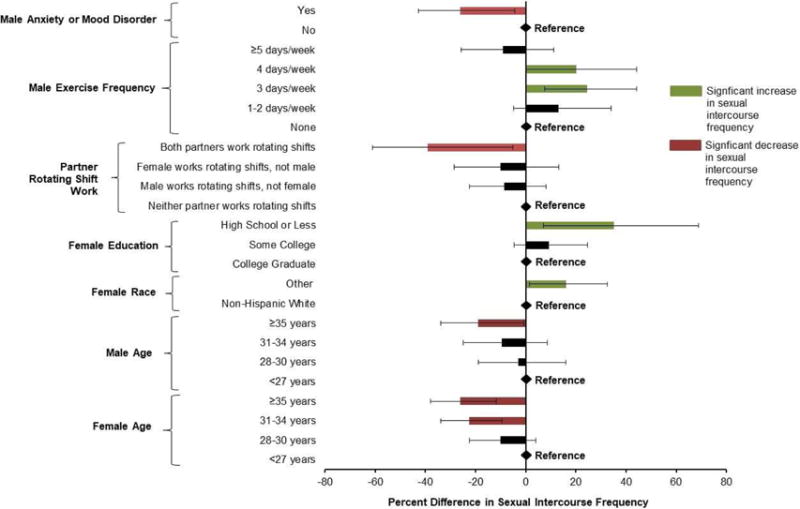
Results: The median (interquartile range) SIF during follow-up was 6 (4-9) acts/mo. For every year increase in age for women and men, SIF decreased by -0.8% (95% CI -2.5 to 1.0%) and -1.7% (95% CI -3.1 to -0.3%). Women with high school education or less and those of non-white race had 34.4% and 16.0% higher SIF, respectively. A similar trend was seen for men's education and race. Only couples where both partners (but not just 1 partner) worked rotating shifts had -39.1% (95% CI -61.0 to -5.0%) lower SIF compared to couples where neither partner worked rotating shifts. Men's (but not women's) exercise was associated with 13.2% (95% CI 1.7-26.0%) higher SIF. Diagnosis of a mood or anxiety disorder in men (but not women) was associated with a 26.0% (95% CI -42.7 to -4.4%) lower SIF. Household income, smoking status, body mass index, night work, alcohol intake, and psychosocial stress were not associated with SIF.
Clinical translation: Even among couples trying to conceive, there was substantial variation in SIF. Both partners' age, education, race, and rotating shift work as well as men's exercise and mental health play an important role in determining SIF.
Conclusions: As this was a secondary analysis of an existing study, we lacked information on many pertinent psychological and relationship quality variables and the hormonal status of participants, which could have affected SIF. The unique population-based couple design, however, captured both partners' demographics, occupational characteristics, and lifestyle behaviors in advance of their daily, prospective reporting of SIF, which was a major strength. Important predictors of SIF among couples attempting to conceive include men's exercise and mental health and both partners' age, education, race, and rotating shift work. Gaskins AJ, Sundaram R, Buck Louis GM, et al. Predictors of Sexual Intercourse Frequency Among Couples Trying to Conceive. J Sex Med 2018;15:519-528.
Keywords: Alcohol; Body Weight; Exercise; Intercourse; Libido; Sexual Activity; Shift Work; Smoking; Stress.
Copyright © 2018 International Society for Sexual Medicine. All rights reserved.
Figures
References
-
- Costa RM, Brody S. Women’s relationship quality is associated with specifically penile-vaginal intercourse orgasm and frequency. J Sex Marital Ther. 2007;33:319–27. - PubMed
-
- Stanford JB, Dunson DB. Effects of sexual intercourse patterns in time to pregnancy studies. Am J Epidemiol. 2007;165:1088–95. - PubMed
-
- Buck Louis GM, Schisterman EF, Sweeney AM, Wilcosky TC, Gore-Langton RE, Lynch CD, et al. Designing prospective cohort studies for assessing reproductive and developmental toxicity during sensitive windows of human reproduction and development–the LIFE Study. Paediatr Perinat Epidemiol. 2011;25:413–24. - PMC - PubMed
Publication types
MeSH terms
Grants and funding
LinkOut - more resources
Full Text Sources
Other Literature Sources
Medical
Research Materials
