


Drug-Associated Risk Tool: development and validation of a self-assessment questionnaire to screen for hospitalised patients at risk for drug-related problems
- PMID: 29523558
- PMCID: PMC5855403
- DOI: 10.1136/bmjopen-2017-016610
Drug-Associated Risk Tool: development and validation of a self-assessment questionnaire to screen for hospitalised patients at risk for drug-related problems
Abstract
Introduction: Identifying patients with a high risk for drug-related problems (DRPs) might optimise the allocation of targeted pharmaceutical care during the hospital stay and on discharge.
Objective: To develop a self-assessment screening tool to identify patients at risk for DRPs and validate the tool regarding feasibility, acceptability and the reliability of the patients' answers.
Design: Prospective validation study.
Setting: Two mid-sized hospitals (300-400 beds).
Participants: 195 patients, exclusion criteria: under 18 years old, patients with a health status not allowing a meaningful communication (eg, delirium, acute psychosis, advanced dementia, aphasia, clouded consciousness state), palliative or terminally ill patients.
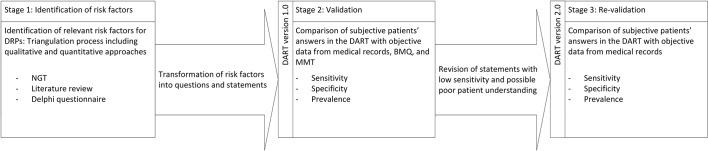
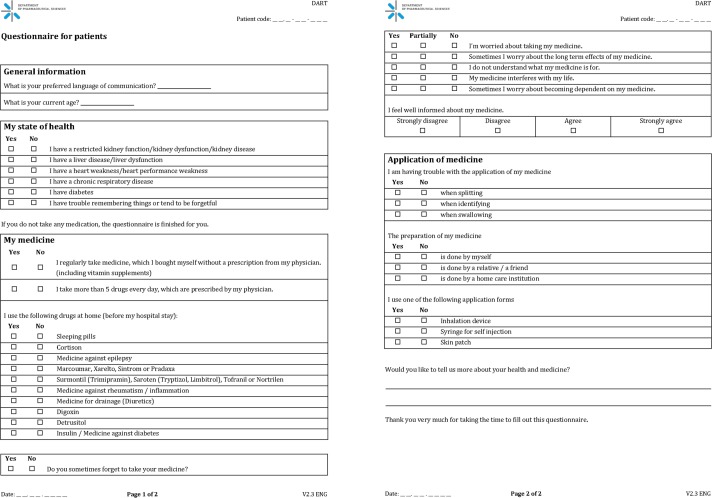
Methods: Twenty-seven risk factors for the development of DRPs, identified in a previous study, provided the basis of the self-assessment questionnaire, the Drug-Associated Risk Tool (DART). Consenting patients filled in DART, and we compared their answers with objective patient data from medical records and laboratory data.
Results: One hundred and sixty-four patients filled in DART V.1.0 in an average time of 7 min. After a first validation, we identified statements with a low sensitivity and revised the wording of the questions related to heart insufficiency, renal impairment or liver impairment. The revised DART (V.2.0) was validated in 31 patients presenting heart insufficiency, renal impairment or liver impairment as comorbidity and reached an average specificity of 88% (range 27-100) and an average sensitivity of 67% (range 21-100).
Conclusions: DART showed a satisfying feasibility and reliability. The specificity of the statements was mostly high. The sensitivity varied and was higher in statements concerning diseases that require regular disease control and attention to self-care and drug management. Asking patients about their conditions, medications and related problems can facilitate getting a first, broad picture of the risk for DRPs and possible pharmaceutical needs.
Keywords: drug-related problems; risk management; self-assessment questionnaire.
© Article author(s) (or their employer(s) unless otherwise stated in the text of the article) 2018. All rights reserved. No commercial use is permitted unless otherwise expressly granted.
Conflict of interest statement
Competing interests: None declared.
Figures

References
-
- Pharmaceutical Care Network Europe (PCNE). The definition of drug-related problems. 2009. http://www.pcne.org/sig/drp/drug-related-problems.php (accessed 10 Nov 2016).
-
- Krähenbühl-Melcher A, Schlienger R, Lampert M, et al. Drug-related problems in hospitals: a review of the recent literature. Drug Saf 2007;30:379–407. - PubMed
Publication types
MeSH terms
LinkOut - more resources
Full Text Sources
Other Literature Sources
Medical
