


Comment
doi: 10.1038/s41418-018-0075-x.
Epub 2018 Mar 9.
RIP3 is an upregulator of aerobic metabolism and the enhanced respiration by necrosomal RIP3 feeds back on necrosome to promote necroptosis
Affiliations
- PMID: 29523873
- PMCID: PMC5943361
- DOI: 10.1038/s41418-018-0075-x
Item in Clipboard
Comment
RIP3 is an upregulator of aerobic metabolism and the enhanced respiration by necrosomal RIP3 feeds back on necrosome to promote necroptosis
Cell Death Differ.
2018 May.
No abstract available
Conflict of interest statement
The authors declare that they have no conflict of interest.
Figures
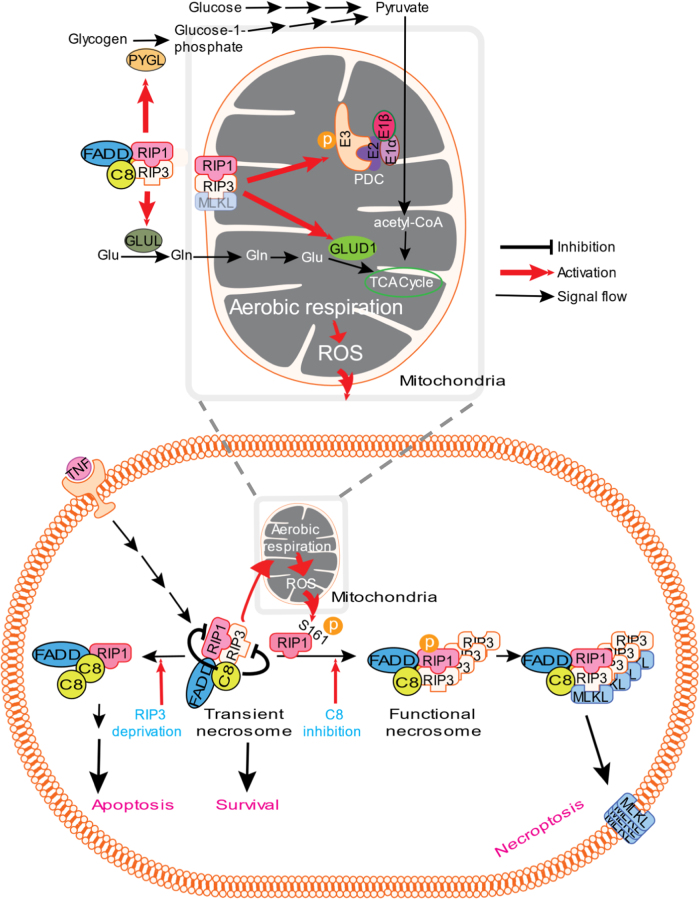
Model of TNF-induced cell death. In most types of cells FADD, caspase-8 (C8), RIP1, and RIP3 form complex (necrosome) upon TNF stimulation. Necrosome at this stage is transient due to that C8 cuts RIP1 and RIP3, and thus no death signal is transduced. Inhibition of C8 stabilizes necrosome and thus allows the signal to flow toward necroptosis. This News & Views focuses on another driving force—RIP3-mediated enhancement of aerobic respiration—which pushes necroptosis-prone cells towards necroptosis. RIP3 in either cytosol- or mitochondrion-associated necrosome is involved in the activation of metabolic enzymes with different subcellular locations (upper, enlarged schematic diagram). PYGL, PDC, GLUL, and GLUD1 are activated by RIP3, and the activation of PDC contributes more than the others to RIP3-mediated enhancement of aerobic respiration. ROS produced by the enhanced respiration promote the formation of functional necrosome via oxidation of RIP1 and subsequent RIP1 autophosphorylation on serine 161
Comment on
-
RIP3 targets pyruvate dehydrogenase complex to increase aerobic respiration in TNF-induced necroptosis.Nat Cell Biol. 2018 Feb;20(2):186-197. doi: 10.1038/s41556-017-0022-y. Epub 2018 Jan 22. Nat Cell Biol. 2018. PMID: 29358703
References
Publication types
MeSH terms
Substances
LinkOut - more resources
Full Text Sources
Other Literature Sources
Miscellaneous
