


Steps Towards Alcohol Misuse Prevention Programme (STAMPP): a school-based and community-based cluster randomised controlled trial
- PMID: 29525770
- PMCID: PMC5879538
- DOI: 10.1136/bmjopen-2017-019722
Steps Towards Alcohol Misuse Prevention Programme (STAMPP): a school-based and community-based cluster randomised controlled trial
Abstract
Objectives: To assess the effectiveness of a combined classroom curriculum and parental intervention (the Steps Towards Alcohol Misuse Prevention Programme (STAMPP)), compared with alcohol education as normal (EAN), in reducing self-reported heavy episodic drinking (HED) and alcohol-related harms (ARHs) in adolescents.
Setting: 105 high schools in Northern Ireland (NI) and in Scotland.
Participants: Schools were stratified by free school meal provision. Schools in NI were also stratified by school type (male/female/coeducational). Eligible students were in school year 8/S1 (aged 11-12 years) at baseline (June 2012).
Intervention: A classroom-based alcohol education intervention, coupled with a brief alcohol intervention for parents/carers. PRIMARY OUTCOMES: (1) The prevalence of self-reported HED in the previous 30 days and (2) the number of self-reported ARHs in the previous 6 months. Outcomes were assessed using two-level random intercepts models (logistic regression for HED and negative binomial for number of ARHs).
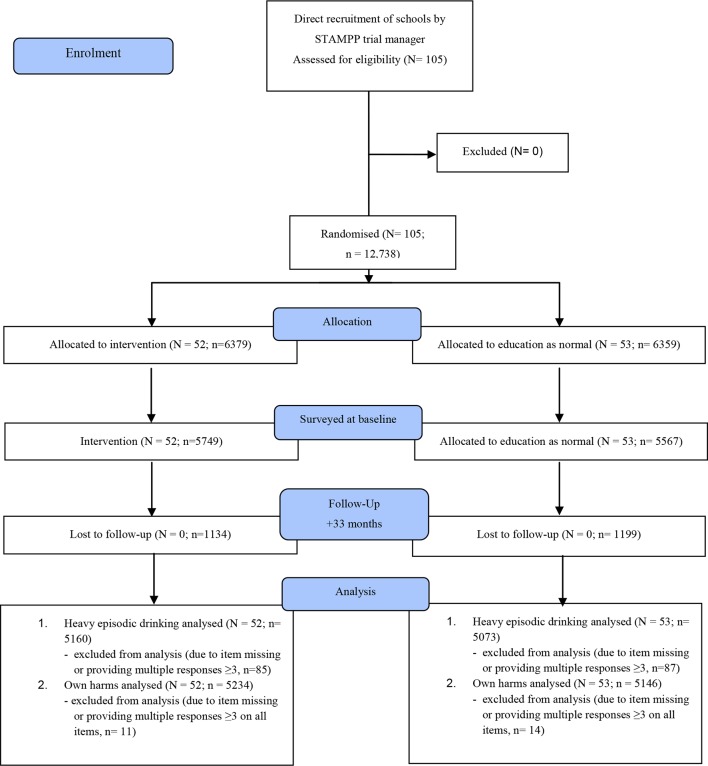
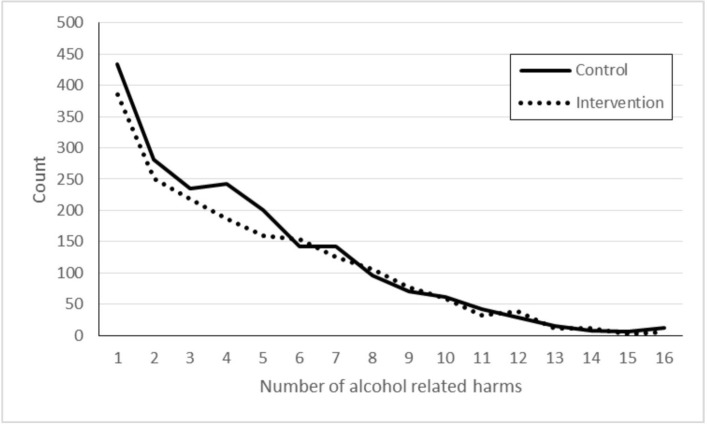
Results: At 33 months, data were available for 5160 intervention and 5073 control students (HED outcome), and 5234 and 5146 students (ARH outcome), respectively. Of those who completed a questionnaire at either baseline or 12 months (n=12 738), 10 405 also completed the questionnaire at 33 months (81.7%). Fewer students in the intervention group reported HED compared with EAN (17%vs26%; OR=0.60, 95% CI 0.49 to 0.73), with no significant difference in the number of self-reported ARHs (incident rate ratio=0.92, 95% CI 0.78 to 1.05). Although the classroom component was largely delivered as intended, there was low uptake of the parental component. There were no reported adverse effects.
Conclusions: Results suggest that STAMPP could be an effective programme to reduce HED prevalence. While there was no significant reduction in ARH, it is plausible that effects on harms would manifest later.
Trial registration number: ISRCTN47028486; Post-results.
Keywords: adolescents; alcohol; alcohol related harm; prevention; school based intervention; universal prevention.
© Article author(s) (or their employer(s) unless otherwise stated in the text of the article) 2018. All rights reserved. No commercial use is permitted unless otherwise expressly granted.
Conflict of interest statement
Competing interests: The sponsor university (LJMU) received and administered a payment from the alcohol industry for printing of student workbooks in the Glasgow trial site only. AP reported that he has previously received funding from the European Foundation of Alcohol Research (ERAB) in relation to the development of statistical models for longitudinal data (2008–2010). DF reported that his department has previously received funding from the alcohol industry for unrelated prevention programme training work. HS reported that his department has previously received funding from the alcohol industry (indirectly via the industry funded Drinkaware charity) for unrelated primary research.
Figures
References
-
- Bellis MA, Morleo M, Hughes K, et al. . A cross-sectional survey of compliance with national guidance for alcohol consumption by children: measuring risk factors, protective factors and social norms for excessive and unsupervised drinking. BMC Public Health 2010;10:8 10.1186/1471-2458-10-547 - DOI - PMC - PubMed
Publication types
MeSH terms
Associated data
LinkOut - more resources
Full Text Sources
Other Literature Sources
Medical
