


Randomised feasibility study to compare the use of Therabite® with wooden spatulas to relieve and prevent trismus in patients with cancer of the head and neck
- PMID: 29526341
- PMCID: PMC5948182
- DOI: 10.1016/j.bjoms.2018.02.012
Randomised feasibility study to compare the use of Therabite® with wooden spatulas to relieve and prevent trismus in patients with cancer of the head and neck
Abstract
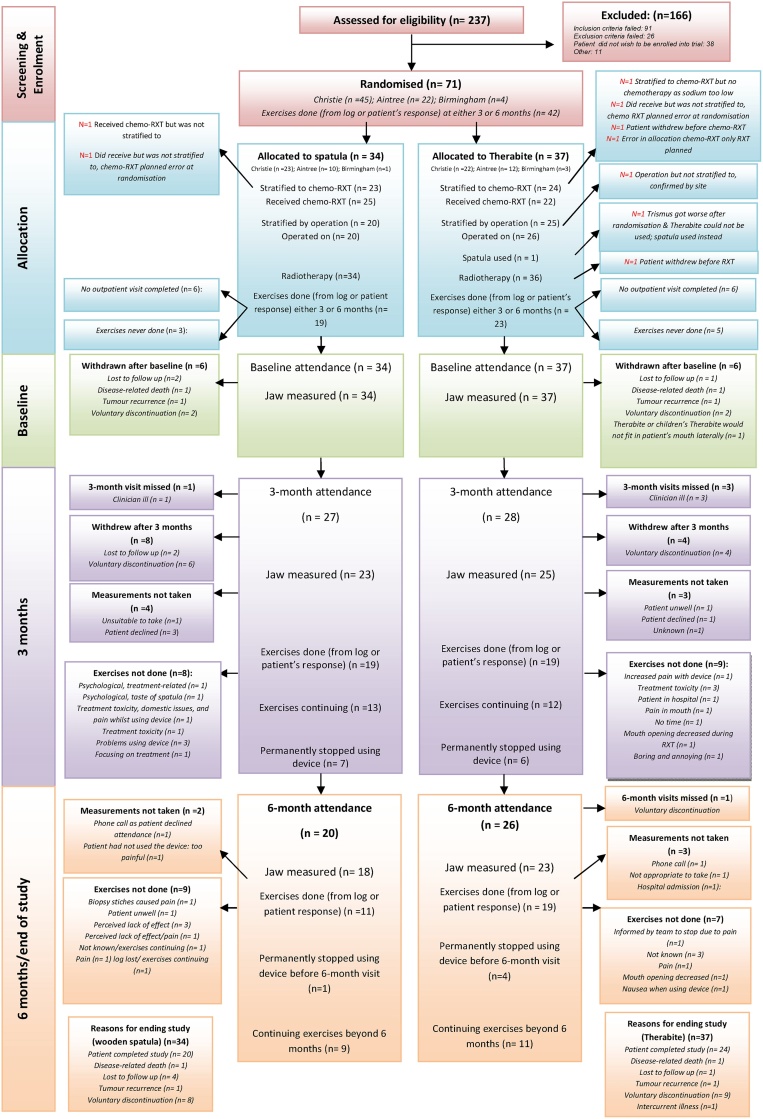
Our aim was to compare the efficacy of the Therabite® jaw motion rehabilitation system (Atos Medical) with that of wooden spatulas to relieve and prevent trismus in patients who have had radiotherapy for stage three and four oral and oropharyngeal cancer. Secondary aims were to assess the feasibility and the impact of exercise on health-related quality of life (QoL), and the use of health services after treatment. We designed a randomised, open-label, controlled, three-centre feasibility study to compare the effectiveness and cost of the Therabite® and wooden spatulas. We studied compliance with exercises and health-related QoL, assessed cost using three health economics measures, and conducted semistructured interviews with patients. Patients were randomised into two groups: the Therabite® group (n=37) and the wooden spatula group (n=34). All patients had some sense of jaw tightening before the study started. Mean mouth opening after six months increased in both groups, but the difference between the groups was not significant (p=0.39). Completion rates for the three economic measures were good. There was no significant difference between the two groups in frequency of contact with care services or in QoL. Exercises during and after radiotherapy can ameliorate trismus in patients with stage three and four oral and oropharygeal cancers, but differences between groups in efficacy, compliance, QoL, or use of hospital or community health services, were not significant.
Trial registration: ClinicalTrials.gov NCT01733797.
Keywords: Exercises; Feasibility; Head and Neck cancer; Health economics; Randomised trial; Trismus.
Copyright © 2018 The Authors. Published by Elsevier Ltd.. All rights reserved.
References
-
- Lee R., Slevin N., Musgrove B. Prediction of post-treatment trismus in head and neck cancer patients. Br J Oral Maxillofac Surg. 2012;50:328–332. - PubMed
-
- Dijkstra P.U., Huisman P.M., Roodenburg J.L. Criteria for trismus in head and neck oncology. Int J Oral Maxillofac Surg. 2006;35:337–342. - PubMed
-
- Weber C., Dommerich S., Pau H.W. Limited mouth opening after primary therapy of head and neck cancer. Oral Maxillofac Surg. 2010;14:169–173. - PubMed
-
- Scott B., Butterworth C., Lowe D. Factors associated with restricted mouth opening and its relationship to health-related quality of life in patients attending a maxillofacial oncology clinic. Oral Oncol. 2008;44:430–438. - PubMed
-
- Louise Kent L., Brennan M.T., Noll J.L. Radiation-induced trismus in head and neck cancer patients. Support Care Cancer. 2008;16:305––309. - PubMed
Publication types
MeSH terms
Associated data
Grants and funding
LinkOut - more resources
Full Text Sources
Other Literature Sources
Medical
Molecular Biology Databases
