


Patients with anomalous aortic origin of the coronary artery remain at risk after surgical repair
- PMID: 29526358
- PMCID: PMC5960432
- DOI: 10.1016/j.jtcvs.2017.12.134
Patients with anomalous aortic origin of the coronary artery remain at risk after surgical repair
Abstract
Objectives: Anomalous aortic origin of a coronary artery (AAOCA) from the opposite sinus of Valsalva is a rare cardiac anomaly associated with sudden cardiac death (SCD). Single-center studies describe surgical repair as safe, although medium- and long-term effects on symptoms and risk of SCD remain unknown. We sought to describe outcomes of surgical repair of AAOCA.
Methods: We reviewed institutional records for patients who underwent AAOCA repair, from 2001 to 2016, at 2 affiliated institutions. Patients with associated heart disease were excluded.
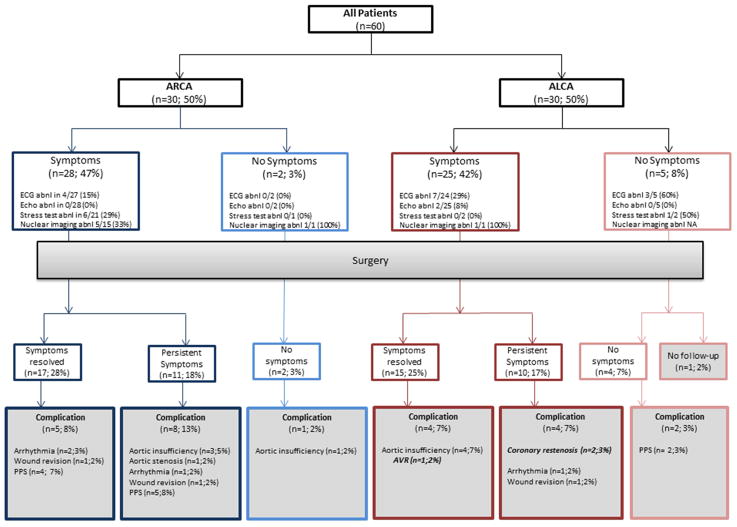
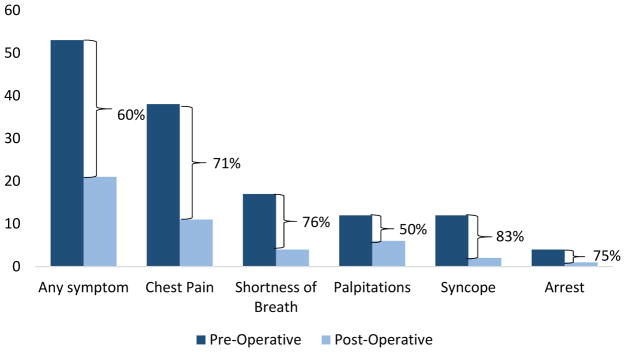
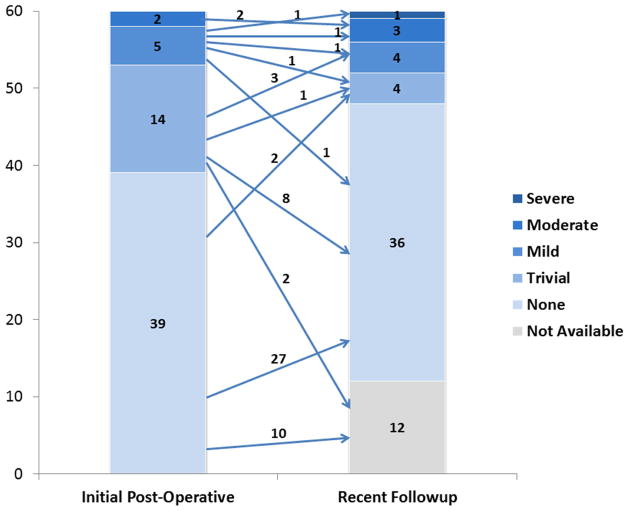
Results: In total, 60 patients underwent AAOCA repair. Half of the patients (n = 30) had an anomalous left coronary artery arising from the right sinus of Valsalva and half had an anomalous right. Median age at surgery was 15.4 years (interquartile range, 11.9-17.9 years; range, 4 months to 68 years). The most common presenting symptoms were chest pain (n = 38; 63%) and shortness of breath (n = 17; 28%); aborted SCD was the presenting symptom in 4 patients (7%). Follow-up data were available for 54 patients (90%) over a median of 1.6 years. Of 53 patients with symptoms at presentation, 34 (64%) had complete resolution postoperatively. Postoperative mild or greater aortic insufficiency was present in 8 patients (17%) and moderate supravalvar aortic stenosis in 1 (2%). One patient required aortic valve replacement for aortic insufficiency. Two patients required reoperation for coronary stenosis at 3 months and 6 years postoperatively.
Conclusions: Surgical repair of AAOCA is generally safe and adverse events are rare. Restenosis, and even sudden cardiac events, can occur and long-term surveillance is critical. Multi-institutional collaboration is vital to identify at-risk subpopulations and refine current recommendations for long-term management.
Keywords: anomalous coronary artery; congenital heart disease; congenital heart surgery; pediatrics; sudden death.
Copyright © 2018 The American Association for Thoracic Surgery. Published by Elsevier Inc. All rights reserved.
Conflict of interest statement
None of the authors have any conflicts of interest to disclose. Funding was provided through the Division of Cardiac, Thoracic and Vascular Surgery at Columbia University.
Figures

Comment in
-
QED? Not yet!J Thorac Cardiovasc Surg. 2018 Jun;155(6):2565-2566. doi: 10.1016/j.jtcvs.2018.01.050. Epub 2018 Feb 8. J Thorac Cardiovasc Surg. 2018. PMID: 29501233 No abstract available.
-
Discussion.J Thorac Cardiovasc Surg. 2018 Jun;155(6):2562-2564. doi: 10.1016/j.jtcvs.2017.12.142. Epub 2018 Mar 8. J Thorac Cardiovasc Surg. 2018. PMID: 29526359 No abstract available.
References
-
- Taylor AJ, Byers JP, Cheitlin MD, Virmani R. Anomalous right or left coronary artery from the contralateral coronary sinus: “High-risk” abnormalities in the initial coronary artery course and heterogeneous clinical outcomes. Am Heart J. 1997;133(4):428–435. doi: 10.1016/S0002-8703(97)70184-4. - DOI - PubMed
-
- Taylor AJ, Rogan KM, Virmani R. Sudden cardiac death associated with isolated congenital coronary artery anomalies. J Am Coll Cardiol. 1992;20(3):640–647. http://www.ncbi.nlm.nih.gov/pubmed/1512344. - PubMed
MeSH terms
Grants and funding
LinkOut - more resources
Full Text Sources
Other Literature Sources
Medical
