


Rehabilitation following rotator cuff repair: A work of the Commission Rehabilitation of the German Society of Shoulder and Elbow Surgery e. V. (DVSE) in collaboration with the German Association for Physiotherapy (ZVK) e. V., the Association Physical Therapy, Association for Physical Professions (VPT) e. V. and the Section Rehabilitation-Physical Therapy of the German Society for Orthopaedics and Trauma e. V. (DGOU)
- PMID: 29527239
- PMCID: PMC5834570
- DOI: 10.1007/s11678-018-0448-2
Rehabilitation following rotator cuff repair: A work of the Commission Rehabilitation of the German Society of Shoulder and Elbow Surgery e. V. (DVSE) in collaboration with the German Association for Physiotherapy (ZVK) e. V., the Association Physical Therapy, Association for Physical Professions (VPT) e. V. and the Section Rehabilitation-Physical Therapy of the German Society for Orthopaedics and Trauma e. V. (DGOU)
Abstract
Background: Tears and lesions of the rotator cuff are a frequent cause of shoulder pain and disability. Surgical repair of the rotator cuff is a valuable procedure to improve shoulder function and decrease pain. However, there is no consensus concerning the rehabilitation protocol following surgery.
Objectives: To review and evaluate current rehabilitation contents and protocols after rotator cuff repair by reviewing the existing scientific literature and providing an overview of the clinical practice of selected German Society of Shoulder and Elbow Surgery e. V. (DVSE) shoulder experts.
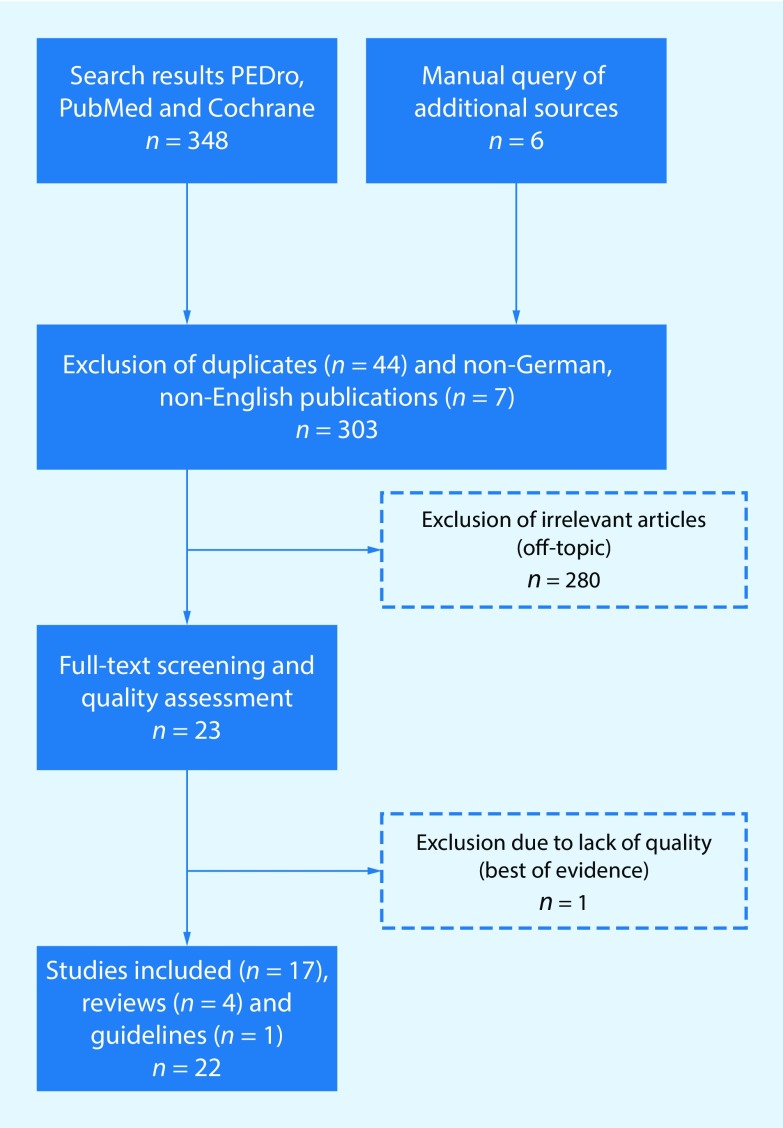
Materials and methods: A literature search for the years 2004-2014 was conducted in relevant databases and bibliographies including the Guidelines International Network, National Guidelines, PubMed, Cochrane CentralRegister of Controlled Trials, Cochrane Database of Systematic Reviews, and the Physiotherapy Evidence Database. In addition, 63 DVSE experts were contacted via online questionnaire.
Results: A total of 17 studies, four reviews and one guideline fulfilled the inclusion criteria. Based on these results and the obtained expert opinions, a four-phase rehabilitation protocol could be developed.
Keywords: Cuff tear; Physiotherapy; Rotator cuff repair; Tendon reconstruction; Treatment outcome.
Conflict of interest statement
Compliance with ethical guidelinesC. Jung, L. Tepohl, R. Tholen, K. Beitzel, S. Buchmann, T. Gottfried, C. Grim, B. Mauch, G. Krischak, H. Ortmann, C. Schoch and F. Mauch declare that they have no competing interests. This article does not contain any studies with human participants or animals performed by any of the authors.
References
-
- Blum K, Chen AL, Chen TJ, et al. Repetitive H‑wave device stimulation and program induces significant increases in the range of motion of post operative rotator cuff reconstruction in a double-blinded randomized placebo controlled human study. BMC Musculoskelet Disord. 2009;10:132. doi: 10.1186/1471-2474-10-132. - DOI - PMC - PubMed
Publication types
LinkOut - more resources
Full Text Sources
Other Literature Sources