


Short-chain perfluoroalkyl acids: environmental concerns and a regulatory strategy under REACH
- PMID: 29527446
- PMCID: PMC5834591
- DOI: 10.1186/s12302-018-0134-4
Short-chain perfluoroalkyl acids: environmental concerns and a regulatory strategy under REACH
Abstract
Background: Short-chain PFASs (per- and polyfluoroalkyl substances) are widely used as alternatives to long-chain PFASs. Long-chain PFASs become gradually regulated under REACH (EC No. 1907/2006) and other international regulations, due to having persistent, bioaccumulative and toxic properties and/or being toxic for reproduction. The increasingly used short-chain PFASs are assumed to have a lower bioaccumulation potential. Nonetheless, they have other properties of concern and are already widely distributed in the environment, also in remote regions. The REACH Regulation does not directly address these emerging properties of concern, complicating the implementation of regulatory measures. Therefore, this study illustrates these environmental concerns and provides a strategy for a regulation of short-chain PFASs within REACH.
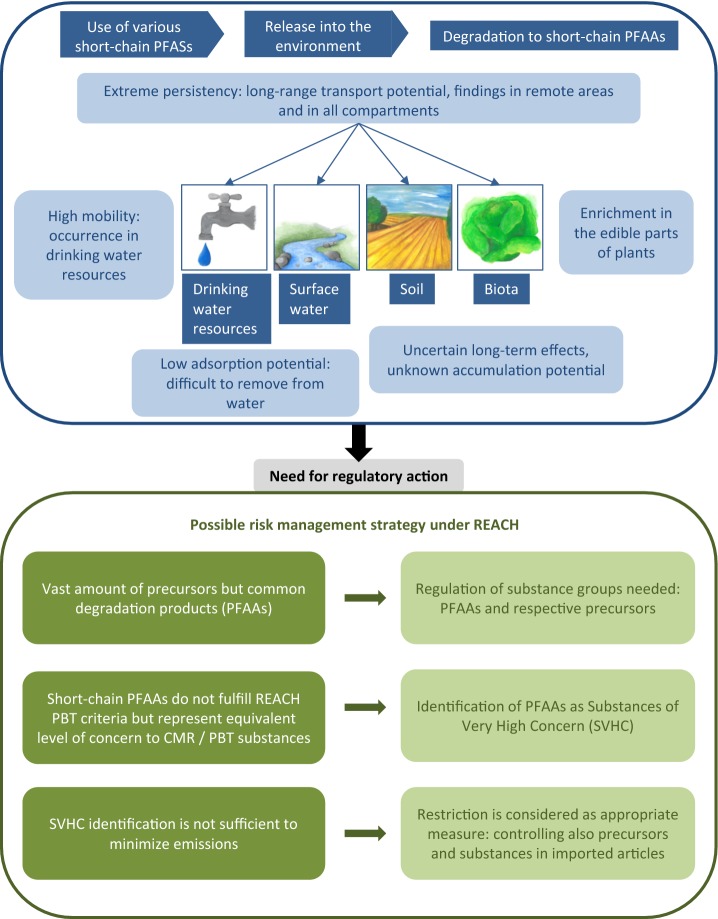
Results: Short-chain PFASs have a high mobility in soil and water, and final degradation products are extremely persistent. This results in a fast distribution to water resources, and consequently, also to a contamination of drinking water resources. Once emitted, short-chain PFASs remain in the environment. A lack of appropriate water treatment technologies results in everlasting background concentrations in the environment, and thus, organisms are permanently and poorly reversibly exposed. Considering such permanent exposure, it is very difficult to estimate long-term adverse effects in organisms. Short-chain PFASs enrich in edible parts of plants and the accumulation in food chains is unknown. Regarding these concerns and uncertainties, especially with respect to the precautionary principle, short-chain PFASs are of equivalent concern to PBT substances. Therefore, they should be identified as substances of very high concern (SVHC) under REACH. The SVHC identification should be followed by a restriction under REACH, which is the most efficient way to minimize the environmental and human exposure of short-chain PFASs in the European Union.
Conclusion: Due to an increasing use of short-chain PFASs, an effective regulation is urgently needed. The concerns of short-chain PFASs do not match the "classical" concerns as defined under REACH, but are not of minor concern. Therefore, it is of advantage to clearly define the concerns of short-chain PFASs. This might facilitate the following restriction process under REACH.
Keywords: Candidate list; PFAAs; PFASs; Per- and polyfluoroalkyl substances; REACH; Regulation; Restriction; SVHC.
Figures
References
-
- Kirsch P. Modern fluoroorganic chemistry: synthesis, reactivity, applications. Hoboken: Wiley; 2013.
-
- Siegemund G, Schwertfeger W, Feiring A, Smart B, Behr F, Vogel H, McKusick B, Kirsch P. Fluorine compounds, organic. Ullmann’s encyclopedia of industrial chemistry. Weinheim: Wiley-VCH Verlag GmbH & Co. KGaA; 2000.
-
- Buck RC, Franklin J, Berger U, Conder JM, Cousins IT, De Voogt P, Jensen AA, Kannan K, Mabury SA, van Leeuwen SP. Perfluoroalkyl and polyfluoroalkyl substances in the environment: terminology, classification, and origins. Integr Environ Assess Manag. 2011;7:513–541. doi: 10.1002/ieam.258. - DOI - PMC - PubMed
-
- Swedish Chemicals Agency (2015) Occurrence and use of highly fluorinated substances and alternatives. www.kemi.se/en/global/rapporter/2015/report-7-15-occurrence-and-use-of-h.... Accessed 15 Jan 2018
LinkOut - more resources
Full Text Sources
Other Literature Sources