Comment
. 2018 Apr 2;128(4):1264-1266.
doi: 10.1172/JCI120260. Epub 2018 Mar 12.

What goes around comes around: modeling malaria transmission from humans back to mosquitos

Affiliations
Comment

What goes around comes around: modeling malaria transmission from humans back to mosquitos

Kazutoyo Miura et al. J Clin Invest. .

Abstract

Malaria, caused by mosquito-transmitted Plasmodium parasites, continues to take a major toll on global health. The development of drugs and vaccines that reduce malaria transmission from humans back to mosquitos could contribute to the control and eventual eradication of malaria, but research models for the early clinical evaluation of candidate interventions are lacking. In this issue of the JCI, Collins and colleagues report the successful transmission of Plasmodium falciparum parasites from humans to mosquitoes during controlled human malaria infection, thus providing a potential tool to accelerate the development of much needed transmission-blocking drugs and vaccines.


Conflict of interest statement

Conflict of interest: The authors have declared that no conflict of interest exists.

Figures

Figure 1
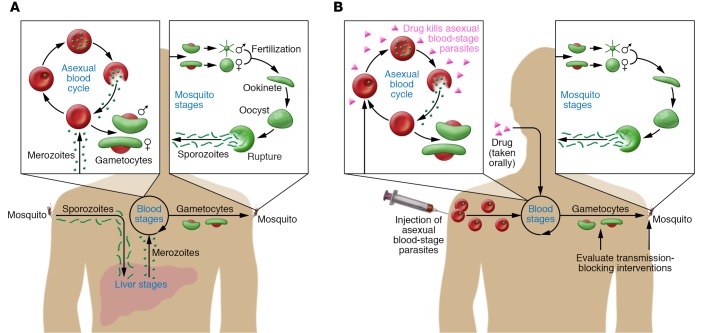
Figure 1. P. falciparum malaria: the life cycle of natural infection and a new model of human-to-mosquito transmission.
(A) Natural P. falciparum infection begins in humans when Anopheles mosquitos inject sporozoites into the skin and blood. Sporozoites migrate to the liver and invade hepatocytes, where they differentiate into merozoites and replicate asexually without causing symptoms. After seven to ten days, merozoites exit the liver into the bloodstream and begin a 48-hour cycle of asexual replication within erythrocytes. Asexual blood-stage parasites cause disease by triggering inflammation and sequestering in blood vessels of vital organs. A small percentage of blood-stage parasites differentiate into male and female gametocytes — the nonpathogenic sexual forms taken up by mosquitos during blood meals. In the mosquito, gametes fuse and ultimately form sporozoites that migrate to the mosquito salivary gland to complete the life cycle. (B) In this issue, Collins and colleagues describe a new model of malaria transmission from humans to mosquitoes using CHMI. P. falciparum–infected erythrocytes were inoculated intravenously into malaria-naive adults, bypassing the liver and directly establishing a blood-stage infection. The drug piperaquine, which is selectively active against asexual blood-stage parasites, was administered orally seven to eight days later to attenuate the replication of pathogenic asexual parasites while allowing nonpathogenic gametocytes to develop and mature. The transmissibility of gametocytes from humans to mosquitos was assessed either directly by feeding laboratory-reared mosquitoes on the skin of infected subjects or indirectly with assays in which infected blood is fed to mosquitoes through an artificial membrane. All subjects received a curative course of antimalarial drugs at the end of the study.

Comment on

References

    1. World Health Organization. World Malaria Report 2017. WHO Website. http://www.who.int/malaria/publications/world-malaria-report-2017/en/ Accessed February 20, 2018.
    1. Bhatt S, et al. The effect of malaria control on Plasmodium falciparum in Africa between 2000 and 2015. Nature. 2015;526(7572):207–211. doi: 10.1038/nature15535. - DOI - PMC - PubMed
    1. Rabinovich RN, et al. malERA: An updated research agenda for malaria elimination and eradication. PLoS Med. 2017;14(11):e1002456. doi: 10.1371/journal.pmed.1002456. - DOI - PMC - PubMed
    1. malERA Refresh Consultative Panel on Tools for Malaria Elimination malERA: An updated research agenda for diagnostics, drugs, vaccines, and vector control in malaria elimination and eradication. PLoS Med. 2017;14(11):e1002455. doi: 10.1371/journal.pmed.1002455. - DOI - PMC - PubMed
    1. Collins KA, et al. A controlled human malaria infection model enabling evaluation of transmission-blocking interventions. J Clin Invest. 2018;128(4):1551–1562. doi: 10.1172/JCI98012. - DOI - PMC - PubMed

Publication types

Substances