


Transsaccadic Perception Deficits in Schizophrenia Reflect the Improper Internal Monitoring of Eye Movement Rather Than Abnormal Sensory Processing
- PMID: 29529412
- PMCID: PMC5851461
- DOI: 10.1016/j.bpsc.2017.06.004
Transsaccadic Perception Deficits in Schizophrenia Reflect the Improper Internal Monitoring of Eye Movement Rather Than Abnormal Sensory Processing
Abstract
Background: Symptoms of psychosis in schizophrenia reflect disturbances in sense of agency-difficulty distinguishing internally from externally generated sensory and perceptual experiences. One theory attributes these anomalies to a disruption in corollary discharge (CD), an internal copy of generated motor commands used to distinguish self-movement-generated sensations from externally generated stimulation.
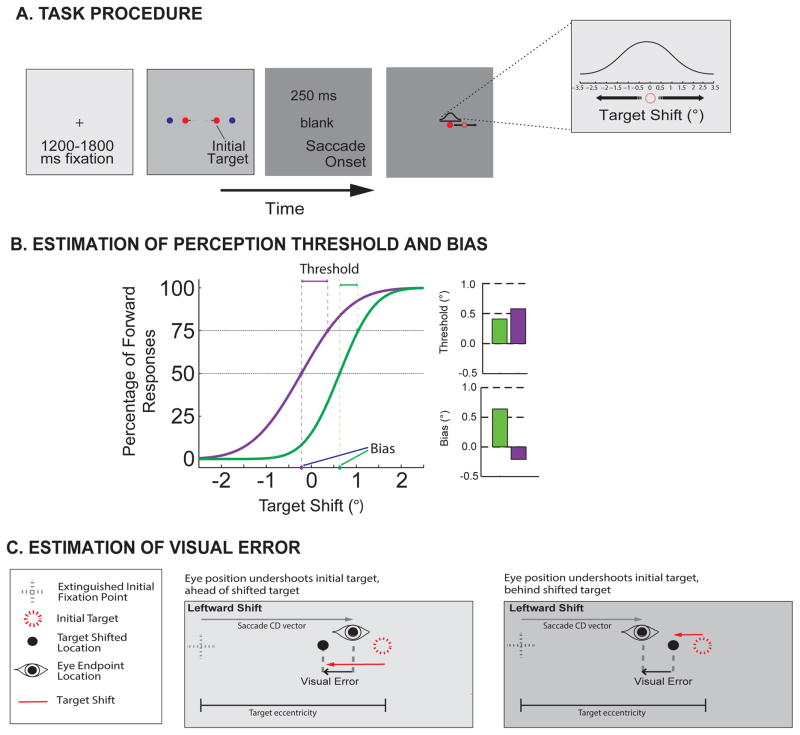
Methods: We used a transsaccadic shift detection paradigm to examine possible deficits in CD and sense of agency based on the ability to perceive visual changes in 31 schizophrenia patients (SZPs) and 31 healthy control subjects. We derived perceptual measures based on manual responses indicating the transsaccadic target shift direction. We also developed a distance-from-unity-line measure to quantify use of CD versus purely sensory (visual) information in evaluating visual changes in the environment after an eye movement.
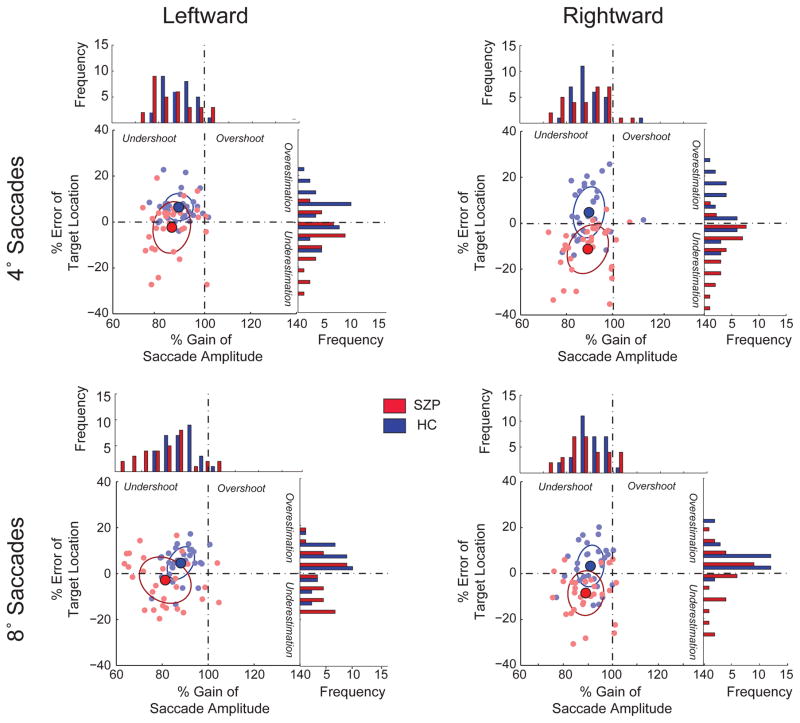
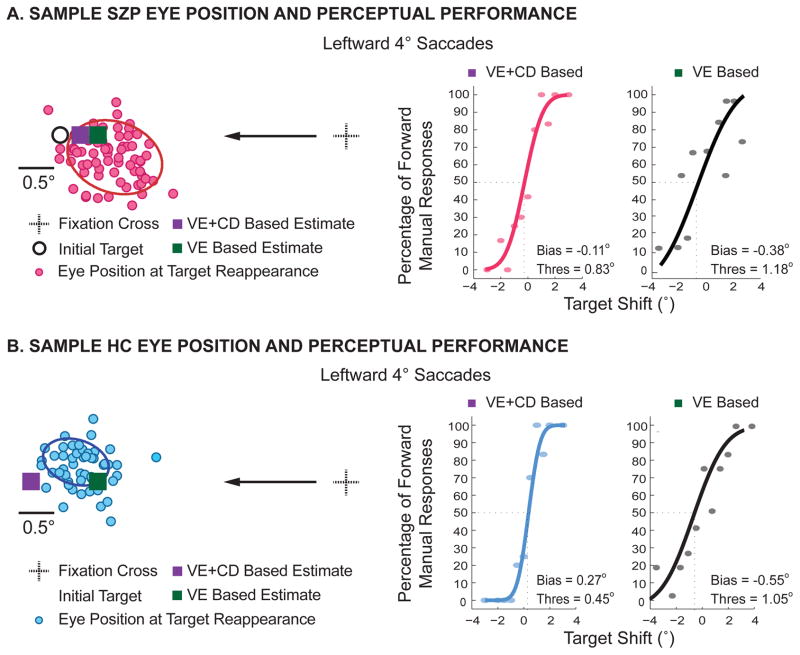
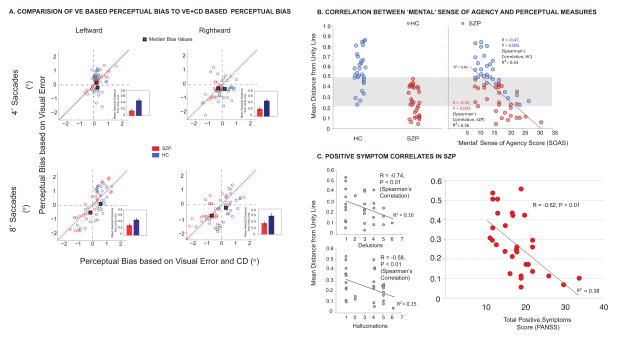
Results: SZPs had higher perceptual thresholds in detecting shift of target location than healthy control subjects, regardless of movement direction or amplitude. Despite producing similar hypometric saccades, healthy control subjects overestimated target location, whereas SZPs relied more on the experienced visual error and consequently underestimated the target position. We show that in SZPs the postsaccadic judgment of the initial target location was largely aligned with the measure based only on visual error, suggesting a deficit in the use of CD. This CD deficit also correlated with positive schizophrenia symptoms and disturbances in sense of agency.
Conclusions: These results provide a novel approach in quantifying abnormal use of CD in SZPs and provide a framework to distinguish deficits in sensory processing versus defects in the internal CD-based monitoring of movement.
Keywords: Corollary discharge; Positive symptoms; Saccade; Schizophrenia; Sense of agency; Visual perception.
Copyright © 2017 Society of Biological Psychiatry. All rights reserved.
Figures
Comment in
-
Saccadic Eye Movement System and Agency Disorders: Yes, They Are Related!Biol Psychiatry Cogn Neurosci Neuroimaging. 2018 Feb;3(2):103-104. doi: 10.1016/j.bpsc.2017.12.005. Epub 2018 Feb 5. Biol Psychiatry Cogn Neurosci Neuroimaging. 2018. PMID: 29529403 No abstract available.
References
-
- Haggard P, Martin F, Taylor-Clarke M, Jeannerod M, Franck N. Awareness of action in schizophrenia. Neuroreport. 2003;14(7):1081–1085. - PubMed
-
- Keefe RSE, Arnold MC, Bayen UJ, McEvoy JP, Wilson WH. Source-monitoring deficits for self-generated stimuli in schizophrenia: Multinomial modeling of data from three sources. Schizophrenia Research. 2002;57:51–67. - PubMed
-
- Gallagher S. Neurocognitive models of schizophrenia: a neurophenomenological critique. Psychopathology. 2004;37(1):8–19. - PubMed
-
- Maeda T, Kato M, Muramatsu T, Iwashita S, Mimura M, Kashima H. Aberrant sense of agency in patients with schizophrenia: Forward and backward over-attribution of temporal causality during intentional action. Psychiatry research. 2012;198(1):1–6. - PubMed
-
- Maeda T, Takahata K, Muramatsu T, Okimura T, Koreki A, Iwashita S, Kato M. Reduced sense of agency in chronic schizophrenia with predominant negative symptoms. Psychiatry research. 2013;209(3):386–392. - PubMed
Publication types
MeSH terms
Grants and funding
LinkOut - more resources
Full Text Sources
Other Literature Sources
Medical
Molecular Biology Databases
