


Efficacy of Guided iCBT for Depression and Mediation of Change by Cognitive Skill Acquisition
- PMID: 29530267
- PMCID: PMC5853137
- DOI: 10.1016/j.beth.2017.04.004
Efficacy of Guided iCBT for Depression and Mediation of Change by Cognitive Skill Acquisition
Abstract
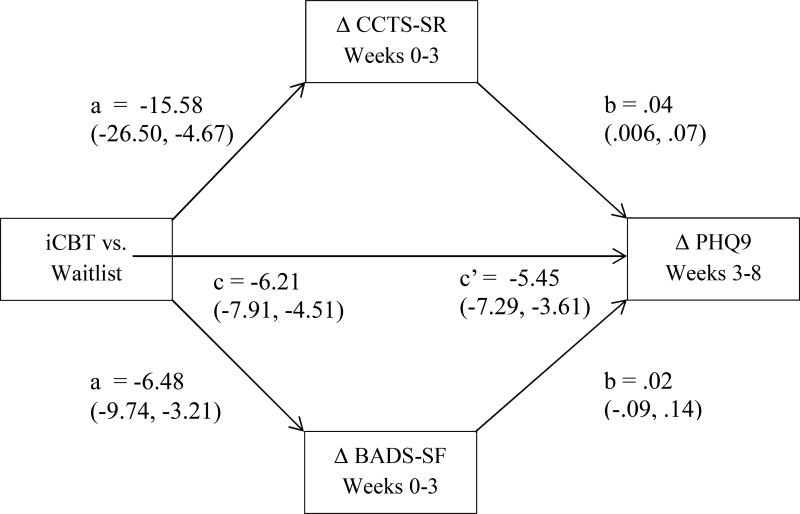
Guided internet CBT (iCBT) is a promising treatment for depression; however, it is less well known through what mechanisms iCBT works. Two possible mediators of change are the acquisition of cognitive skills and increases in behavioral activation. We report results of an 8-week waitlist controlled trial of guided iCBT, and test whether early change in cognitive skills or behavioral activation mediated subsequent change in depression. The sample was 89 individuals randomized to guided iCBT (n = 59) or waitlist (n = 30). Participants were 75% female, 72% Caucasian, and 33 years old on average. The PHQ9 was the primary outcome measure. Mediators were the Competencies of Cognitive Therapy Scale-Self Report and the Behavioral Activation Scale for Depression-Short Form. Treatment was Beating the Blues plus manualized coaching. Outcomes were analyzed using linear mixed models, and mediation with a bootstrap resampling approach. The iCBT group was superior to waitlist, with large effect sizes at posttreatment (Hedges' g = 1.45). Dropout of iCBT was 29% versus 10% for waitlist. In the mediation analyses, the acquisition of cognitive skills mediated subsequent depression change (indirect effect = -.61, 95% bootstrapped biased corrected CI: -1.47, -0.09), but increases in behavioral activation did not. iCBT is an effective treatment for depression, but dropout rates remain high. Change in iCBT appears to be mediated by improvements in the use of cognitive skills, such as critically evaluating and restructuring negative thoughts.
Keywords: behavioral activation; cognitive skills; depression; guided iCBT; mediation.
Copyright © 2017. Published by Elsevier Ltd.
Conflict of interest statement
The authors declare that there are no conflicts of interest.
Figures
References
-
- Adler AD, Strunk DR, Fazio RH. What Changes in Cognitive Therapy for Depression? An Examination of Cognitive Therapy Skills and Maladaptive Beliefs. Behavior Therapy. 2015;46(1):96–109. https://doi.org/10.1016/j.beth.2014.09.001. - DOI - PMC - PubMed
-
- Andersson G, Cuijpers P. Internet-based and other computerized psychological treatments for adult depression: a meta-analysis. Cognitive Behaviour Therapy. 2009;38(4):196–205. https://doi.org/10.1080/16506070903318960. - DOI - PubMed
-
- Andersson G, Hesser H, Veilord A, Svedling L, Andersson F, Sleman O, Carlbring P. Randomised controlled non-inferiority trial with 3-year follow-up of internet-delivered versus face-to-face group cognitive behavioural therapy for depression. Journal of Affective Disorders. 2013;151(3):986–994. https://doi.org/10.1016/j.jad.2013.08.022. - DOI - PubMed
-
- Andrews G, Cuijpers P, Craske MG, McEvoy P, Titov N. Computer therapy for the anxiety and depressive disorders is effective, acceptable and practical health care: a meta-analysis. PloS One. 2010;5(10):e13196. https://doi.org/10.1371/journal.pone.0013196. - DOI - PMC - PubMed
Publication types
MeSH terms
Grants and funding
LinkOut - more resources
Full Text Sources
Other Literature Sources
Medical
