


Increasing Resistance to Azithromycin in Neisseria gonorrhoeae in Eastern Chinese Cities: Resistance Mechanisms and Genetic Diversity among Isolates from Nanjing
- PMID: 29530847
- PMCID: PMC5923098
- DOI: 10.1128/AAC.02499-17
Increasing Resistance to Azithromycin in Neisseria gonorrhoeae in Eastern Chinese Cities: Resistance Mechanisms and Genetic Diversity among Isolates from Nanjing
Abstract
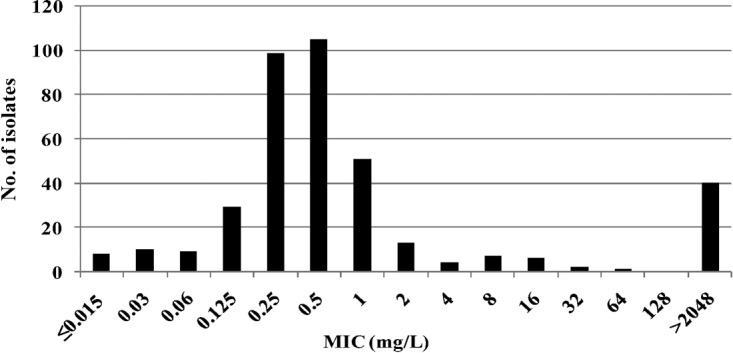
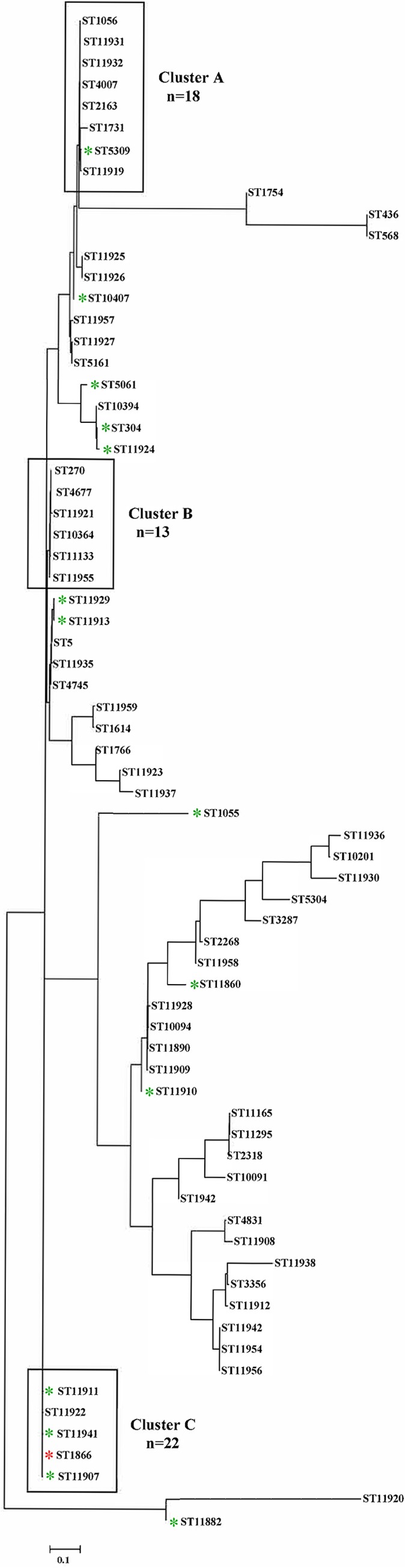
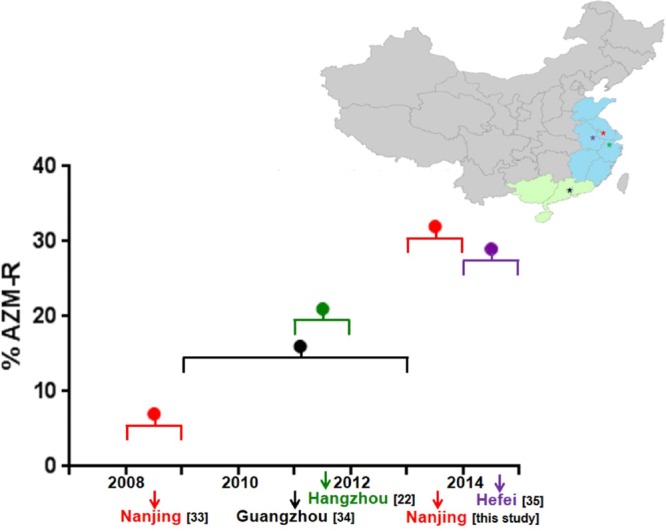
Azithromycin resistance (AZM-R) of Neisseria gonorrhoeae is emerging as a clinical and public health challenge. We determined molecular characteristics of recent AZM-R Nanjing gonococcal isolates and tracked the emergence of AZM-R isolates in eastern Chinese cities in recent years. A total of 384 N. gonorrhoeae isolates from Nanjing collected from 2013 to 2014 were tested for susceptibility to AZM and six additional antibiotics; all AZM-R strains were characterized genetically for resistance determinants by sequencing and were genotyped using N. gonorrhoeae multiantigen sequence typing (NG-MAST). Among the 384 isolates, 124 (32.3%) were AZM-R. High-level resistance (MIC, ≥256 mg/liter) was present in 10.4% (40/384) of isolates, all of which possessed the A2143G mutation in all four 23S rRNA alleles. Low- to mid-level resistance (MIC, 1 to 64 mg/liter) was present in 21.9% (84/384) of isolates, 59.5% of which possessed the C2599T mutation in all four 23S rRNA alleles. The 124 AZM-R isolates were distributed in 71 different NG-MAST sequence types (STs). ST1866 was the most prevalent type in high-level AZM-R (HL-AZM-R) isolates (45% [18/40]). This study, together with previous reports, revealed that the prevalence of AZM-R in N. gonorrhoeae isolates in certain eastern Chinese cities has risen >4-fold (7% to 32%) from 2008 to 2014. The principal mechanisms of AZM resistance in recent Nanjing isolates were A2143G mutations (high-level resistance) and C2599T mutations (low- to mid-level resistance) in the 23S rRNA alleles. Characterization of NG-MAST STs and phylogenetic analysis indicated the genetic diversity of N. gonorrhoeae in Nanjing; however, ST1866 was the dominant genotype associated with HL-AZM-R isolates.
Keywords: Neisseria gonorrhoeae; antimicrobial resistance; azithromycin; eastern Chinese cities; molecular epidemiology.
Copyright © 2018 Wan et al.
Figures
References
-
- Newman L, Rowley J, Vander Hoorn S, Wijesooriya NS, Unemo M, Low N, Stevens G, Gottlieb S, Kiarie J, Temmerman M. 2015. Global estimates of the prevalence and incidence of four curable sexually transmitted infections in 2012 based on systematic review and global reporting. PLoS One 10:e0143304. doi:10.1371/journal.pone.0143304. - DOI - PMC - PubMed
-
- National Health and Family Planning Commission of China. 2016. General situation of national legal infectious diseases in 2016. National Health and Family Planning Commission of China, Beijing, China: http://www.nhfpc.gov.cn/jkj/s3578/201702/38ca5990f8a54ddf9ca6308fec40615....
-
- Ohnishi M, Golparian D, Shimuta K, Saika T, Hoshina S, Iwasaku K, Nakayama S, Kitawaki J, Unemo M. 2011. Is Neisseria gonorrhoeae initiating a future era of untreatable gonorrhea? Detailed characterization of the first strain with high-level resistance to ceftriaxone. Antimicrob Agents Chemother 55:3538–3545. doi:10.1128/AAC.00325-11. - DOI - PMC - PubMed
-
- Martin I, Sawatzky P, Allen V, Hoang L, Lefebvre B, Mina N, Wong T, Gilmour M. 2012. Emergence and characterization of Neisseria gonorrhoeae isolates with decreased susceptibilities to ceftriaxone and cefixime in Canada: 2001–2010. Sex Transm Dis 39:316–323. doi:10.1097/OLQ.0b013e3182401b69. - DOI - PubMed
Publication types
MeSH terms
Substances
Grants and funding
LinkOut - more resources
Full Text Sources
Other Literature Sources
Medical
Molecular Biology Databases
