Imidazolopiperazines Kill both Rings and Dormant Rings in Wild-Type and K13 Artemisinin-Resistant Plasmodium falciparum In Vitro
- PMID: 29530849
- PMCID: PMC5923180
- DOI: 10.1128/AAC.02235-17
Imidazolopiperazines Kill both Rings and Dormant Rings in Wild-Type and K13 Artemisinin-Resistant Plasmodium falciparum In Vitro
Abstract
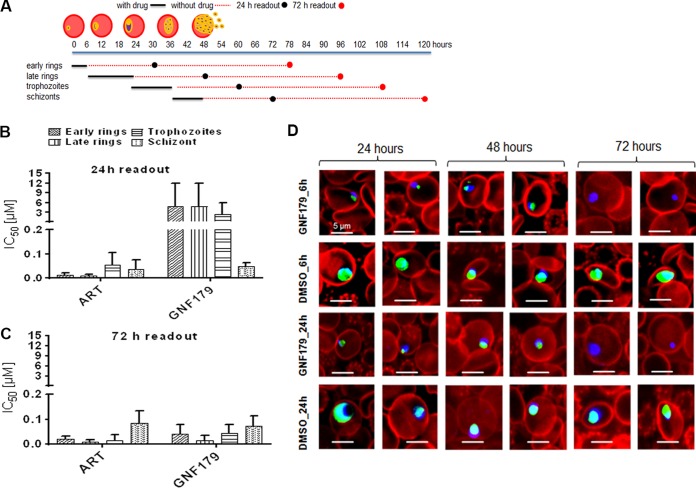
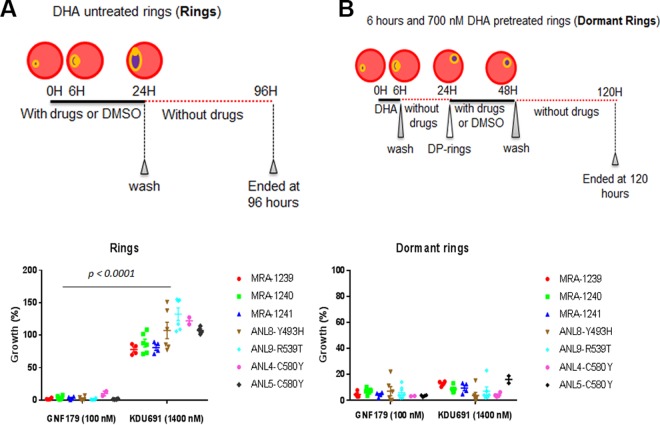
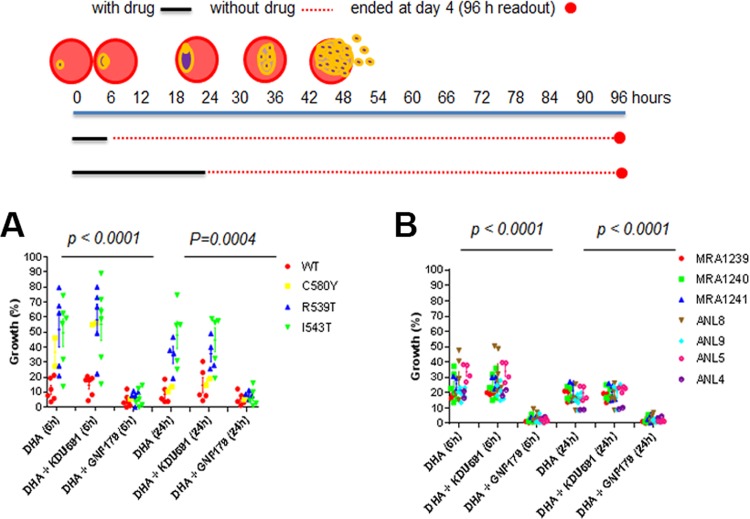
Artemisinin (ART) resistance has spread through Southeast Asia, posing a serious threat to the control and elimination of malaria. ART resistance has been associated with mutations in the Plasmodium falciparum kelch-13 (Pfk13) propeller domain. Phenotypically, ART resistance is defined as delayed parasite clearance in patients due to the reduced susceptibility of early ring-stage parasites to the active metabolite of ART dihydroartemisinin (DHA). Early rings can enter a state of quiescence upon DHA exposure and resume growth in its absence. These quiescent rings are referred to as dormant rings or DHA-pretreated rings (here called dormant rings). The imidazolopiperazines (IPZ) are a novel class of antimalarial drugs that have demonstrated efficacy in early clinical trials. Here, we characterized the stage of action of the IPZ GNF179 and evaluated its activity against rings and dormant rings in wild-type and ART-resistant parasites. Unlike DHA, GNF179 does not induce dormancy. We show that GNF179 is more rapidly cidal against schizonts than against ring and trophozoite stages. However, with 12 h of exposure, the compound effectively kills rings and dormant rings of both susceptible and ART-resistant parasites within 72 h. We further demonstrate that in combination with ART, GNF179 effectively prevents recrudescence of dormant rings, including those bearing pfk13 propeller mutations.
Keywords: GNF179; dormant rings; drug susceptibility; imidazolopiperazines; malaria; rings; triple therapy.
Copyright © 2018 Dembele et al.
Figures
References
-
- WHO. 2015. World malaria report. World Health Organization, Geneva, Switzerland.
-
- Dondorp AM, Nosten F, Yi P, Das D, Phyo AP, Tarning J, Lwin KM, Ariey F, Hanpithakpong W, Lee SJ, Ringwald P, Silamut K, Imwong M, Chotivanich K, Lim P, Herdman T, An SS, Yeung S, Singhasivanon P, Day NP, Lindegardh N, Socheat D, White NJ. 2009. Artemisinin resistance in Plasmodium falciparum malaria. N Engl J Med 361:455–467. doi:10.1056/NEJMoa0808859. - DOI - PMC - PubMed
-
- Phyo AP, Ashley EA, Anderson TJ, Bozdech Z, Carrara VI, Sriprawat K, Nair S, White MM, Dziekan J, Ling C, Proux S, Konghahong K, Jeeyapant A, Woodrow CJ, Imwong M, McGready R, Lwin KM, Day NP, White NJ, Nosten F. 2016. Declining efficacy of artemisinin combination therapy against P. falciparum malaria on the Thai-Myanmar border (2003-2013): the role of parasite genetic factors. Clin Infect Dis 63:784–791. doi:10.1093/cid/ciw388. - DOI - PMC - PubMed
-
- Leang R, Taylor WR, Bouth DM, Song L, Tarning J, Char MC, Kim S, Witkowski B, Duru V, Domergue A, Khim N, Ringwald P, Menard D. 2015. Evidence of Plasmodium falciparum malaria multidrug resistance to artemisinin and piperaquine in western Cambodia: dihydroartemisinin-piperaquine open-label multicenter clinical assessment. Antimicrob Agents Chemother 59:4719–4726. doi:10.1128/AAC.00835-15. - DOI - PMC - PubMed
Publication types
MeSH terms
Substances
LinkOut - more resources
Full Text Sources
Other Literature Sources
Research Materials