Treating Subthreshold Depression in Primary Care: A Randomized Controlled Trial of Behavioral Activation With Mindfulness
- PMID: 29531101
- PMCID: PMC5847348
- DOI: 10.1370/afm.2206
Treating Subthreshold Depression in Primary Care: A Randomized Controlled Trial of Behavioral Activation With Mindfulness
Abstract
Purpose: We undertook a randomized controlled trial to assess the efficacy of group-based behavioral activation with mindfulness (BAM) for treating subthreshold depression in primary care in Hong Kong.
Methods: We recruited adult patients aged 18 years or older with subthreshold depression from public primary care clinics and randomly assigned them to a BAM intervention group or a usual care group. The BAM group was provided with eight 2-hour weekly BAM sessions by trained allied health care workers. Patients in the usual care group received usual medical care with no additional psychological interventions. The primary outcome was depressive symptoms measured by the Beck Depression Inventory-II at 12 months. Secondary outcomes included incidence of major depressive disorder at 12 months. We assessed quality of life, activity and circumstances change, functional impairment, and anxiety at baseline, end of intervention, 5 months, and 12 months.
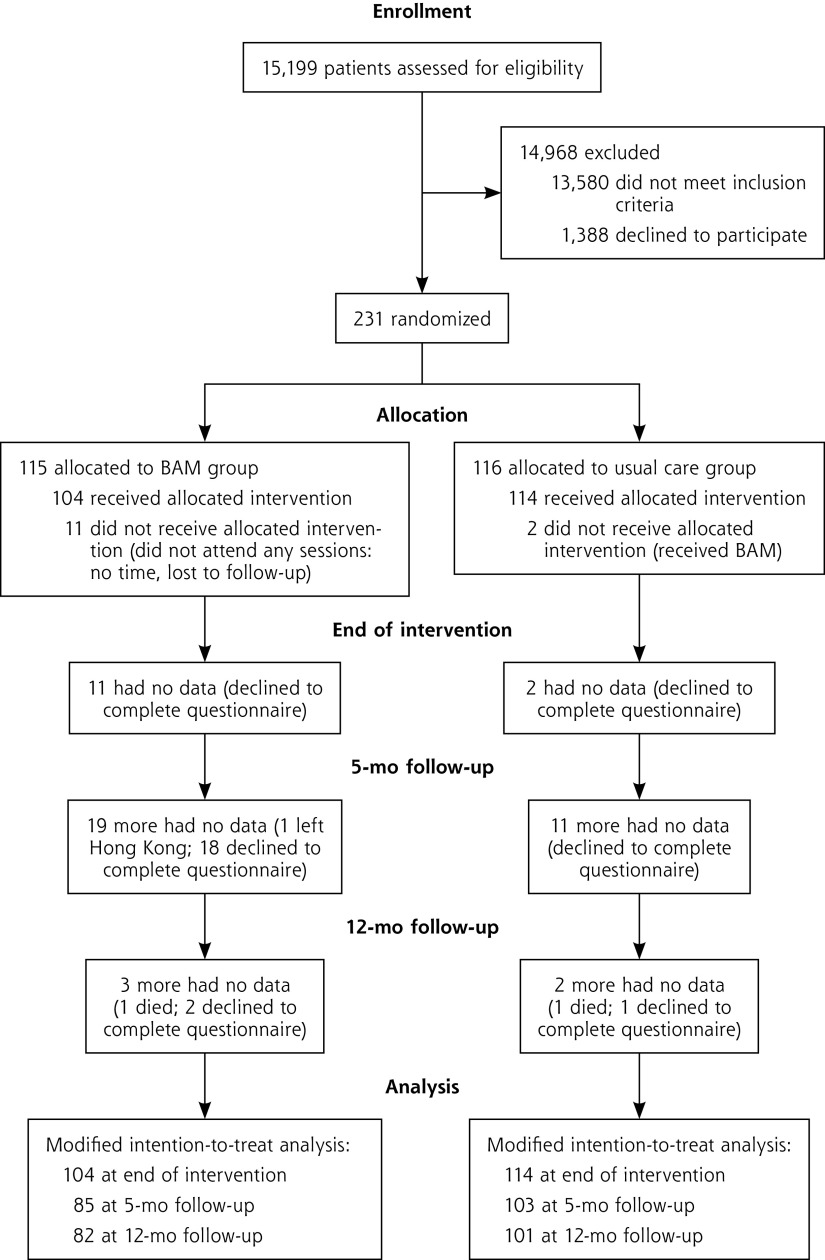
Results: We randomly allocated 115 patients to the BAM intervention and 116 patients to usual care. At 12 months, compared with usual care peers, BAM patients had a slightly more favorable change in levels of depressive symptoms on the Beck Depression Inventory-II (between-group mean difference in score = -3.85; 95% CI, -6.36 to -1.34; Cohen d = -0.46, 95% CI, -0.76 to -0.16). Incidence of major depressive disorder was lower with BAM (10.8% vs 26.8%, P = .01), whereas groups did not differ significantly on other secondary outcomes at 12 months.
Conclusions: Group BAM appears to be efficacious for decreasing depressive symptoms and reducing the incidence of major depression among patients with subthreshold depression in primary care, although generalizability of our findings may be limited.
Keywords: behavioral activation; mindfulness; prevention; primary care; randomized controlled trial; subthreshold depression.
© 2018 Annals of Family Medicine, Inc.
Conflict of interest statement
Conflicts of interest: authors report none.
Figures
References
-
- Kessler RC, Zhao S, Blazer DG, Swartz M. Prevalence, correlates, and course of minor depression and major depression in the National Comorbidity Survey. J Affect Disord. 1997; 45(1–2): 19–30. - PubMed
-
- Jongenelis K, Pot AM, Eisses AM, Beekman AT, Kluiter H, Ribbe MW. Prevalence and risk indicators of depression in elderly nursing home patients: the AGED study. J Affect Disord. 2004; 83(2–3): 135–142. - PubMed
-
- Rucci P, Gherardi S, Tansella M, et al. Subthreshold psychiatric disorders in primary care: prevalence and associated characteristics. J Affect Disord. 2003; 76(1–3): 171–181. - PubMed
-
- Backenstrass M, Frank A, Joest K, Hingmann S, Mundt C, Kronmüller KT. A comparative study of nonspecific depressive symptoms and minor depression regarding functional impairment and associated characteristics in primary care. Compr Psychiatry. 2006; 47(1): 35–41. - PubMed
-
- Cuijpers P, Smit F, Oostenbrink J, de Graaf R, Ten Have M, Beekman A. Economic costs of minor depression: a population-based study. Acta Psychiatr Scand. 2007; 115(3): 229–236. - PubMed
Publication types
MeSH terms
LinkOut - more resources
Full Text Sources
Other Literature Sources
Medical
Miscellaneous