. 2018 Mar 12;8(1):4329.
doi: 10.1038/s41598-018-22631-z.

IMPPAT: A curated database of Indian Medicinal Plants, Phytochemistry And Therapeutics

Affiliations

IMPPAT: A curated database of Indian Medicinal Plants, Phytochemistry And Therapeutics

Karthikeyan Mohanraj et al. Sci Rep. .

Abstract

Phytochemicals of medicinal plants encompass a diverse chemical space for drug discovery. India is rich with a flora of indigenous medicinal plants that have been used for centuries in traditional Indian medicine to treat human maladies. A comprehensive online database on the phytochemistry of Indian medicinal plants will enable computational approaches towards natural product based drug discovery. In this direction, we present, IMPPAT, a manually curated database of 1742 Indian Medicinal Plants, 9596 Phytochemicals, And 1124 Therapeutic uses spanning 27074 plant-phytochemical associations and 11514 plant-therapeutic associations. Notably, the curation effort led to a non-redundant in silico library of 9596 phytochemicals with standard chemical identifiers and structure information. Using cheminformatic approaches, we have computed the physicochemical, ADMET (absorption, distribution, metabolism, excretion, toxicity) and drug-likeliness properties of the IMPPAT phytochemicals. We show that the stereochemical complexity and shape complexity of IMPPAT phytochemicals differ from libraries of commercial compounds or diversity-oriented synthesis compounds while being similar to other libraries of natural products. Within IMPPAT, we have filtered a subset of 960 potential druggable phytochemicals, of which majority have no significant similarity to existing FDA approved drugs, and thus, rendering them as good candidates for prospective drugs. IMPPAT database is openly accessible at: https://cb.imsc.res.in/imppat .


Conflict of interest statement

The authors declare no competing interests.

Figures
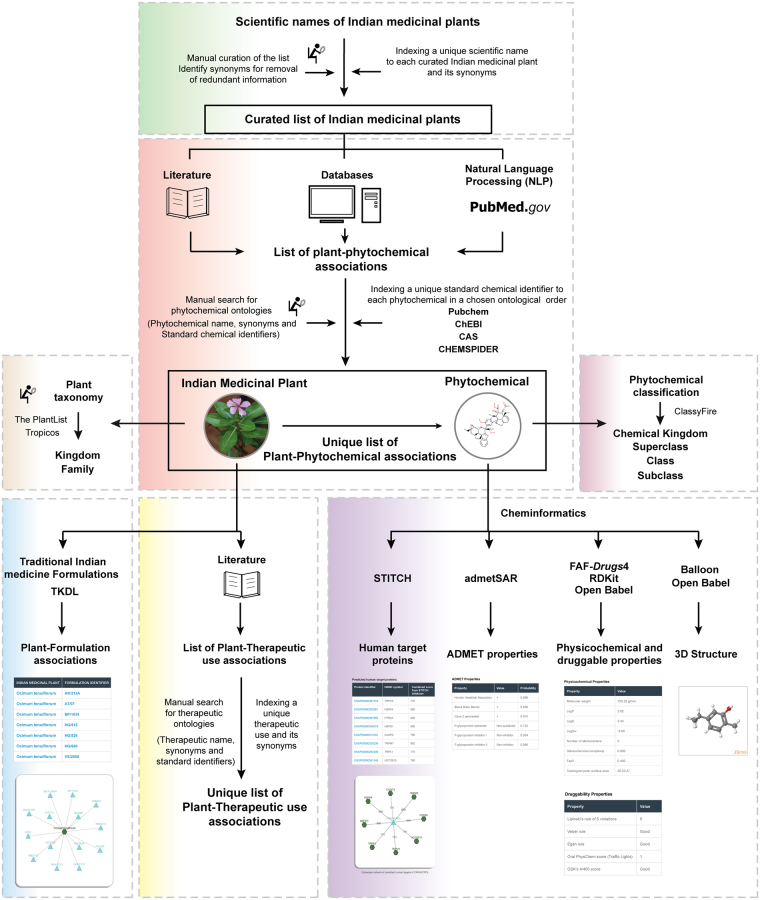
Figure 1
Figure 1
Schematic overview of the IMPPAT database construction pipeline. Briefly, we first compiled a comprehensive list of Indian medicinal plants from various sources. We next mined specialized books on Indian traditional medicine, existing databases and PubMed abstracts of journal articles to gather information on phytochemicals of Indian medicinal plants. We then manually annotated, curated and indexed names of identified phytochemicals with standard identifiers to build a non-redundant library of phytochemicals. This manual curation effort led to a unique list of plant-phytochemical associations. We also classified the Indian medicinal plants into taxonomic families and phytochemicals into chemical classes. Subsequently, we gathered ethnopharmacological information from books on traditional Indian medicine to build a unique list of plant-therapeutic use associations. We also extracted publicly accessible information on traditional medicine formulations from TKDL database to build a list of plant-formulation associations. Lastly, we have used cheminformatic tools to obtain the 3D structures, physicochemical properties, druggability scores, predicted ADMET properties and predicted target human proteins of phytochemicals.
Figure 2
Figure 2
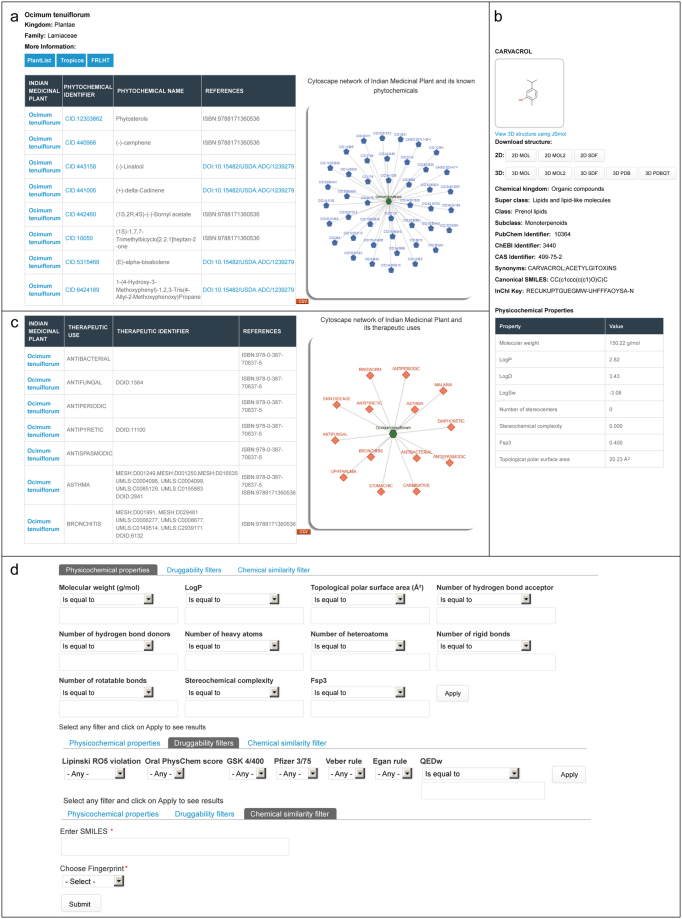
Web-interface of the IMPPAT database. (a) Snapshot of the result of a standard query for phytochemicals of an Indian medicinal plant. In this example, we show the plant-phytochemical association for Ocimum tenuiflorum, commonly known as Tulsi, from IMPPAT database. (b) Snapshot of the dedicated page containing detailed information on 2D and 3D chemical structure, physicochemical properties, druggability scores, predicted ADMET properties and predicted target human proteins for a chosen phytochemical. From the dedicated page for each phytochemical, users can download the 2D and 3D structure of the phytochemical in the form of a SDF or MOL or MOL2 or PDB or PDBQT file. (c) Snapshot of the result of a standard query for therapeutic uses of an Indian medicinal plant. In this example, we show the therapeutic uses of Ocimum tenuiflorum from IMPPAT database. (d) Snapshot of the advanced search options which enable users to filter phytochemicals based on their physiochemical properties or druggability scores or chemical similarity with a query compound.
Figure 3
Figure 3
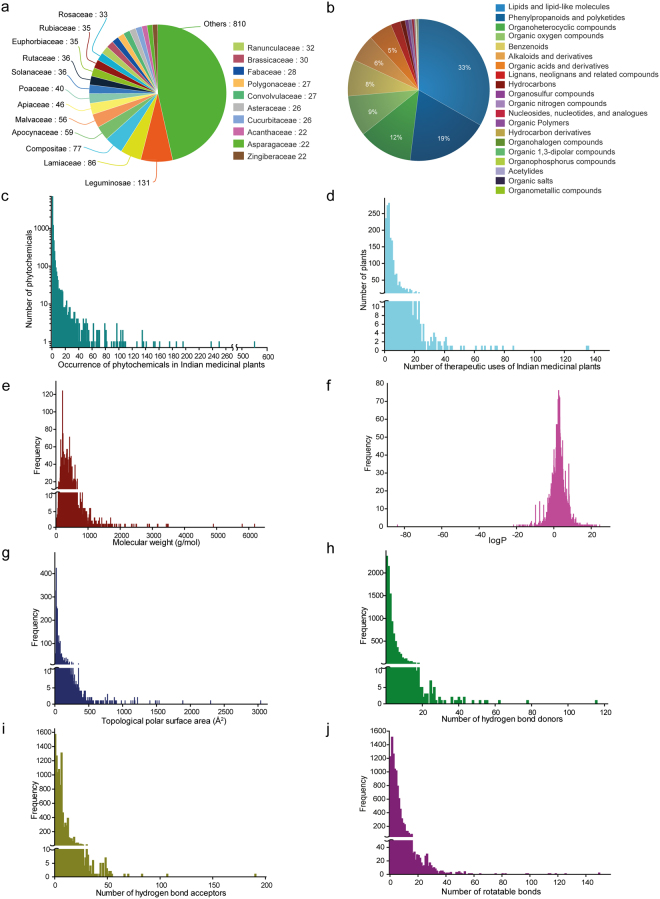
Basic statistics for Indian medicinal plants and associated phytochemicals in IMPPAT database. (a) Pie chart shows the distribution of the 1742 Indian medicinal plants in IMPPAT database across different taxonomic families. (b) Pie chart shows the distribution of the 9596 IMPPAT phytochemicals across different chemical super-classes obtained from ClassyFire. (c) Histogram of the number of Indian medicinal plants which produce a given phytochemical in our database. (d) Histogram of the number of therapeutic uses per Indian medicinal plant in our database. (ej) Histogram of the molecular weight (in g/mol), logP, TPSA (in Å2), number of hydrogen bond donors, number of hydrogen bond acceptors and number of rotatable bonds of the phytochemicals in our database.
Figure 4
Figure 4
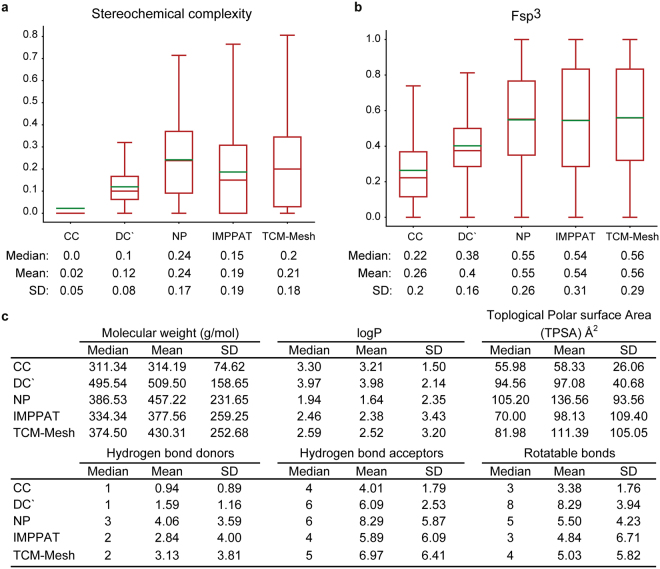
Comparison of the physicochemical properties of IMPPAT phytochemicals with other small molecule collections. (a) Box plot shows the distribution of the stereochemical complexity of the small molecule collections CC, DC’, NP, IMPPAT phytochemicals and TCM-Mesh phytochemicals. The median, mean and standard deviation (SD) of the stereochemical complexity for each small molecule collection is shown below the box plot. (b) Box plot shows the distribution of the Fsp3 for the small molecule collections CC, DC’, NP, IMPPAT phytochemicals and TCM-Mesh phytochemicals. The median, mean and SD of the Fsp3 for each small molecule collection is shown below the box plot. Note the lower end of the box shows the first quartile, upper end of the box shows the third quartile, brown line shows the median and green line shows the mean of the distribution of stereochemical complexity or Fsp3 in the two box plots. (c) Median, mean and SD of six physicochemical properties, namely, molecular weight, logP, TPSA, number of hydrogen bond donors, number of hydrogen bond acceptors and number of rotatable bonds for the small molecule collections CC, DC’, NP, IMPPAT phytochemicals and TCM-Mesh phytochemicals.
Figure 5
Figure 5
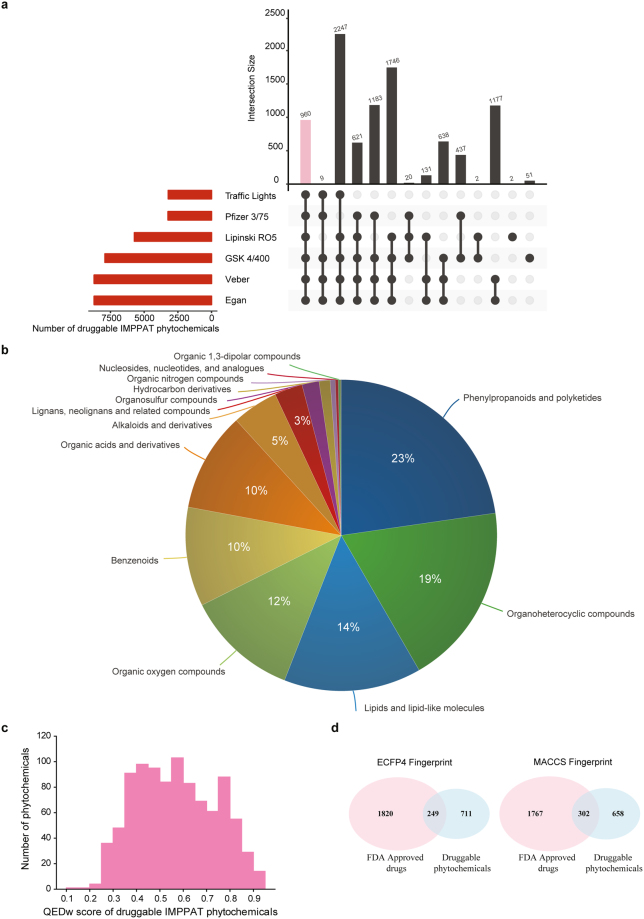
Druggability analysis of phytochemicals in IMPPAT database. (a) Evaluation of drug-likeliness of phytochemicals based on multiple scores. The horizontal bar plot shows the number of phytochemicals in the IMPPAT database that satisfy different druggability scores (Methods). The vertical bar plot shows the overlap between sets of phytochemicals that satisfy different druggability scores. The pink bar in the vertical plot gives the 960 phytochemicals which satisfy all druggability scores. This plot was generated using UpSetR package. (b) Classification of the 960 druggable phytochemicals into chemical super-classes obtained from ClassyFire. (c) Distribution of QEDw scores for the 960 IMPPAT phytochemicals which satisfy all druggability scores. (d) Venn diagrams summarizing structural similarity analysis of 960 druggable phytochemicals in IMPPAT database and FDA approved drugs. Based on ECFP4 and MACCS keys molecular fingerprints, 249 and 302 druggable phytochemicals, respectively, were found to be similar to FDA approved drugs.
Figure 6
Figure 6
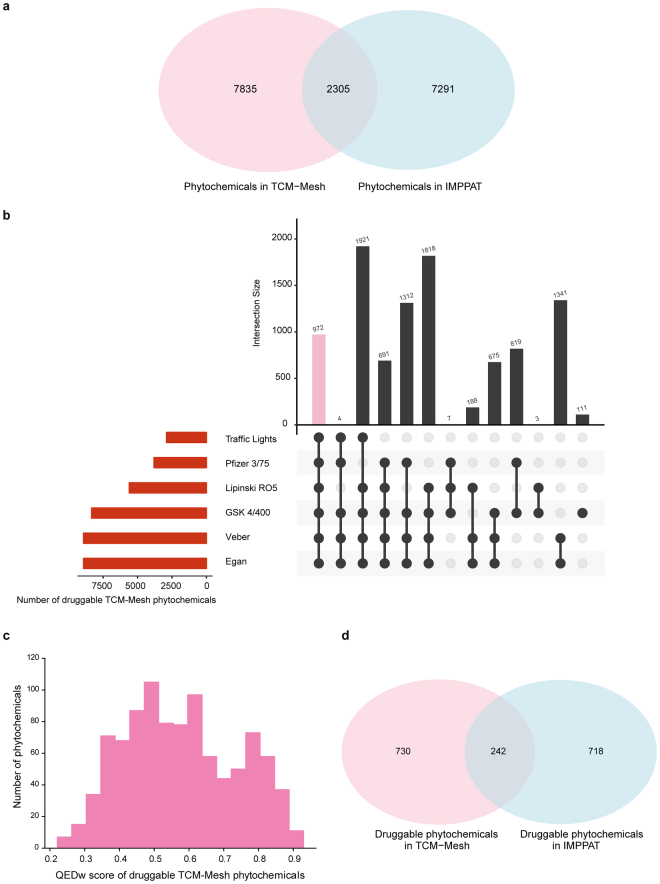
Comparison of the phytochemical space of Indian and Chinese medicinal plants. (a) Venn diagram shows the overlap of the phytochemicals in IMPPAT and TCM-Mesh database. (b) Evaluation of the drug-likeliness of TCM-Mesh phytochemicals based on multiple scores. The horizontal bar plot shows the number of phytochemicals in the TCM-Mesh database that satisfy different druggability scores (Methods). The vertical bar plot shows the overlap between sets of TCM-Mesh phytochemicals that satisfy different druggability scores. The pink bar in the vertical plot gives the 972 phytochemicals in TCM-Mesh database which satisfy all druggability scores. (c) Distribution of QEDw scores for the 972 TCM-Mesh phytochemicals which satisfy all druggability scores. (d) Venn diagram shows the overlap between the druggable phytochemicals in IMPPAT database and TCM-Mesh database.

References

    1. Koehn FE, Carter GT. The evolving role of natural products in drug discovery. Nat Rev Drug Discov. 2005;4:206–220. doi: 10.1038/nrd1657. - DOI - PubMed
    1. Newman DJ, Cragg GM. Natural Products as Sources of New Drugs from 1981 to 2014. J Nat Prod. 2016;79:629–661. doi: 10.1021/acs.jnatprod.5b01055. - DOI - PubMed
    1. Li JW, Vederas JC. Drug discovery and natural products: end of an era or an endless frontier? Science. 2009;325:161–165. doi: 10.1126/science.1168243. - DOI - PubMed
    1. Pye CR, Bertin MJ, Lokey RS, Gerwick WH, Linington RG. Retrospective analysis of natural products provides insights for future discovery trends. Proc Natl Acad Sci USA. 2017;114:5601–5606. doi: 10.1073/pnas.1614680114. - DOI - PMC - PubMed
    1. Lagunin AA, et al. Chemo- and bioinformatics resources for in silico drug discovery from medicinal plants beyond their traditional use: a critical review. Nat Prod Rep. 2014;31:1585–1611. doi: 10.1039/C4NP00068D. - DOI - PubMed

Publication types

LinkOut - more resources