


Testing a frequency of exposure hypothesis in attentional bias for alcohol-related stimuli amongst social drinkers
- PMID: 29531982
- PMCID: PMC5845920
- DOI: 10.1016/j.abrep.2015.05.001
Testing a frequency of exposure hypothesis in attentional bias for alcohol-related stimuli amongst social drinkers
Abstract
Aims: To examine whether a group of social drinkers showed longer response latencies to alcohol-related stimuli than neutral stimuli and to test whether exposure to 1) an alcohol-related environment and 2) consumption related cues influenced the interference from alcohol-related stimuli.
Methods: A 2 × 2 × 2 × 5 factorial design with Exposure Group (high, low) and Consumption Group (high, low) as between-participant factors and Word Type (alcohol, neutral) and Block (1-5) as within-participant factors was used. Forty-three undergraduate university students, 21 assigned to a high exposure group and 22 to a low exposure group, took part in the experiment. Exposure Group was defined according to whether or not participants currently worked in a bar or pub. Consumption Group was defined according to a median split on a quantity-frequency measure derived from two questions of the Alcohol Use Disorders Identification Test (AUDIT) questionnaire. A modified computerised Stroop colour naming test was used to measure response latencies.
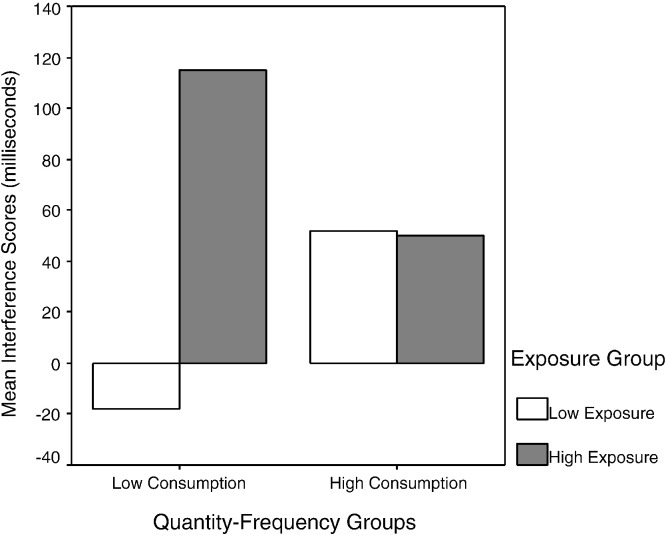
Results: Exposure and consumption factors interacted to produce greater interference from alcohol-related stimuli. In particular, the low consumption group showed interference from alcohol-related stimuli only in the high exposure condition. Exposure did not affect the magnitude of interference in the high consumption group.
Conclusions: Attentional bias is dependent upon exposure to distinct types of alcohol-related cues.
Keywords: Attentional bias; Cues; Exposure; Social drinkers.
Figures
References
-
- Albery I.P., Sharma D., Niazi A., Moss A.C. Theoretical perspectives and approaches. In: Munafò M., Albery I.P., editors. Cognition and addiction. Oxford University Press; Oxford: 2006. pp. 1–29.
-
- Attwood A.S., O'Sullivan H., Leonards U., Mackintosh B., Munafò M. Attentional bias training and cue reactivity in cigarette smokers. Addiction. 2008;103:1875–1882. - PubMed
-
- Bauer D., Cox W.M. Alcohol-related words are distracting to both alcohol abusers and non-abusers in the Stroop color-naming task. Addiction. 1998;93:1539–1542. - PubMed
-
- Bruce G., Jones B. A pictorial Stroop paradigm reveals an alcohol attentional bias in heavier as compared to lighter social drinkers. Journal of Psychopharmacology. 2004;18:527–533. - PubMed
-
- Bruce G., Jones B. Methods, measures, and findings of attentional bias in substance use, abuse, and dependence. In: Wiers R.W., Stacy A.W., editors. Handbook of implicit cognition and addiction. 2006. pp. 135–150.
LinkOut - more resources
Full Text Sources
Other Literature Sources
