Association of Excessive Daytime Sleepiness With Longitudinal β-Amyloid Accumulation in Elderly Persons Without Dementia
- PMID: 29532057
- PMCID: PMC5885188
- DOI: 10.1001/jamaneurol.2018.0049
Association of Excessive Daytime Sleepiness With Longitudinal β-Amyloid Accumulation in Elderly Persons Without Dementia
Abstract
Importance: Aging is associated with excessive daytime sleepiness (EDS), which has been linked to cognitive decline in the elderly. However, whether EDS is associated with the pathologic processes of Alzheimer disease remains unclear.
Objective: To investigate whether EDS at baseline is associated with a longitudinal increase in regional β-amyloid (Aβ) accumulation in a cohort of elderly individuals without dementia.
Design, setting, and participants: This prospective analysis included participants enrolled in the Mayo Clinic Study of Aging, a longitudinal population-based study in Olmsted County, Minnesota. Of 2900 participants, 2172 (74.9%) agreed to undergo carbon 11-labeled Pittsburgh compound B positron emission tomography (PiB-PET). We included 283 participants 70 years or older without dementia who completed surveys assessing sleepiness at baseline and had at least 2 consecutive PiB-PET scans from January 1, 2009, through July 31, 2016, after excluding 45 (13.7%) who had a comorbid neurologic disorder.
Main outcomes and measures: Excessive daytime sleepiness was defined as an Epworth Sleepiness Scale score of at least 10. The difference in Aβ levels between the 2 consecutive scans (ΔPiB) in Aβ-susceptible regions (prefrontal, anterior cingulate, posterior cingulate-precuneus, and parietal) was determined. Multiple linear regression models were fit to explore associations between baseline EDS and ΔPiB while adjusting for baseline age, sex, presence of the apolipoprotein E ε4 allele, educational level, baseline PiB uptake, global PiB positivity (standardized uptake value ratio ≥1.4), physical activity, cardiovascular comorbidities (obesity, hypertension, hyperlipidemia, and diabetes), reduced sleep duration, respiratory symptoms during sleep, depression, and interval between scans.
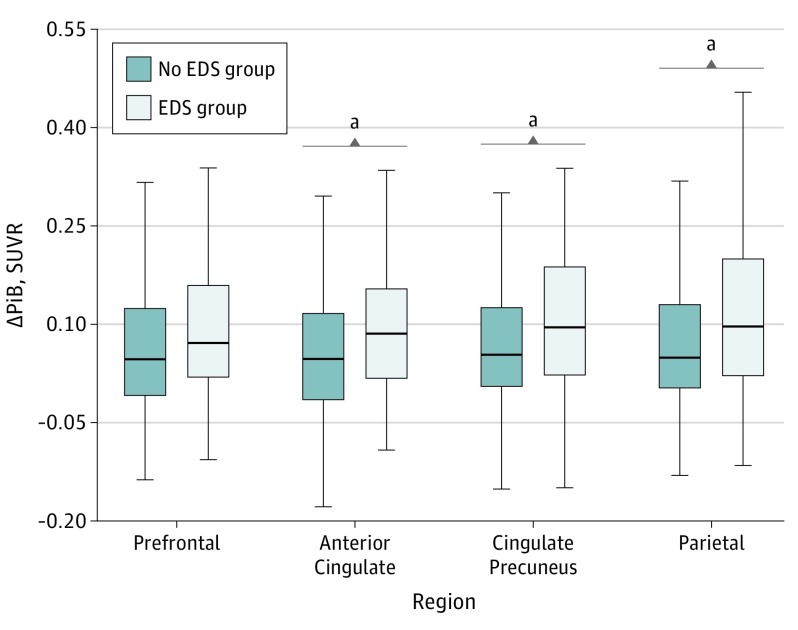
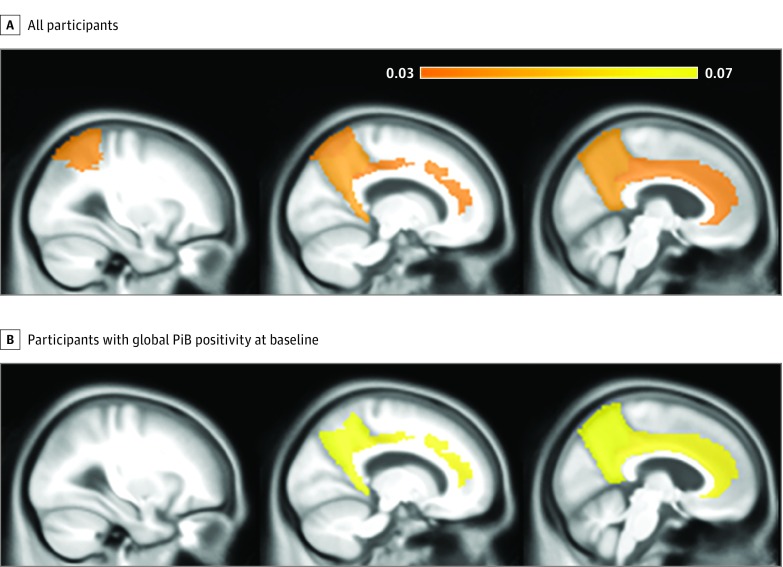
Results: Of the initial 283 participants, mean (SD) age was 77.1 (4.8) years; 204 (72.1%) were men and 79 (27.9%) were women. Sixty-three participants (22.3%) had EDS. Baseline EDS was significantly associated with increased regional Aβ accumulation in the anterior cingulate (B coefficient = 0.031; 95% CI, 0.001-0.061; P = .04), posterior cingulate-precuneus (B coefficient = 0.038; 95% CI, 0.006-0.069; P = .02), and parietal (B coefficient = 0.033; 95% CI, 0.001-0.065; P = .04) regions. Association of EDS with longitudinal Aβ accumulation was stronger in participants with baseline global PiB positivity in the anterior cingulate (B coefficient = 0.065; 95% CI, 0.010-0.118; P = .02) and cingulate-precuneus (B coefficient = 0.068; 95% CI, 0.009-0.126; P = .02) regions.
Conclusions and relevance: Baseline EDS was associated with increased longitudinal Aβ accumulation in elderly persons without dementia, suggesting that those with EDS may be more vulnerable to pathologic changes associated with Alzheimer disease. Further work is needed to elucidate whether EDS is a clinical marker of greater sleep instability, synaptic or network overload, or neurodegeneration of wakefulness-promoting centers. Early identification of patients with EDS and treatment of underlying sleep disorders could reduce Aβ accumulation in this vulnerable group.
Conflict of interest statement
Figures
Comment in
-
Waking Up to the Importance of Sleep in the Pathogenesis of Alzheimer Disease.JAMA Neurol. 2018 Jun 1;75(6):654-656. doi: 10.1001/jamaneurol.2018.0005. JAMA Neurol. 2018. PMID: 29532083 No abstract available.
References
-
- American Academy of Sleep Medicine The International Classification of Sleep Disorders: Diagnostic and Coding Manual. 2nd ed Westchester, IL: American Academy of Sleep Medicine; 2005.
-
- Young TB. Epidemiology of daytime sleepiness: definitions, symptomatology, and prevalence. J Clin Psychiatry. 2004;65(suppl 16):12-16. - PubMed
-
- Hayley AC, Williams LJ, Kennedy GA, Berk M, Brennan SL, Pasco JA. Prevalence of excessive daytime sleepiness in a sample of the Australian adult population. Sleep Med. 2014;15(3):348-354. - PubMed
-
- Bixler EO, Vgontzas AN, Lin HM, Calhoun SL, Vela-Bueno A, Kales A. Excessive daytime sleepiness in a general population sample: the role of sleep apnea, age, obesity, diabetes, and depression. J Clin Endocrinol Metab. 2005;90(8):4510-4515. - PubMed
-
- Gooneratne NS, Weaver TE, Cater JR, et al. . Functional outcomes of excessive daytime sleepiness in older adults. J Am Geriatr Soc. 2003;51(5):642-649. - PubMed
Publication types
MeSH terms
Substances
Grants and funding
- R01 AG034676/AG/NIA NIH HHS/United States
- R01 AG056366/AG/NIA NIH HHS/United States
- R01 NS097495/NS/NINDS NIH HHS/United States
- U01 AG006786/AG/NIA NIH HHS/United States
- P50 AG016574/AG/NIA NIH HHS/United States
- R01 AG011378/AG/NIA NIH HHS/United States
- R01 AG041851/AG/NIA NIH HHS/United States
- U01 AG045390/AG/NIA NIH HHS/United States
- U54 NS092089/NS/NINDS NIH HHS/United States
- R01 AG041797/AG/NIA NIH HHS/United States
- R01 AG037551/AG/NIA NIH HHS/United States
- U01 HL096917/HL/NHLBI NIH HHS/United States
- U01 AG032438/AG/NIA NIH HHS/United States
- U01 AG024904/AG/NIA NIH HHS/United States
- C06 RR018898/RR/NCRR NIH HHS/United States
LinkOut - more resources
Full Text Sources
Other Literature Sources
Medical