. 2018 Aug 15;198(4):497-508.
doi: 10.1164/rccm.201711-2180OC.

The Lung Microbiota of Healthy Mice Are Highly Variable, Cluster by Environment, and Reflect Variation in Baseline Lung Innate Immunity

Affiliations

The Lung Microbiota of Healthy Mice Are Highly Variable, Cluster by Environment, and Reflect Variation in Baseline Lung Innate Immunity

Robert P Dickson et al. Am J Respir Crit Care Med. .

Abstract

Rationale: The "gut-lung axis" is commonly invoked to explain the microbiome's influence on lung inflammation. Yet the lungs harbor their own microbiome, which is altered in respiratory disease. The relative influence of gut and lung bacteria on lung inflammation is unknown.

Objectives: To determine whether baseline lung immune tone reflects local (lung-lung) or remote (gut-lung) microbe-host interactions.

Methods: We compared lung, tongue, and cecal bacteria in 40 healthy, genetically identical, 10-week-old mice, using 16S ribosomal RNA gene quantification and sequencing. We measured inflammatory cytokines, using a multiplex assay of homogenized lung tissue. We compared lung bacteria in healthy mice treated with varied durations of systemic antibiotics.

Measurements and main results: Lung bacterial communities are highly variable among mice, cluster strongly by cage, shipment, and vendor, and are altered by antibiotics in a microbiologically predictable manner. Baseline lung concentrations of two key inflammatory cytokines (IL-1α and IL-4) are correlated with the diversity and community composition of lung bacterial communities. Lung concentrations of these inflammatory cytokines correlate more strongly with variation in lung bacterial communities than with that of the gut or mouth.

Conclusions: In the lungs of healthy mice, baseline innate immune tone more strongly reflects local (lung-lung) microbe-host interactions than remote (gut-lung) microbe-host interactions. Our results independently confirm the existence and immunologic significance of the murine lung microbiome, even in health. Variation in lung microbiota is likely an important, underappreciated source of experimental and clinical variability. The lung microbiome is an unexplored therapeutic target for the prevention and treatment of inflammatory lung disease.

Keywords: 16S; host–microbiome interactions; innate immunity; lung microbiome.


Figures
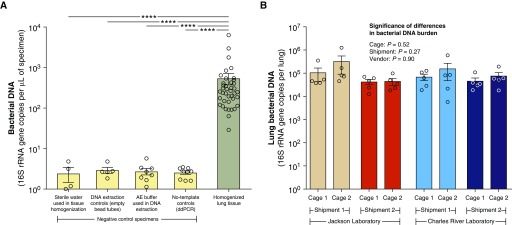
Figure 1.
Figure 1.
Bacterial DNA is detectable in the lungs of healthy mice. Bacterial DNA was quantified by droplet digital PCR of the 16S ribosomal RNA gene. (A) Homogenized lung tissue contained more bacterial DNA than did all negative control specimens (****P < 0.0001 for all comparisons). The lowest-abundance lung specimen had more bacterial DNA than the highest-abundance negative control specimen. (B) We found a 200-fold variation in lung bacterial DNA burden across individual mice, but no difference across vendors, shipments, or cages (P > 0.05 for all). Significance was determined by (A and B) Mann-Whitney test and by (B) Kruskal-Wallis test. Data presented are means and SEMs. ddPCR = droplet digital PCR; rRNA = ribosomal RNA.
Figure 2.
Figure 2.
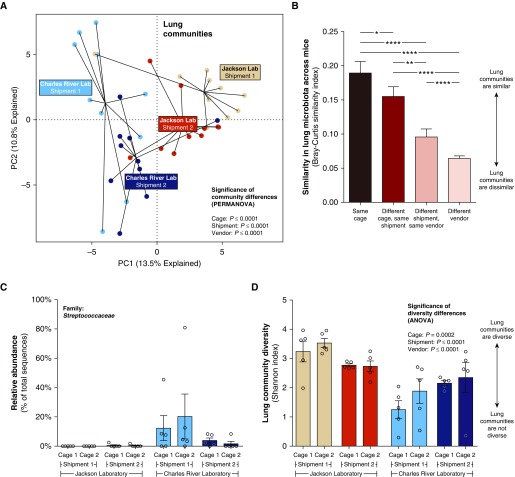
Murine lung bacteria are highly variable and cluster by cage, shipment, and vendor. (A) Bacterial communities detected in the lungs of healthy, genetically identical mice cluster by cage, shipment, and vendor. (B) Lung bacteria communities were most similar among cohoused mice, and most dissimilar when mice from different vendors were compared. (C) As an example, members of the Streptococcaceae family were almost absent from Jackson Laboratory mice (2 of 20 mice, 0.2% of all sequences) but were common and abundant in mice from Charles River Laboratories (12 of 20 mice, 9.5% of all sequences). (D) Lung community diversity differed by cage, shipment, and vendor. Significance was determined by (A) permutational multivariate ANOVA and by (B and D) ANOVA with Holm-Sidak multiple comparisons test. *P ≤ 0.05; **P ≤ 0.01; ****P < 0.0001. Data presented in BD are means and SEMs. PC1 and PC2 = principal components 1 and 2; PERMANOVA = permutational multivariate ANOVA.
Figure 3.
Figure 3.
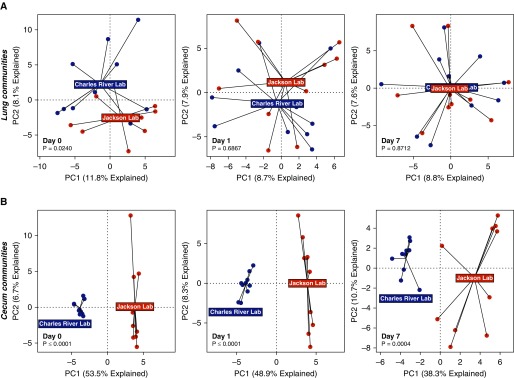
Murine lung bacteria converge with increased duration of cohousing. Genetically identical mice from two vendors were housed together and harvested at various durations of cohousing. (A) Lung communities converged within 1 day of cohousing and were indistinguishable after 1 week. (B) By contrast, cecal communities remained distinct by vendor even after 1 week of cohousing. Significance was determined by permutational multivariate ANOVA. PC1 and PC2 = principal components 1 and 2.
Figure 4.
Figure 4.
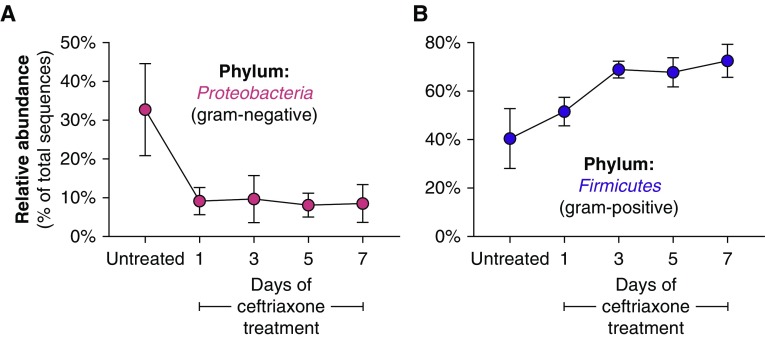
The lung microbiome of healthy mice is altered by systemic antibiotics in a microbiologically predictable manner. Healthy, cohoused, 10-week-old mice were administered various durations of systemic (intraperitoneal) ceftriaxone, a third-generation cephalosporin with antimicrobial activity against gram-negative bacteria. After treatment, (A) the relative abundance of Proteobacteria (the most abundant phylum of gram-negative lung bacteria) was rapidly and persistently suppressed; (B) in contrast, the relative abundance of Firmicutes (the most abundant phylum of gram-positive lung bacteria) was increased. Data presented are means and SEMs.
Figure 5.
Figure 5.
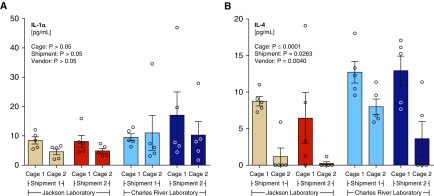
Variation in inflammatory cytokines in the lungs of healthy mice. Concentrations of inflammatory cytokines were measured in homogenized lung tissue collected from genetically identical 10-week-old mice. Twenty-fold differences in both cytokines were detected between mice. (A) Lung concentrations of IL-1α did not significantly differ by cage, shipment, or vendor, whereas (B) lung concentrations of IL-4 differed by cage, shipment, and vendor. Significance was determined by ANOVA with the Holm-Sidak multiple comparisons test (shipment and cage) and Student’s t test (vendor). Concentrations of IL-1α were log-normalized before comparison. Data presented are means and SEMs.
Figure 6.
Figure 6.
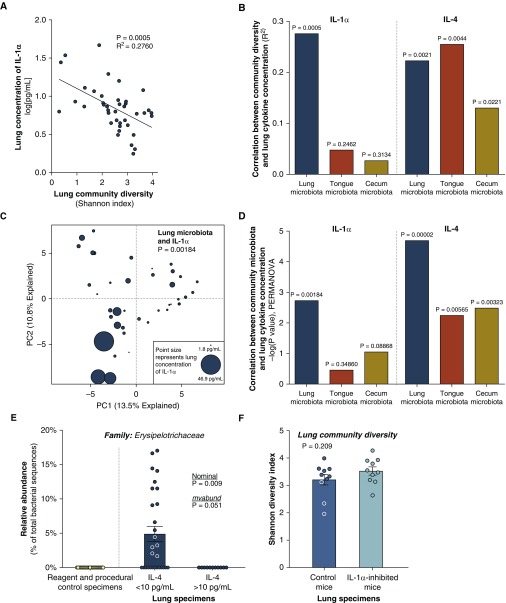
Lung microbial communities are correlated with lung immunity in healthy mice. Lung bacterial communities and concentrations of inflammatory cytokines were compared in genetically identical 10-week-old mice. (A) Lung concentrations of IL-1α were significantly and negatively associated with the community diversity of lung bacteria. Of the variation in lung IL-1α concentrations, 27.6% was explained by lung bacterial diversity. (B) Lung concentrations of IL-1α were not correlated with the diversity of tongue or cecal microbiota. Lung concentrations of IL-4 were significantly and negatively correlated with community diversity of lung, tongue, and cecal bacteria. (C) The community composition of lung microbiota was significantly associated with lung concentrations of IL-1α: specimens with similar microbiota had similar concentrations of IL-1α. (D) Although lung IL-1α concentrations were significantly correlated with lung microbiota, they had no detectable relationship with tongue or cecal microbiota. Lung IL-4 concentrations were most strongly correlated with lung communities. (E) The anaerobic Erysipelotrichaceae family was not detected in negative control specimens and was enriched in the lungs of mice with low concentrations of IL-4. (F) Inhibition of IL-1α via systemic antibodies to the IL-1 receptor had no effect on lung community diversity or community composition. Significance was determined by (A and B) linear regression, (C and D) permutational multivariate ANOVA, (E and F) t test, and (E) mvabund. Data presented in E and F are means and SEMs. PC1 and PC2 = principal components 1 and 2; PERMANOVA = permutational multivariate ANOVA.

Comment in

References

    1. Ege MJ, Mayer M, Normand AC, Genuneit J, Cookson WO, Braun-Fahrländer C, et al. GABRIELA Transregio 22 Study Group. Exposure to environmental microorganisms and childhood asthma. N Engl J Med. 2011;364:701–709. - PubMed
    1. Hoskin-Parr L, Teyhan A, Blocker A, Henderson AJ. Antibiotic exposure in the first two years of life and development of asthma and other allergic diseases by 7.5 yr: a dose-dependent relationship. Pediatr Allergy Immunol. 2013;24:762–771. - PMC - PubMed
    1. Weiss B, Bujanover Y, Yahav Y, Vilozni D, Fireman E, Efrati O. Probiotic supplementation affects pulmonary exacerbations in patients with cystic fibrosis: a pilot study. Pediatr Pulmonol. 2010;45:536–540. - PubMed
    1. Bruzzese E, Raia V, Spagnuolo MI, Volpicelli M, De Marco G, Maiuri L, et al. Effect of Lactobacillus GG supplementation on pulmonary exacerbations in patients with cystic fibrosis: a pilot study. Clin Nutr. 2007;26:322–328. - PubMed
    1. Morrow LE, Kollef MH, Casale TB. Probiotic prophylaxis of ventilator-associated pneumonia: a blinded, randomized, controlled trial. Am J Respir Crit Care Med. 2010;182:1058–1064. - PMC - PubMed

Publication types