Review
. 2018 Mar 13;7(3):21.
doi: 10.3390/cells7030021.

Elucidating the Metabolic Plasticity of Cancer: Mitochondrial Reprogramming and Hybrid Metabolic States

Affiliations
Review

Elucidating the Metabolic Plasticity of Cancer: Mitochondrial Reprogramming and Hybrid Metabolic States

Dongya Jia et al. Cells. .

Abstract

Aerobic glycolysis, also referred to as the Warburg effect, has been regarded as the dominant metabolic phenotype in cancer cells for a long time. More recently, it has been shown that mitochondria in most tumors are not defective in their ability to carry out oxidative phosphorylation (OXPHOS). Instead, in highly aggressive cancer cells, mitochondrial energy pathways are reprogrammed to meet the challenges of high energy demand, better utilization of available fuels and macromolecular synthesis for rapid cell division and migration. Mitochondrial energy reprogramming is also involved in the regulation of oncogenic pathways via mitochondria-to-nucleus retrograde signaling and post-translational modification of oncoproteins. In addition, neoplastic mitochondria can engage in crosstalk with the tumor microenvironment. For example, signals from cancer-associated fibroblasts can drive tumor mitochondria to utilize OXPHOS, a process known as the reverse Warburg effect. Emerging evidence shows that cancer cells can acquire a hybrid glycolysis/OXPHOS phenotype in which both glycolysis and OXPHOS can be utilized for energy production and biomass synthesis. The hybrid glycolysis/OXPHOS phenotype facilitates metabolic plasticity of cancer cells and may be specifically associated with metastasis and therapy-resistance. Moreover, cancer cells can switch their metabolism phenotypes in response to external stimuli for better survival. Taking into account the metabolic heterogeneity and plasticity of cancer cells, therapies targeting cancer metabolic dependency in principle can be made more effective.

Keywords: EMT; OXPHOS; Warburg effect; cancer metabolism; hybrid metabolic phenotype; metabolic plasticity; metastasis; mitochondrial respiration; oxidative phosphorylation; stemness; tumorigenesis.


Conflict of interest statement

The authors declare no conflict of interest.

Figures
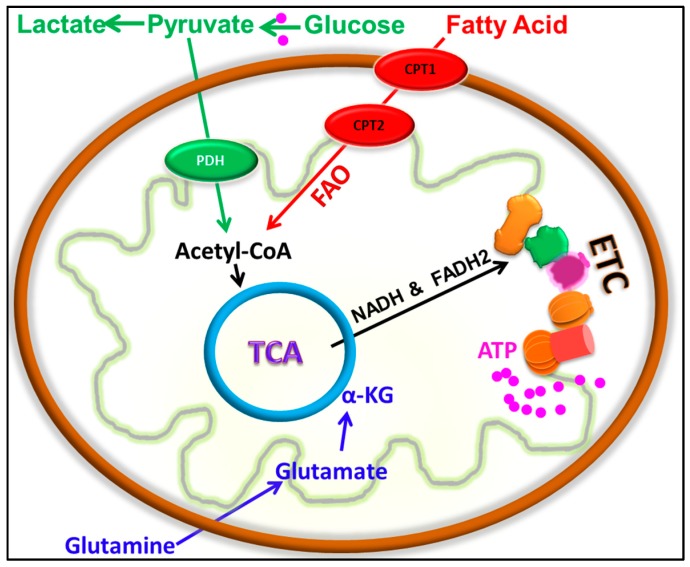
Figure 1
Figure 1
Major sources of mitochondrial energy pathways. Glucose, fatty acids, and glutamine are the major energy sources that support the tricarboxylic acid (TCA) cycle to generate ATP from the mitochondrial ETC.
Figure 2
Figure 2
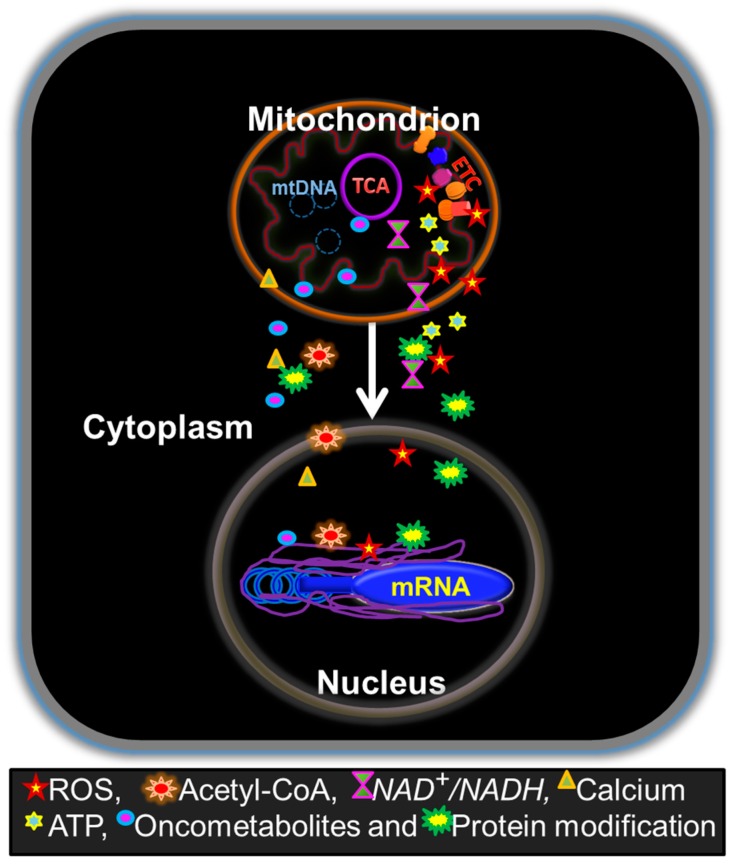
Schematic illustration of mitochondrial retrograde signaling. The illustration represents the major substrates and selected second messengers derived from mitochondrial function that play major roles in mitochondrial retrograde signaling. Retrograde signaling regulates the nuclear genome and transcriptional regulation as well as affects the posttranslational modification of proteins. Mitochondrial signals include but are not limited to ROS [63,64], Acetyl-CoA [10,65], NAD+/NADH ratio [66,67], calcium [68,69], ATP [10,70], and oncometabolites [71,72,73,74]. Availability of these regulators can be modulated by various mitochondrial properties including, mtDNA mutations, TCA activity, ETC function, and mitochondrial membrane potential. Mitochondrial signals can directly affect the nuclear genome by DNA mutation, histone modification, substrate availability etc. c-Src [10], MAPK [46], AMPK [75], PARPs [76,77], and SIRT1 [66,77] are examples of proteins that can be modified by the mitochondrial signaling. These protein modifications can further influence other protein targets and the nuclear genome.
Figure 3
Figure 3
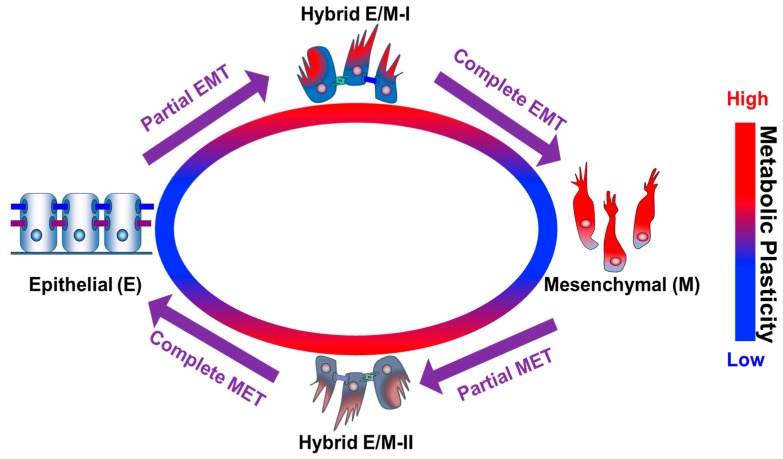
EMT and metabolic plasticity. As compared to the epithelial (E) and mesenchymal (M) phenotypes, the hybrid E/M phenotypes during EMT/MET may have higher metabolic plasticity.
Figure 4
Figure 4
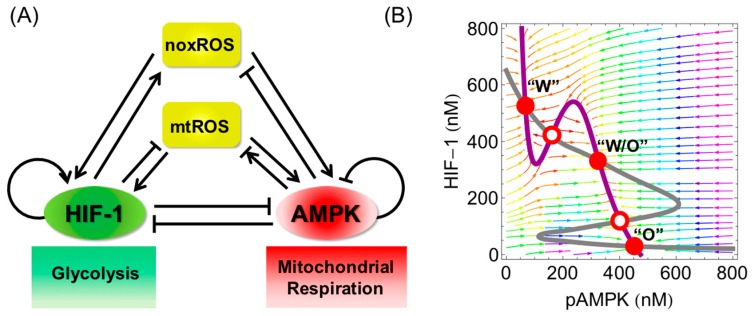
Modeling the interplay between glycolysis and OXPHOS in cancer. (A) The AMPK:HIF-1:ROS regulatory circuit. The arrows represent the excitatory regulations and the bar-headed arrows represent inhibitory regulations; (B) Nullclines and steady states in the phase space of pAMPK and HIF-1. The AMPK activity is represented by the level of phosphorylated AMPK (pAMPK) at threonine-172 of the α subunit. The gray line represents the nullcline of dh/dt=0, where h represents the levels of HIF-1. The purple line represents the nullcline of dA/dt=0, where A represents the levels of pAMPK. The intersections of these two nullclines represent the steady states of the regulatory circuit shown in (A). The arrow denotes the direction of motion in the vector field. The steady state corresponding to various initial conditions can be identified following the arrows. The red solid dots represent the stable steady states, i.e., stable metabolic phenotypes. The red hollow dots represent the unstable steady states, i.e., unstable metabolic phenotypes. “W” represents the Warburg state, i.e., aerobic glycolysis. “O” represents the OXPHOS state. “W/O” represents the hybrid glycolysis/OXPHOS state. More details of the model can be found in [8].

References

    1. Warburg O., Posener K., Negelein E. Über den Stoffwechsel der Carcinomzelle. Biochem. Z. 1924;152:309–344. doi: 10.1007/BF01726151. - DOI
    1. Warburg O. On respiratory impairment in cancer cells. Science. 1956;124:269–270. - PubMed
    1. Warburg O. On the origin of cancer cells. Science. 1956;123:309–314. doi: 10.1126/science.123.3191.309. - DOI - PubMed
    1. Ward P.S., Thompson C.B. Metabolic reprogramming: A cancer hallmark even warburg did not anticipate. Cancer Cell. 2012;21:297–308. doi: 10.1016/j.ccr.2012.02.014. - DOI - PMC - PubMed
    1. Hanahan D., Weinberg R.A. Hallmarks of Cancer: The Next Generation. Cell. 2011;144:646–674. doi: 10.1016/j.cell.2011.02.013. - DOI - PubMed