Review
. 2018 Mar 11;19(3):812.
doi: 10.3390/ijms19030812.

Liddle Syndrome: Review of the Literature and Description of a New Case

Affiliations
Review

Liddle Syndrome: Review of the Literature and Description of a New Case

Martina Tetti et al. Int J Mol Sci. .

Abstract

Liddle syndrome is an inherited form of low-renin hypertension, transmitted with an autosomal dominant pattern. The molecular basis of Liddle syndrome resides in germline mutations of the SCNN1A, SCNN1B and SCNN1G genes, encoding the α, β, and γ-subunits of the epithelial Na⁺ channel (ENaC), respectively. To date, 31 different causative mutations have been reported in 72 families from four continents. The majority of the substitutions cause an increased expression of the channel at the distal nephron apical membrane, with subsequent enhanced renal sodium reabsorption. The most common clinical presentation of the disease is early onset hypertension, hypokalemia, metabolic alkalosis, suppressed plasma renin activity and low plasma aldosterone. Consequently, treatment of Liddle syndrome is based on the administration of ENaC blockers, amiloride and triamterene. Herein, we discuss the genetic basis, clinical presentation, diagnosis and treatment of Liddle syndrome. Finally, we report a new case in an Italian family, caused by a SCNN1B p.Pro618Leu substitution.

Keywords: Liddle syndrome; SCNN1A; SCNN1B; SCNN1G; hypertension; hypokalemia; low renin hypertension; monogenic hypertension.


Conflict of interest statement

The authors declare no conflict of interest.

Figures
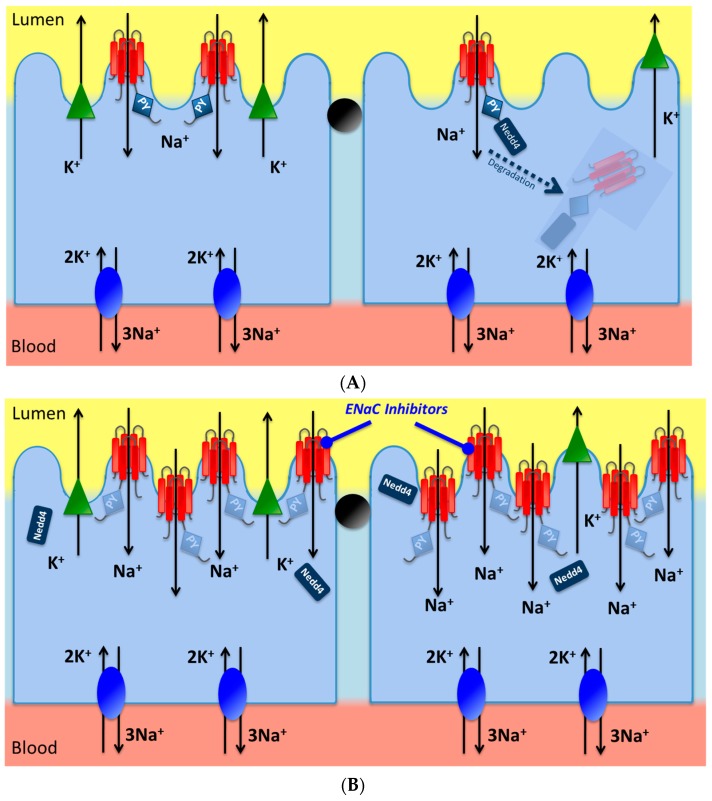
Figure 1
Figure 1
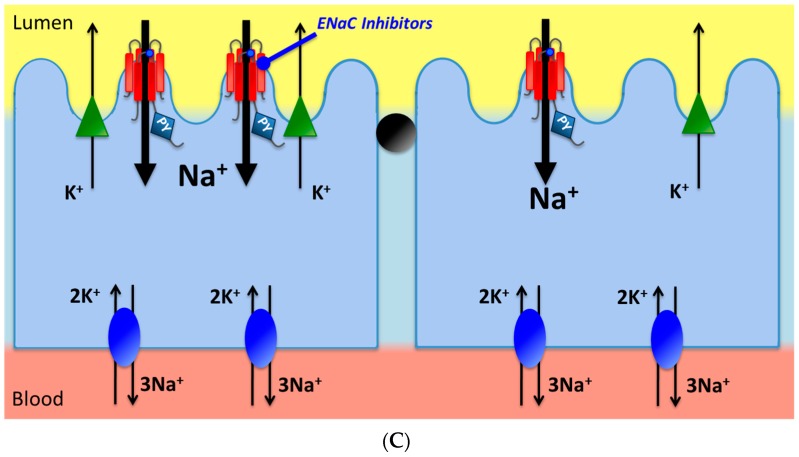
(A) Physiopathology of ENaC. Under physiological conditions, the epithelial Na+ channel (ENaC) is expressed on the luminal side of distal nephron epithelium. ENaC is positively regulated by aldosterone and antidiuretic hormone and allows the passage of Na+ ions from lumen toward cytoplasm. The proline-rich sequence (indicated as PY), located at the C-terminus of each subunit, regulates channel internalization and degradation, through Nedd4 binding and ubiquitination. ENaC function is combined with K+ channel ROMK (green triangles) and Na+/K+ ATPase (blue ovals) and it is crucial for hydroelectrolytic homeostasis, consisting in sodium renal reabsorption and potassium excretion; (B) β and γ subunits mutations. The germline mutations of the SCNN1B and SCNN1G genes causes the loss or disruption of proline-rich sequence that has a pivotal role in negative regulation of the channel. These mutations are gain-of-function and determine an increased membrane density of ENaC and a consequent increase in renal Na+ reabsorption; (C) α subunit mutation. The germline mutation of the SCNN1A gene affects the extracellular domain, causing the disruption of a disulphide bridge. It is a gain-of-function mutation that leads to an increase of the open probability of the channel and a consequent increase in Na+ current, without affecting the PY motif.
Figure 1
Figure 1
(A) Physiopathology of ENaC. Under physiological conditions, the epithelial Na+ channel (ENaC) is expressed on the luminal side of distal nephron epithelium. ENaC is positively regulated by aldosterone and antidiuretic hormone and allows the passage of Na+ ions from lumen toward cytoplasm. The proline-rich sequence (indicated as PY), located at the C-terminus of each subunit, regulates channel internalization and degradation, through Nedd4 binding and ubiquitination. ENaC function is combined with K+ channel ROMK (green triangles) and Na+/K+ ATPase (blue ovals) and it is crucial for hydroelectrolytic homeostasis, consisting in sodium renal reabsorption and potassium excretion; (B) β and γ subunits mutations. The germline mutations of the SCNN1B and SCNN1G genes causes the loss or disruption of proline-rich sequence that has a pivotal role in negative regulation of the channel. These mutations are gain-of-function and determine an increased membrane density of ENaC and a consequent increase in renal Na+ reabsorption; (C) α subunit mutation. The germline mutation of the SCNN1A gene affects the extracellular domain, causing the disruption of a disulphide bridge. It is a gain-of-function mutation that leads to an increase of the open probability of the channel and a consequent increase in Na+ current, without affecting the PY motif.

References

    1. Olsen M.H., Angell S.Y., Asma S., Boutouyrie P., Burger D., Chirinos J.A., Damasceno A., Delles C., Gimenez-Roqueplo A.P., Hering D., et al. A call to action and a lifecourse strategy to address the global burden of raised blood pressure on current and future generations: The Lancet Commission on hypertension. Lancet. 2016;388:2665–2712. doi: 10.1016/S0140-6736(16)31134-5. - DOI - PubMed
    1. Burrello J., Monticone S., Buffolo F., Tetti M., Veglio F., Williams T.A., Mulatero P. Is there a role for genomics in the management of hypertension? Int. J. Mol. Sci. 2017;18:E1131. doi: 10.3390/ijms18061131. - DOI - PMC - PubMed
    1. Zennaro M.C., Boulkroun S., Fernandes-Rosa F. Inherited forms of mineralocorticoid hypertension. Best Pract. Res. Clin. Endocrinol. Metab. 2015;29:633–645. doi: 10.1016/j.beem.2015.04.010. - DOI - PubMed
    1. Liddle G.W., Bledsoe T., Coppage W.S.J. A familial renal disorder simulating primary aldosteronism but with negligible aldosterone secretion. Trans. Assoc. Am. Phys. 1963;76:199–213.
    1. Palmer B.F., Alpern R.J. Liddle’s syndrome. Am. J. Med. 1998;104:301–309. doi: 10.1016/S0002-9343(98)00018-7. - DOI - PubMed

Substances