Review
. 2018 Mar 12;7(3):54.
doi: 10.3390/jcm7030054.

The Cells of the Islets of Langerhans

Affiliations
Review

The Cells of the Islets of Langerhans

Gabriela Da Silva Xavier. J Clin Med. .

Abstract

Islets of Langerhans are islands of endocrine cells scattered throughout the pancreas. A number of new studies have pointed to the potential for conversion of non-β islet cells in to insulin-producing β-cells to replenish β-cell mass as a means to treat diabetes. Understanding normal islet cell mass and function is important to help advance such treatment modalities: what should be the target islet/β-cell mass, does islet architecture matter to energy homeostasis, and what may happen if we lose a particular population of islet cells in favour of β-cells? These are all questions to which we will need answers for islet replacement therapy by transdifferentiation of non-β islet cells to be a reality in humans. We know a fair amount about the biology of β-cells but not quite as much about the other islet cell types. Until recently, we have not had a good grasp of islet mass and distribution in the human pancreas. In this review, we will look at current data on islet cells, focussing more on non-β cells, and on human pancreatic islet mass and distribution.

Keywords: diabetes; endocrine; ghrelin; glucagon; insulin; islets of Langerhans; pancreas; pancreatic polypeptide; somatostatin.


Conflict of interest statement

The author declares no conflict of interest.

Figures
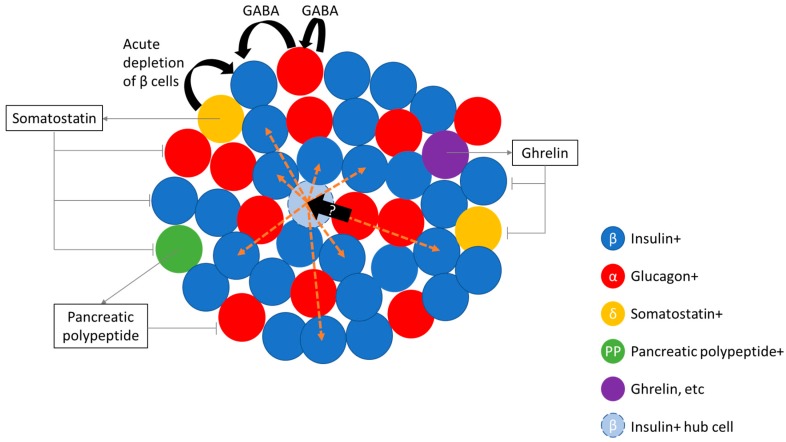
Figure 1
Figure 1
Schematic diagram showing the interdependency of islet cells. Evidence in the literature points to the possibility of the transdifferentiation (solid black arrows) of α-cells (red circle) via stimulation by gamma aminobutyric acid (GABA), and δ-cells (yellow circle) into insulin-containing β (like)-cells (blue circle). It is currently unclear whether the replenishment of β-cells from the transdifferentiation of α-cells is able to replace hub β-cells (light blue circle) which influence (yellow arrows) the function of other β-cells. Somatostatin, released from δ-cells, can inhibit the release of glucagon, insulin, and pancreatic polypeptide from α-, β-, and PP cells (green circle), respectively. Pancreatic polypeptide, released from PP cells, can inhibit the release of glucagon. Ghrelin, released from ghrelin-positive islet cells (purple circle), can inhibit insulin and somatostatin secretion.

References

    1. Borden P., Houtz J., Leach S.D., Kuruvilla R. Sympathetic innervation during development is necessary for pancreatic islet architecture and functional maturation. Cell Rep. 2013;4:287–301. doi: 10.1016/j.celrep.2013.06.019. - DOI - PMC - PubMed
    1. Dor Y., Brown J., Martinez O.I., Melton D.A. Adult pancreatic beta-cells are formed by self-duplication rather than stem-cell differentiation. Nature. 2004;429:41–46. doi: 10.1038/nature02520. - DOI - PubMed
    1. Cano D.A., Rulifson I.C., Heiser P.W., Swigart L.B., Pelengaris S., German M., Evan G.I., Bluestone J.A., Hebrok M. Regulated beta-cell regeneration in the adult mouse pancreas. Diabetes. 2008;57:958–966. doi: 10.2337/db07-0913. - DOI - PubMed
    1. Thorel F., Nepote V., Avril I., Kohno K., Desgraz R., Chera S., Herrera P.L. Conversion of adult pancreatic alpha-cells to beta-cells after extreme beta-cell loss. Nature. 2010;464:1149–1154. doi: 10.1038/nature08894. - DOI - PMC - PubMed
    1. Chera S., Baronnier D., Ghila L., Cigliola V., Jensen J.N., Gu G., Furuyama K., Thorel F., Gribble F.M., Reimann F., et al. Diabetes recovery by age-dependent conversion of pancreatic delta-cells into insulin producers. Nature. 2014;514:503–507. doi: 10.1038/nature13633. - DOI - PMC - PubMed
