


Predictors and Prognostic Value of Worsening Renal Function During Admission in HFpEF Versus HFrEF: Data From the KorAHF (Korean Acute Heart Failure) Registry
- PMID: 29535141
- PMCID: PMC5907555
- DOI: 10.1161/JAHA.117.007910
Predictors and Prognostic Value of Worsening Renal Function During Admission in HFpEF Versus HFrEF: Data From the KorAHF (Korean Acute Heart Failure) Registry
Abstract
Background: Worsening renal function (WRF) is associated with adverse outcomes in patients with heart failure. We investigated the predictors and prognostic value of WRF during admission, in patients with preserved ejection fraction (HFpEF) versus those with reduced ejection fraction (HFrEF).
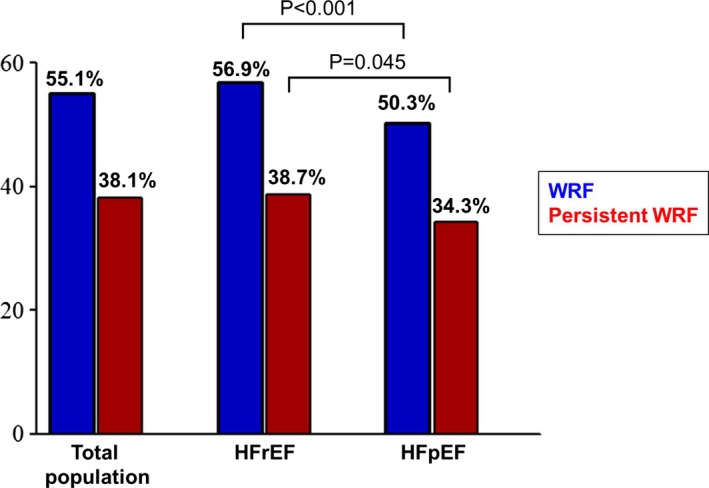
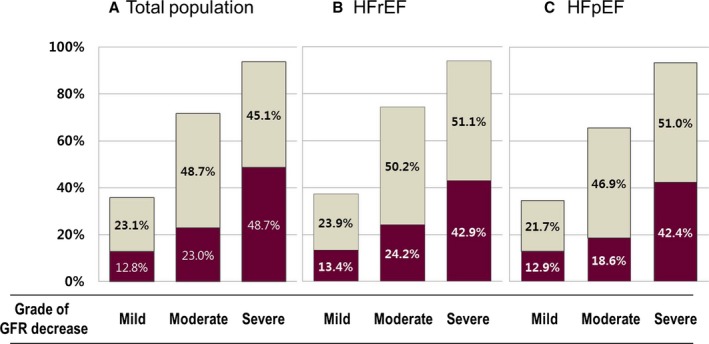
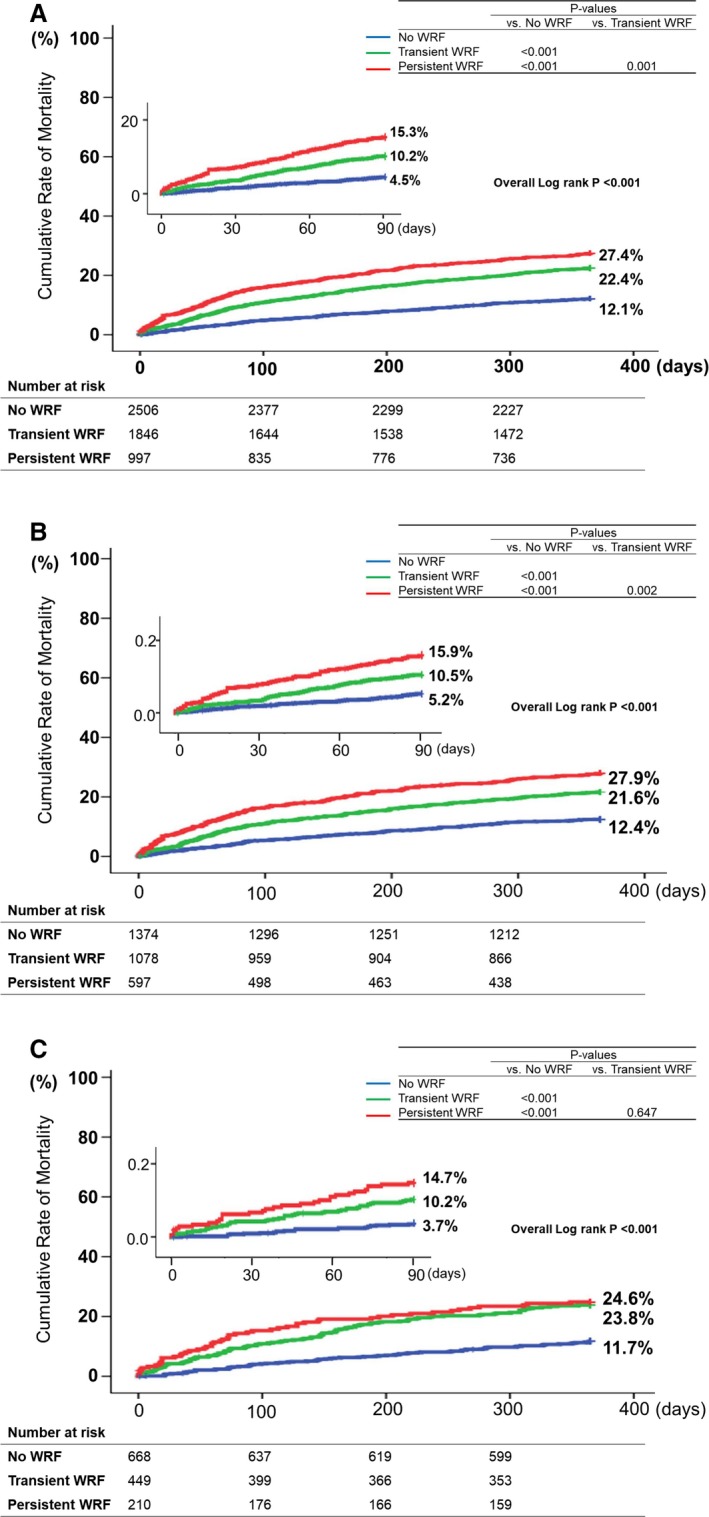
Methods and results: A total of 5625 patients were enrolled in the KorAHF (Korean Acute Heart Failure) registry. WRF was defined as an absolute increase in creatinine of ≥0.3 mg/dL. Transient WRF was defined as recovery of creatinine at discharge, whereas persistent WRF was indicated by a nonrecovered creatinine level. HFpEF and HFrEF were defined as a left ventricle ejection fraction ≥50% and ≤40%, respectively. Among the total population, WRF occurred in 3101 patients (55.1%). By heart failure subgroup, WRF occurred more frequently in HFrEF (57.0% versus 51.3%; P<0.001 in HFrEF and HFpEF). Prevalence of WRF increased as creatinine clearance decreased in both heart failure subgroups. Among various predictors of WRF, chronic renal failure was the strongest predictor. WRF was an independent predictor of adverse in-hospital outcomes (HFrEF: odds ratio; 2.75; 95% confidence interval, 1.50-5.02; P=0.001; HFpEF: odds ratio, 9.48; 95% confidence interval, 1.19-75.89; P=0.034) and 1-year mortality (HFrEF: hazard ratio, 1.41; 95% confidence interval, 1.12-1.78; P=0.004 versus HFpEF: hazard ratio, 1.72; 95% confidence interval, 1.23-2.42; P=0.002). Transient WRF was a risk factor for 1-year mortality, whereas persistent WRF had no additive risk compared to transient WRF.
Conclusions: In patients with acute heart failure patients, WRF is an independent predictor of adverse in-hospital and follow-up outcomes in both HFrEF and HFpEF, though with a different effect size.
Clinical trial registration: URL: https://www.clinicaltrials.gov. Unique identifier: NCT01389843.
Keywords: heart failure; heart failure with preserved ejection fraction; heart failure with reduced ejection fraction; renal function.
© 2018 The Authors. Published on behalf of the American Heart Association, Inc., by Wiley.
Figures
References
-
- de Silva R, Nikitin NP, Witte KK, Rigby AS, Goode K, Bhandari S, Clark AL, Cleland JG. Incidence of renal dysfunction over 6 months in patients with chronic heart failure due to left ventricular systolic dysfunction: contributing factors and relationship to prognosis. Eur Heart J. 2006;27:569–581. - PubMed
-
- Damman K, Navis G, Voors AA, Asselbergs FW, Smilde TD, Cleland JG, van Veldhuisen DJ, Hillege HL. Worsening renal function and prognosis in heart failure: systematic review and meta‐analysis. J Card Fail. 2007;13:599–608. - PubMed
-
- Damman K, Valente MA, Voors AA, O'Connor CM, van Veldhuisen DJ, Hillege HL. Renal impairment, worsening renal function, and outcome in patients with heart failure: an updated meta‐analysis. Eur Heart J. 2014;35:455–469. - PubMed
-
- Bock JS, Gottlieb SS. Cardiorenal syndrome: new perspectives. Circulation. 2010;121:2592–2600. - PubMed
Publication types
MeSH terms
Substances
Associated data
LinkOut - more resources
Full Text Sources
Other Literature Sources
Medical
