. 2018 May;209(1):31-35.
doi: 10.1534/genetics.118.300682. Epub 2018 Mar 13.

Genetic Reagents for Making Split-GAL4 Lines in Drosophila

Affiliations

Genetic Reagents for Making Split-GAL4 Lines in Drosophila

Heather Dionne et al. Genetics. 2018 May.

Abstract

The ability to reproducibly target expression of transgenes to small, defined subsets of cells is a key experimental tool for understanding many biological processes. The Drosophila nervous system contains thousands of distinct cell types and it has generally not been possible to limit expression to one or a few cell types when using a single segment of genomic DNA as an enhancer to drive expression. Intersectional methods, in which expression of the transgene only occurs where two different enhancers overlap in their expression patterns, can be used to achieve the desired specificity. This report describes a set of over 2800 transgenic lines for use with the split-GAL4 intersectional method.

Keywords: cell type; enhancer; gene expression; genetic intersection; neuron.


Figures

Figure 1
Figure 1
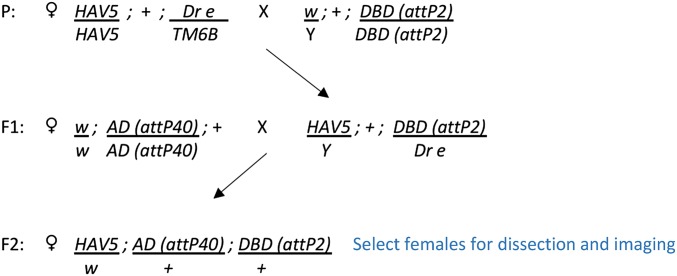
Crossing scheme used to generate split-GAL4 lines for screening. AD, activation domain; DBD, DNA-binding domain; P, parent; HAV, pJFRC200-10XUAS-IVS-myr::smGFP-HA (attP18), pJFRC216-13XLexAop2-IVS-myr::smGFP-V5 (su(Hw)attP8.
Figure 2
Figure 2
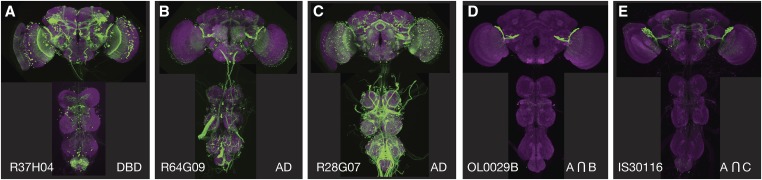
Two intersections attempting to make a split-GAL4 driver line specific for the LPLC1 cell type. (A–C) Expression patterns of the generation 1 GAL4 lines R37H04 (A), R64G09 (B), and R28G07 (C) observed with insertion of the transgene in attP2 (Jenett et al. 2012). (D) The result of an intersection between the R37H04-DBD (in attP2) and R64G09-AD (in attP40) lines; highly specific expression in the desired cell type is observed. (E) The result of an intersection between the R37H04-DBD (in attP2) and R28G07-AD (in attP40) lines; expression in the desired cell type is observed, but now with off-target expression in other cells. AD, activation domain; DBD, DNA-binding domain.
Figure 3
Figure 3
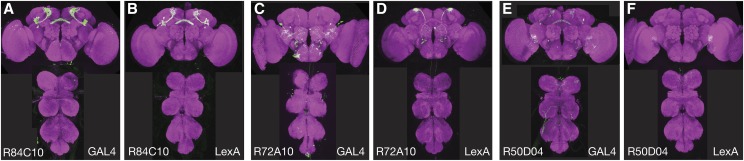
Comparison of the expression patterns driven by three enhancer fragments when inserted as GAL4 constructs in attP2 and as lexA constructs in attP40. (A and B) Enhancer R84C10 drives similar expression in both sites. (C and D) Enhancer R72A10 drives in a more restricted pattern in attP40, but the cell type indicated by the arrow is more prominent. (E and F) R50D04 has a more restricted pattern in attP40 and the cell type indicated by the arrow is not observed. All images are from Jenett et al. (2012) and confocal stacks can be downloaded from www.janelia.org/gal4-gen1.
Figure 4
Figure 4
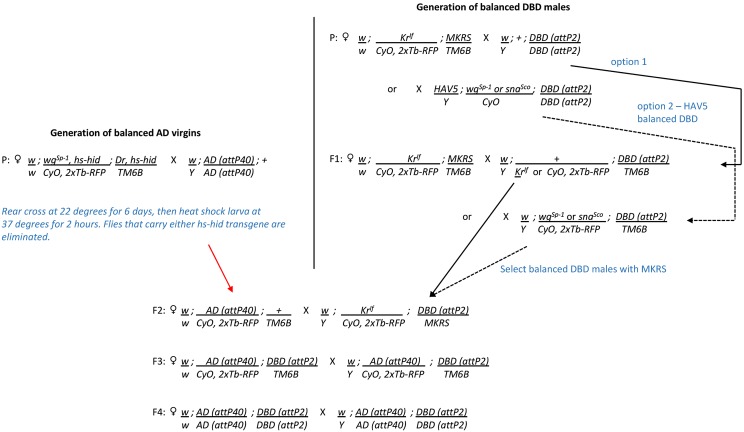
Crossing scheme used to construct homozygous stable split-GAL4 lines. AD, activation domain; DBD, DNA-binding domain; P, parent.

References

    1. Aso Y., Hattori D., Yu Y., Johnston R. M., Iyer N. A., et al. , 2014. The neuronal architecture of the mushroom body provides a logic for associative learning. Elife 3: e04577 10.7554/eLife.04577 - DOI - PMC - PubMed
    1. Diao F., Ironfield H., Luan H., Diao F., Shropshire W. C., et al. , 2015. Plug-and-play genetic access to drosophila cell types using exchangeable exon cassettes. Cell Rep. 10: 1410–1421. 10.1016/j.celrep.2015.01.059 - DOI - PMC - PubMed
    1. Dolan M. J., Luan H., Shropshire W. C., Sutcliffe B., Cocanougher B., et al. , 2017. Facilitating neuron-specific genetic manipulations in Drosophila melanogaster using a split GAL4 repressor. Genetics 206: 775–784. 10.1534/genetics.116.199687 - DOI - PMC - PubMed
    1. Eichler K., Li F., Litwin-Kumar A., Park Y., Andrade I., et al. , 2017. The complete connectome of a learning and memory centre in an insect brain. Nature 548: 175–182. 10.1038/nature23455 - DOI - PMC - PubMed
    1. Gohl D. M., Silies M. A., Gao X. J., Bhalerao S., Luongo F. J., et al. , 2011. A versatile in vivo system for directed dissection of gene expression patterns. Nat. Methods 8: 231–237. 10.1038/nmeth.1561 - DOI - PMC - PubMed

LinkOut - more resources